
Mind-Blowing Paradoxes challenge the very foundation of our logic, forcing us to question reality, time, and even our own identity. A paradox is a statement or situation that contradicts itself or defies intuition, yet leads to a conclusion that seems logically unacceptable. Philosophers and scientists have used these puzzles for centuries to test the limits of the human mind.
Unlike the Psychological Effects that explain our behavior, these riddles expose the cracks in the universe itself. From time travel nightmares to infinite hotels that are always full, here are 10 Mind-Blowing Paradoxes that will break your brain and leave you thinking for days.
Table of Contents
1. The Grandfather Paradox (Time Travel)
The Grandfather Paradox is one of the most famous Mind-Blowing Paradoxes related to time travel. Imagine you travel back in time and kill your grandfather before he meets your grandmother. This means your father is never born, which means you are never born. But if you are never born, you couldn’t have traveled back in time to kill him.
So, did you kill him or not? This circular contradiction suggests that changing the past is logically impossible. Some physicists solve this with the “multiverse theory,” where your action simply creates a new, separate timeline. However, without alternate universes, this remains one of the ultimate Mind-Blowing Paradoxes that makes time travel a logical nightmare.
2. The Ship of Theseus (Identity)
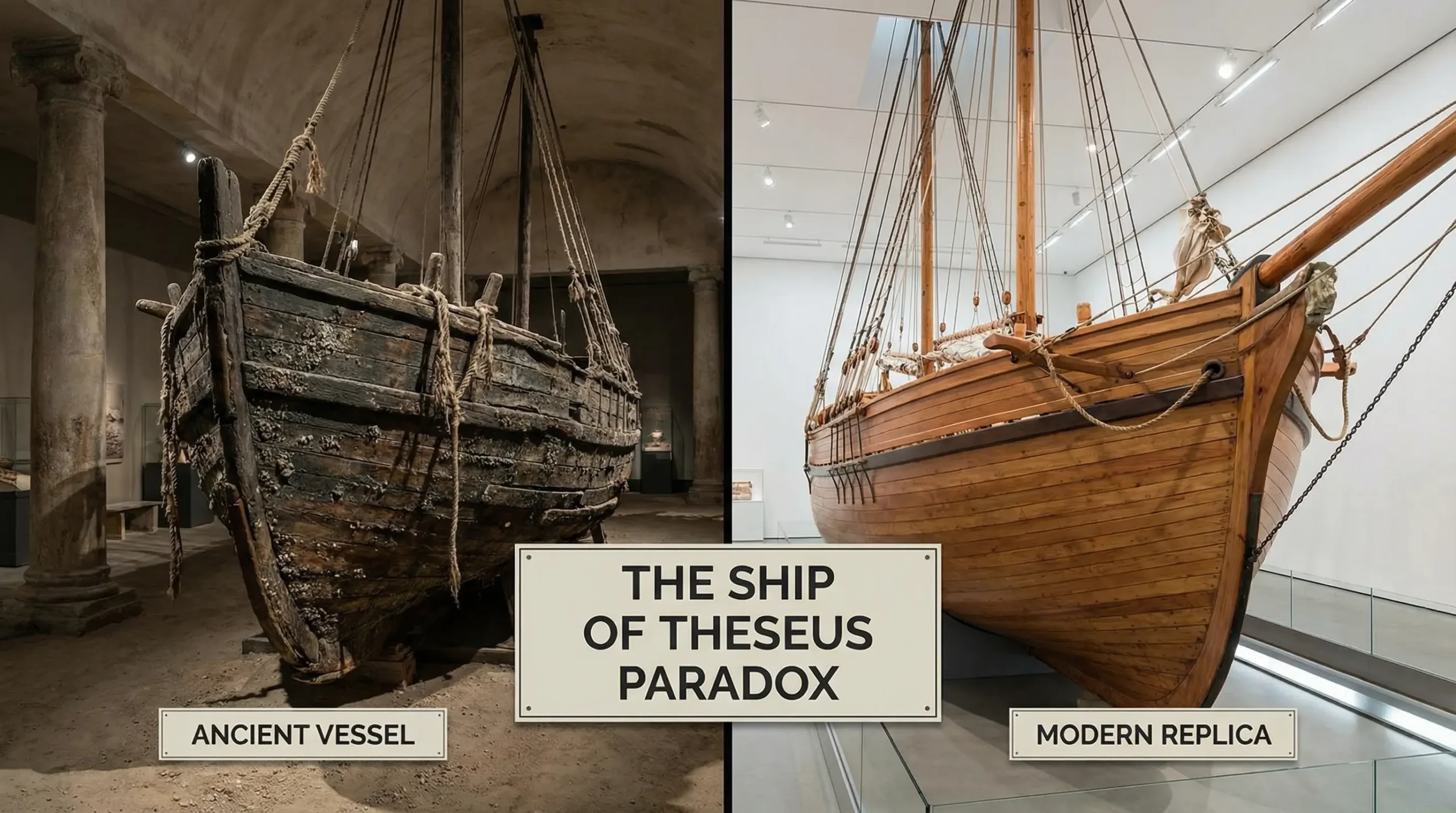
This ancient Greek thought experiment asks a simple question: If you replace every single wooden plank of a ship over time, is it still the same ship? And if you took all the old planks and built a second ship, which one is the “real” Ship of Theseus? This is one of the classic Mind-Blowing Paradoxes of identity.
It applies to humans too. Your body replaces almost all its cells every 7 to 10 years. Are you the same person you were a decade ago? These Mind-Blowing Paradoxes force us to define what makes an object—or a person—truly “themselves” when their physical composition is constantly changing.
3. Schrödinger’s Cat (Quantum Mechanics)
Erwin Schrödinger proposed this scenario to highlight the absurdity of quantum mechanics. A cat is placed in a sealed box with a radioactive atom that has a 50% chance of decaying and releasing poison. Until you open the box, quantum theory suggests the cat is both alive and dead at the same time.
This state is called “superposition.” While it sounds ridiculous for a cat, subatomic particles actually behave this way. They exist in multiple states until they are observed. Among Mind-Blowing Paradoxes, this one bridges the gap between the weird world of physics and our everyday reality.
4. The Infinite Hotel Paradox
Imagine a hotel with an infinite number of rooms, and every room is full. A new guest arrives. Can you fit them in? Yes, by moving the guest in room 1 to room 2, room 2 to room 3, and so on forever. Room 1 is now empty. This is one of the mathematical Mind-Blowing Paradoxes proposed by David Hilbert.
It gets weirder. If an infinite number of new guests arrive, you can move every current guest to a room number that is double their current room number (1 to 2, 2 to 4). Now, all the odd-numbered rooms are empty—an infinite amount of them. These Mind-Blowing Paradoxes show that infinity acts very differently from normal numbers.
5. The Fermi Paradox (Aliens)
The universe is billions of years old and contains billions of stars. Statistically, Earth-like planets should be common, and intelligent life should have colonized the galaxy by now. So, where is everybody? This silence is one of the most unsettling Mind-Blowing Paradoxes in astronomy.
Possible solutions include the “Great Filter,” which wipes out civilizations before they can travel through space, or the “Zoo Hypothesis,” where aliens are watching us but refuse to interfere. The Fermi Paradox remains one of the great Mind-Blowing Paradoxes because both answers (we are alone, or we are not) are equally terrifying.
6. Zeno’s Paradox (The Dichotomy)
Zeno of Elea argued that motion is an illusion. He proposed that to walk across a room, you must first walk halfway. To walk the remaining half, you must walk half of that, and so on. Since there are an infinite number of “halves” to cross, you should never be able to reach the other side. This is one of the oldest Mind-Blowing Paradoxes.
Logically, it seems you can never start moving because you have an infinite number of tasks to complete. While calculus eventually solved this by calculating the sum of infinite series, it stood as one of the unsolvable Mind-Blowing Paradoxes for over 2,000 years.
7. The Bootstrap Paradox (Information Loop)
Imagine a time traveler goes back to the 18th century and gives a young Beethoven the sheet music for his 5th Symphony. Beethoven copies it and publishes it. But if the time traveler got it from Beethoven, and Beethoven got it from the time traveler, who actually wrote the music? This is one of the most confusing Mind-Blowing Paradoxes.
In this scenario, the information (the symphony) exists without ever being created by anyone. It is a causal loop with no origin. These Mind-Blowing Paradoxes suggest that if time travel is possible, the concept of “cause and effect” might completely break down.
8. The Prisoner’s Dilemma
Two criminals are arrested. If both stay silent, they get 1 year in jail. If both betray each other, they get 2 years. But if one betrays and the other stays silent, the betrayer goes free, and the silent one gets 3 years. Logic dictates you should betray your partner to minimize your sentence, but if you both think logically, you both get a worse outcome. This is a classic example of Game Theory among Mind-Blowing Paradoxes.
This paradox explains why nations stockpile nuclear weapons or why companies engage in price wars. Even when cooperation is better for everyone, individual self-interest often leads to a worse collective result. It is one of the Mind-Blowing Paradoxes that governs human psychology and politics.
9. Olbers’ Paradox (Dark Night Sky)
If the universe is infinite and full of infinite stars, then every line of sight from Earth should eventually hit a star. This means the night sky should be as bright as the surface of the Sun. So, why is the sky dark? This is Olbers’ Paradox, one of the cosmological Mind-Blowing Paradoxes.
The solution helped prove the Big Bang theory. The sky is dark because the universe is not infinitely old; light from distant stars hasn’t reached us yet. Also, the universe is expanding, stretching the light into invisible infrared waves. These Mind-Blowing Paradoxes help astronomers understand the structure of our cosmos.
10. The Liar Paradox
Consider the statement: “This sentence is false.” If it is true, then it is false. But if it is false, then it must be true. This simple linguistic trap creates an endless loop of contradiction. It is one of the simplest yet most frustrating Mind-Blowing Paradoxes in logic.
This paradox shows the limitations of language and binary logic (true/false). It has plagued philosophers for thousands of years and even relates to computer programming loops. These Mind-Blowing Paradoxes prove that not every question has a clear answer.
Logic vs. Reality
These Mind-Blowing Paradoxes are more than just puzzles; they reveal the strange nature of our universe. Whether it’s the mysteries of time travel or the weirdness of quantum mechanics, reality is often far more complex than common sense suggests.
By wrestling with these Mind-Blowing Paradoxes, we stretch our minds and learn to accept that the world doesn’t always follow the rules we expect. Read more about philosophical puzzles at the Stanford Encyclopedia of Philosophy.