
Look, I was genuinely shocked to learn just how close we are to living in a sci-fi movie. When we think about the next decade, our minds usually jump to flying cars or colonies on Mars, but the most profound changes will happen right inside our homes.
A wave of future everyday technology is currently being prototyped in labs around the world, and it will completely change our daily routines.
Think about how smartphones revolutionized our lives just a short time ago. The next massive leap in consumer gadgets is focused on seamless integration, moving away from bulky screens and moving toward invisible, intuitive assistants.
In fact, some of these upcoming concepts sound just as bizarre as the bizarre physics phenomena that break reality, yet they are completely grounded in real engineering. If you want to see exactly what top researchers at MIT Technology Review are tracking, you are in for an extraordinary ride.
What will daily technology look like in 10 years?
In exactly ten years, daily tech will shift away from hand-held screens to ambient, invisible interfaces. This future everyday technology includes augmented reality contacts, kinetic-charging clothing, and holographic displays. Devices will anticipate your needs naturally without requiring constant manual input or traditional charging cables.
📋 Table of Contents
- Overview
- 1. True Holographic Smartphone Displays
- 2. Augmented Reality Smart Contacts
- 3. Atmospheric Home Water Generators
- 4. Kinetic Energy Harvesting Fabrics
- 5. Real-Time Translation Earbuds
- 6. AI-Generated Interactive Entertainment
- 7. Programmable Color-Changing Clothing
- 8. Solid-State Battery Integration
- 9. Silent Ion-Propulsion Delivery Drones
- 10. Smart AR Mirrors for Virtual Try-Ons
- FAQ
The Ultimate Gadget Evolution
The transition from clunky hardware to elegant, integrated tech is happening faster than anyone predicted. The devices we use to communicate, wear, and even hydrate are undergoing a massive transformation behind closed doors. Here is a quick snapshot of the extraordinary inventions coming to your home.
| # | Name | Key Fact |
|---|---|---|
| 1 | Holographic Displays | Projects 3D images without glasses. |
| 2 | AR Contact Lenses | Puts digital info directly on your eye. |
| 3 | Atmospheric Water | Pulls drinking water from thin air. |
| 4 | Kinetic Fabrics | Charges phones while you walk. |
| 5 | Translation Earbuds | Flawless real-time language decoding. |
| 6 | Interactive AI Media | Movies that change based on your choices. |
| 7 | Programmable Clothes | Changes color via a smartphone app. |
| 8 | Solid-State Batteries | Charges devices in minutes, lasts weeks. |
| 9 | Silent Ion Drones | Delivers packages without rotor noise. |
| 10 | Smart AR Mirrors | Shows how clothes fit before you buy. |
1. True Holographic Smartphone Displays
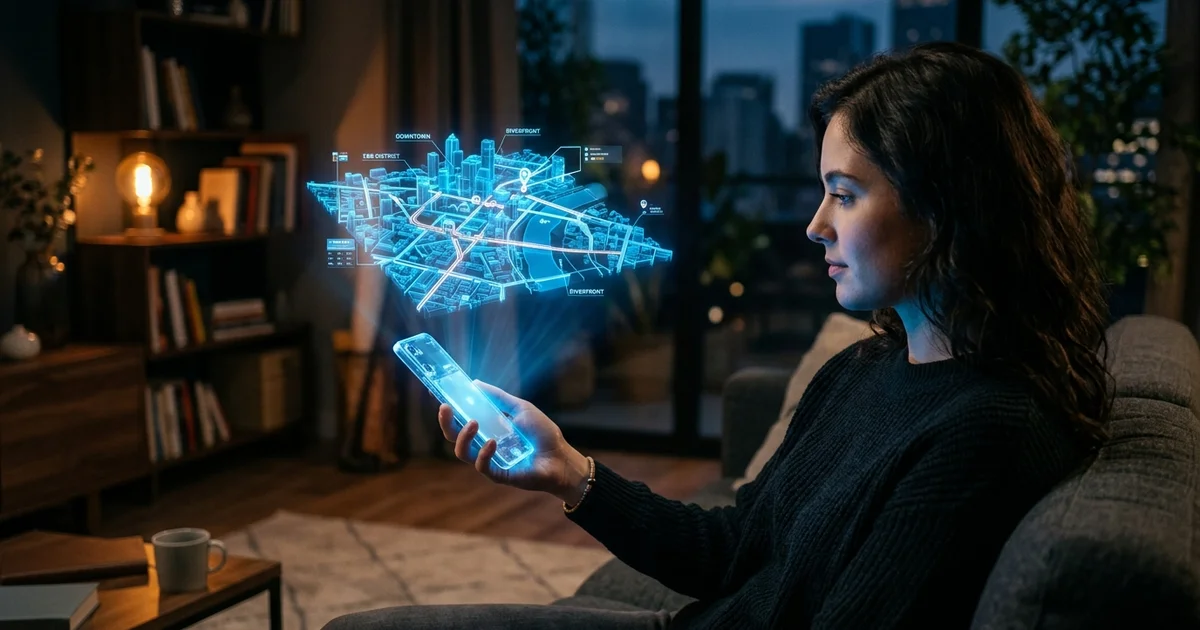
I remember watching classic sci-fi movies where characters communicated via glowing blue holograms, thinking it was pure fantasy. Surprisingly, researchers are currently perfecting light field display panels that create genuine three-dimensional projections. This piece of future everyday technology uses millions of microscopic nanostructures to bend light precisely into your field of vision.
The result is a fully dimensional image floating just above your smartphone screen without needing clunky 3D glasses. You will be able to look at a GPS map and actually see the varying heights of the buildings and hills.
Eye-tracking sensors will adjust the projection angle in real-time as you move your head around the device.
My personal take on this tech is that it will absolutely revolutionize online shopping. Imagine trying to buy a new couch and being able to rotate a perfectly scaled 3D hologram of it right on your kitchen table. You get a perfect sense of depth and texture that flat photographs can never provide.
It will also change how we connect with loved ones during video calls. Seeing a dimensional, miniature projection of your family member is going to make distant communication feel incredibly personal. Flat screens will soon feel as outdated as black-and-white television.
2. Augmented Reality Smart Contacts
Smart glasses have been trying to find a market for years, but the ultimate goal has always been making the hardware completely invisible. Tech companies are currently clinical-testing smart contact lenses that feature microscopic LED screens built right into the hydrogel.
This breathtaking future everyday technology overlays digital information directly onto your natural field of vision.
Instead of constantly looking down at a smartwatch or phone, your notifications will subtly float in your peripheral vision. These lenses are powered by microscopic solid-state batteries and wirelessly tethered to your phone in your pocket. The displays are completely invisible to anyone looking at you from the outside.
I genuinely believe this will change how we navigate cities forever. Imagine walking out of a subway station and seeing glowing green arrows painted onto the sidewalk, guiding you exactly to your destination. You will never have to stare at a confusing GPS map while walking down a busy street again.
My analytical take here is that this will dramatically reduce screen addiction by removing the physical barrier of a phone. We will still consume information, but we will keep our heads up and stay engaged with the physical world around us. It is the perfect blend of digital convenience and real-world presence.
3. Atmospheric Home Water Generators
We are used to relying on municipal pipes or bottled deliveries for our drinking water, but that infrastructure is quickly aging. Engineers have developed atmospheric water generators that literally pull pure, filtered drinking water out of the ambient humidity in your home.
This astonishing future everyday technology essentially creates water from thin air, right on your kitchen counter.
These devices use advanced condensation coils and multi-stage filtration to capture moisture, clean it, and dispense it. Even in relatively dry climates, these generators can produce gallons of fresh water every single day. They run on standard household electricity and completely bypass traditional plumbing lines.
My personal take is that this will be a massive game-changer for off-grid living and eco-friendly home designs. You could theoretically build a house anywhere in the world and never have to worry about digging a well or connecting to city water. It offers an incredible level of independence and self-sufficiency for modern homeowners.
Think about the environmental impact this will have on plastic bottle waste alone. If every household can generate their own endless supply of pure drinking water from the air, the bottled water industry will become obsolete. It is a brilliant, elegant solution to one of our most basic human needs.
4. Kinetic Energy Harvesting Fabrics
Battery anxiety is a universal modern struggle, but what if you never had to plug your devices into a wall again? Material scientists are weaving piezoelectric fibers directly into everyday clothing like jeans, jackets, and sneakers. This innovative future everyday technology converts your physical movement into usable electrical power.
Every time you take a step, bend your arm, or even shift your weight, the friction in these smart fabrics generates a micro-charge. That electricity is then routed to a wireless charging pad perfectly positioned inside your jacket pocket.
You will simply drop your phone in your pocket, and it will charge while you walk down the street.
My personal take on this is that it will radically change outdoor recreation and travel. If your hiking boots and backpack are constantly generating power, you will never need to carry heavy portable power banks again. You become your own walking power plant, completely untethered from the electrical grid.
These fabrics are completely washable and feel exactly like normal cotton or polyester blends. We are moving toward a future where our clothing does much more than just keep us warm. Our garments will become active, functional tools that seamlessly support our digital lives.
5. Real-Time Translation Earbuds
Language barriers have always been one of the biggest hurdles in global travel and international business. We currently rely on clunky phone apps that require awkward pauses, but the next generation of translation earbuds is going to change everything.
This fascinating future everyday technology uses localized AI to translate spoken languages into your ear in real-time with almost zero latency.
You can sit at a cafe in Tokyo, and as the waiter speaks Japanese, you will hear flawless English in your ear simultaneously. The AI doesn’t just translate the words; it analyzes the speaker’s tone, pacing, and local idioms to provide accurate conversational context. It makes natural, flowing conversation between two different languages entirely possible.
I genuinely believe this will spark a massive boom in global cultural exchange. When you remove the anxiety of not being able to communicate, people will travel further and connect much more deeply with locals. It feels exactly like the universal translator devices from Star Trek, finally brought into reality.
My analytical take is that this will also heavily disrupt the global workforce. When language is no longer a barrier, companies can seamlessly hire and collaborate with talent from anywhere on Earth without friction. It is a beautiful example of technology bringing humanity closer together.
6. AI-Generated Interactive Entertainment
Right now, watching a movie is a completely passive experience where millions of people all watch the exact same ending. However, entertainment studios are experimenting with generative AI engines that render movie scenes dynamically as you watch them.
This incredible future everyday technology will allow you to make verbal choices that instantly alter the plot, dialogue, and camera angles of a film.
If you are watching a thriller and yell, “Don’t go in the basement,” the AI will seamlessly generate a new branch of the movie where the character listens to you. The lighting, voice acting, and musical score will adapt on the fly to match your unique storyline.
No two viewing experiences will ever be exactly the same.
My personal take on this trend is that the line between video games and cinema is about to disappear completely. We are moving toward an era of personalized storytelling where the viewer is essentially the co-director. It will make media consumption incredibly engaging, especially for mysteries and suspense thrillers.
Of course, this raises fascinating questions about artistic intent and who exactly is authoring the story. But as a consumer, the idea of exploring endless “what if” scenarios in my favorite movies sounds absolutely brilliant. It takes the old “Choose Your Own Adventure” books and scales them up to Hollywood blockbuster levels.
7. Programmable Color-Changing Clothing
Fast fashion creates an enormous amount of textile waste because people constantly buy new clothes to keep up with trends. Imagine if you could own just one high-quality jacket and change its color or pattern every single morning.
That is exactly what this future everyday technology promises, utilizing flexible micro-displays and E-ink threads woven into standard fabrics.
Using an app on your phone, you can instantly turn a black evening dress into a vibrant red one covered in floral patterns. The threads use microscopic electrical charges to shift pigments, requiring zero power to maintain the color once it changes.
You can match your outfit to your mood, your shoes, or even the current weather instantly.
My analytical take on this is that it will be the biggest disruption the fashion industry has seen in a century. It completely solves the issue of closet space and significantly reduces the environmental impact of discarded clothing. You buy the physical garment once, and then you just download new digital patterns from designers.
Think about the safety applications, too; a cyclist could program their jacket to glow bright neon yellow at night for visibility. Then, when they arrive at the office, they tap their phone and the jacket reverts to a subtle, professional grey. It is practical, highly sustainable, and incredibly fun.
8. Solid-State Battery Integration
Lithium-ion batteries have powered our devices for decades, but they are heavy, slow to charge, and prone to overheating. The tech world is aggressively pivoting to solid-state batteries, which replace the liquid electrolyte with a solid conductive material.
This vital piece of future everyday technology packs vastly more energy into a significantly smaller and safer package.
What does this mean for you? It means your future smartphone will charge from zero to 100 percent in less than five minutes and last for an entire week. It also means electric vehicles will finally be able to travel over 1,000 miles on a single, lightning-fast charge at a highway station.
My personal take is that this will finally kill the internal combustion engine for good. The only thing holding many consumers back from buying electric cars is charge time and range anxiety on road trips. Once solid-state batteries hit the mass market, filling up an EV will be faster than pumping a tank of gas.
Beyond cars, this technology will make all our portable gadgets incredibly thin and lightweight. When batteries no longer need heavy protective casings to prevent liquid leaks, device design is going to become radically minimalist. We are on the verge of a massive leap in portable power.
9. Silent Ion-Propulsion Delivery Drones
Drone delivery is already being tested by major retailers, but the biggest complaint from neighborhoods is the loud, annoying buzz of the spinning propellers. To solve this, aviation engineers are developing drones that use solid-state ion propulsion instead of traditional rotors.
This brilliant future everyday technology uses high-voltage electric fields to accelerate air molecules downward, creating lift with zero moving parts.
Because there are no spinning blades or gears, these ion drones are completely silent as they fly through the air. You could have a package delivered directly to your backyard while you are reading on the patio, and you would barely hear a whisper.
It removes the noise pollution that has held automated delivery back for years.
My personal take here is that quiet skies are absolutely essential if we want automated logistics to scale in suburban areas. Nobody wants their neighborhood sounding like a bustling airport tarmac all day long. Ion propulsion solves the noise issue elegantly while also making the drones much safer for pedestrians.
This tech might sound like magic, but BBC Future recently highlighted working prototypes successfully flying in indoor wind tunnels. Once the power-to-weight ratio is optimized, the skies above our homes will be filled with silent, invisible supply chains working flawlessly.
10. Smart AR Mirrors for Virtual Try-Ons
Buying clothes online is always a gamble because you never truly know how a garment will drape over your specific body type. Retailers are solving this by introducing smart augmented reality mirrors into both physical dressing rooms and our homes.
This highly practical future everyday technology uses depth sensors to perfectly map your body and digitally overlay clothing onto your reflection.
You can stand in front of your bedroom mirror and swipe through dozens of outfits, seeing exactly how the fabric moves when you twist and turn. The AI calculates physics like gravity and fabric weight, so you know exactly if a shirt will be too tight on the shoulders.
It completely eliminates the tedious process of ordering three different sizes just to return two of them.
My analytical take is that this will absolutely decimate the traditional retail fitting room model within a decade. Physical stores will transform into showrooms where you don’t actually try anything on in person. You will just scan the racks, let the mirror do the work, and have the clothes shipped to your house.
Even better, your home smart mirror will be able to suggest outfits based on the local weather forecast or your calendar events. It brings personal styling and perfect tailoring directly into your bedroom every single morning. Getting dressed is about to become a highly optimized, completely stress-free experience.
Final Thoughts
Looking at these incredible concepts, it is clear that future everyday technology is focused on removing friction from our daily routines. We are moving away from glowing screens that distract us and toward invisible assistants that quietly empower us.
From translating foreign languages flawlessly to pulling pure water right out of the air, these innovations prove human ingenuity is limitless. Just like those everyday optical illusions that trick your brain, the technology of tomorrow will blur the line between what is real and what is digital, and I cannot wait to experience it.

Written by the List of Ten Team
We verify every fact using peer-reviewed sources.
Frequently Asked Questions
Will AR contact lenses completely replace smartphones?
While they won’t entirely replace smartphones immediately, AR contacts will likely handle most quick notifications and GPS navigation. The smartphone will transition into a pocket-sized processing hub that wirelessly powers and feeds data to your lenses.
Are kinetic energy fabrics safe to wash?
Yes, modern piezoelectric threads are coated in waterproof polymers that make them completely safe to put through a standard washing machine. They are designed to withstand normal wear, stretching, and folding without losing their energy-harvesting capabilities.
How do atmospheric water generators work in dry climates?
Advanced atmospheric water generators use ultra-efficient desiccants to absorb even trace amounts of moisture from the air. While they are most efficient in high humidity, modern units can still produce multiple liters of drinking water daily in environments with as little as 20% relative humidity.