
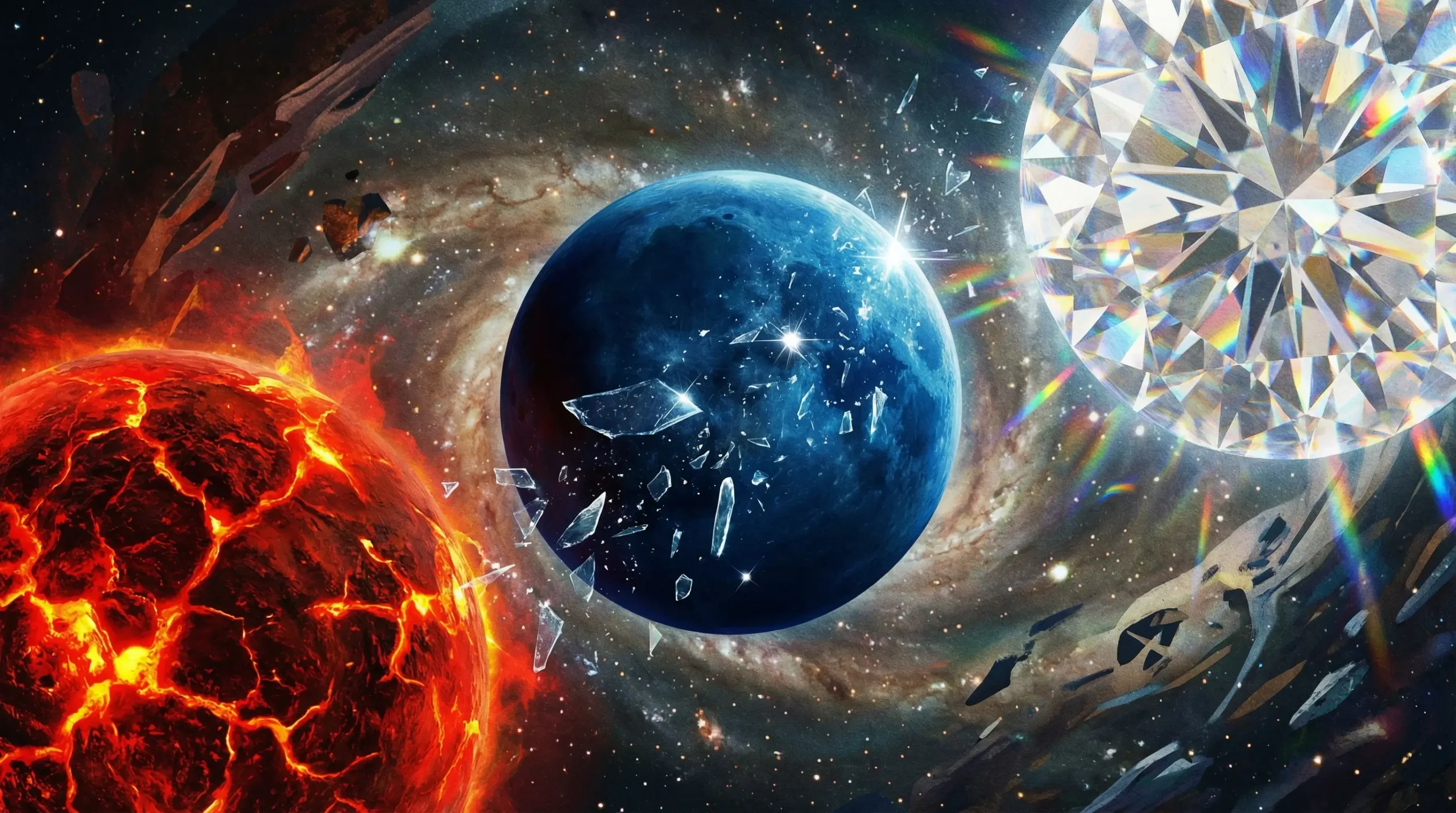
The Most Extreme Planets ever discovered make Earth look like a paradise. While our home has perfect temperatures and breathable air, astronomers have found alien worlds that defy the laws of imagination.
Compared to the Natural Disasters on Earth, these worlds are pure hell. From raining glass to burning ice, this list covers the Most Extreme Planets in the known universe.
Pack your spacesuit, but don’t plan on visiting these worlds.
Table of Contents
Top 10 Most Extreme Planets Ever Discovered
1. HD 189733 b (Rains of Glass)
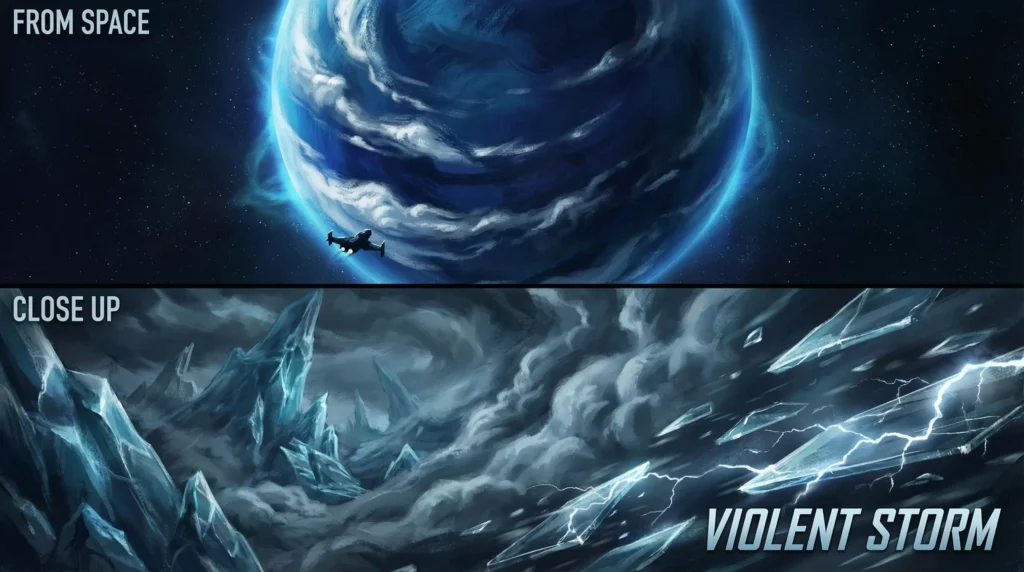
From a distance, this planet looks like a peaceful blue marble, similar to Earth. But don’t be fooled.
The winds blow at 5,400 mph (7 times the speed of sound). The atmosphere is full of silicate particles, which means it literally rains glass—sideways. It is widely considered one of the Most Extreme Planets for weather conditions.
⚡ Fun Fact: If you stood there, the wind would push you around the entire planet in an hour.
2. 55 Cancri e (The Diamond Planet)
This “Super-Earth” is twice the size of our planet but 8 times heavier. It is extremely carbon-rich and hot.
Scientists believe that due to the pressure and heat, at least a third of the planet’s mass is pure diamond. Its value is estimated at $26.9 nonillion.
⚡ Fun Fact: It orbits its star so closely that a year there lasts only 18 hours.
3. GJ 436 b (Burning Ice)
This planet defies the laws of physics as we know them. It is covered in ice, yet its temperature is 439°C (822°F).
How? The gravity is so incredibly strong that it compresses the water vapor into a solid state (“Ice-X”) despite the heat. It is a world of burning ice.
⚡ Fun Fact: It leaves a massive tail of hydrogen behind it, like a giant comet.
4. WASP-12b (The Pitch Black Planet)
This planet is being eaten alive by its own star. It is so close that gravity has pulled it into the shape of an egg.
It absorbs almost 94% of the light that hits it, making it look like black asphalt. It is one of the doomed Most Extreme Planets that won’t exist for much longer.
⚡ Fun Fact: Scientists estimate it has about 10 million years left before it is completely devoured.
5. J1407b (Super Saturn)
We all love Saturn’s rings, but J1407b puts them to shame. Its ring system is 200 times larger than Saturn’s.
If this planet replaced Saturn in our sky, its rings would appear larger than the full moon. It is a true giant of the cosmos.
⚡ Fun Fact: The rings are so wide that they would span from the Earth to the Sun.
6. KELT-9b (Hotter Than Stars)
This is the hottest gas giant ever found. Its dayside temperature reaches 4,300°C (7,800°F).
That is hotter than most stars in the universe (including Red Dwarfs). Molecules can’t even exist there; they are ripped apart by the heat, making KELT-9b one of the Most Extreme Planets known to science.
⚡ Fun Fact: It is so hot that it glows like a lightbulb.
7. TrES-2b (The Darkest Planet)
If you flew a spaceship near TrES-2b, you wouldn’t see it. It reflects less than 1% of the light that hits it.
It is darker than coal or black acrylic paint. However, it isn’t cold; it burns with a faint, evil red glow due to its extreme temperature.
⚡ Fun Fact: Astronomers still don’t know exactly why it is so pitch black.
8. Kepler-16b (Real-Life Tatooine)
Fans of Star Wars, rejoice. Kepler-16b is a circumbinary planet, which means it orbits two stars instead of one.
If you stood on its surface, you would see a double sunset every evening. However, it is extremely cold and gaseous, so you couldn’t actually stand there.
⚡ Fun Fact: George Lucas guessed correctly; planets with two suns really do exist.
9. HAT-P-7b (Ruby Rain)
On this gas giant, the clouds are made of corundum—the mineral that forms rubies and sapphires.
Because of the violent winds, it literally rains liquid gems across the planet. It sounds rich, but the weather makes it one of the Most Extreme Planets to avoid.
⚡ Fun Fact: It was the first planet where scientists detected weather outside our solar system.
10. PSR B1257+12 (Zombie Worlds)
These planets shouldn’t exist. They orbit a pulsar—a dead, rapidly spinning star that blasts deadly radiation like a lighthouse.
The radiation is so intense it constantly “sterilizes” the planets, making life impossible. They are affectionately called “Poltergeist,” “Phobetor,” and “Draugr.”
⚡ Fun Fact: These were actually the very first exoplanets ever discovered in 1992.
The Mystery of the Most Extreme Planets
The universe is far stranger than science fiction. These Most Extreme Planets show us that nature’s imagination has no limits.
Which of these worlds would you visit if you could survive? Read more space news at NASA.