
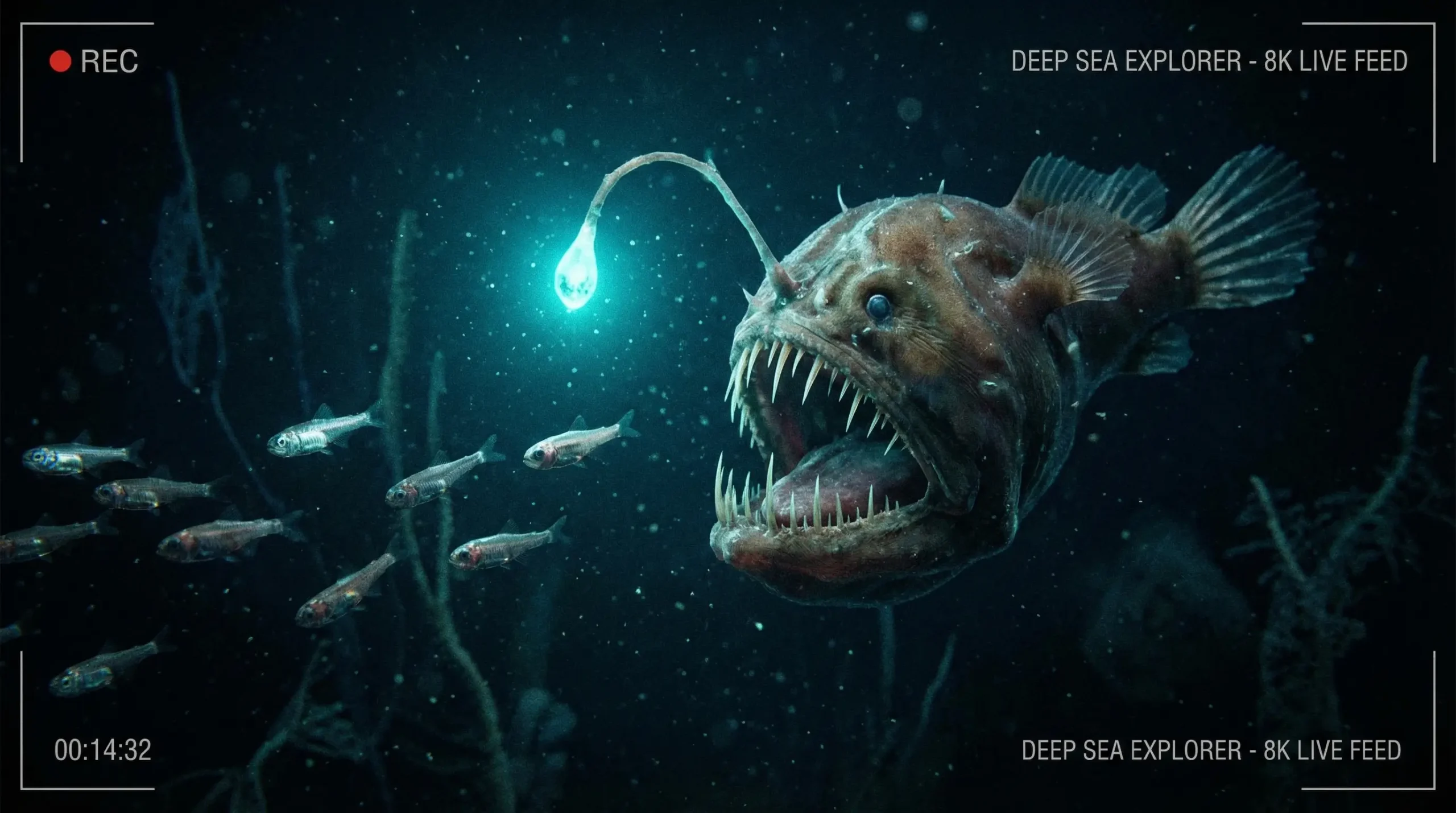
We spend billions exploring the cosmos, yet more than 80% of our own ocean remains unmapped and unseen. In the crushing darkness of the abyss, evolution has taken a completely different path, creating Bizarre Deep Sea Creatures that look like nightmares brought to life. These animals have adapted to extreme pressure, freezing temperatures, and total darkness in ways that defy our understanding of biology.
Unlike the Strangest Planets which are light-years away, these alien-like beings live right here on Earth. From sharks with extending jaws to squids that inhabit the “twilight zone,” the ocean floor is teeming with life that seems impossible. Here are 10 Bizarre Deep Sea Creatures that prove reality is often stranger than fiction.
Table of Contents
1. The Barreleye Fish (Transparent Head)
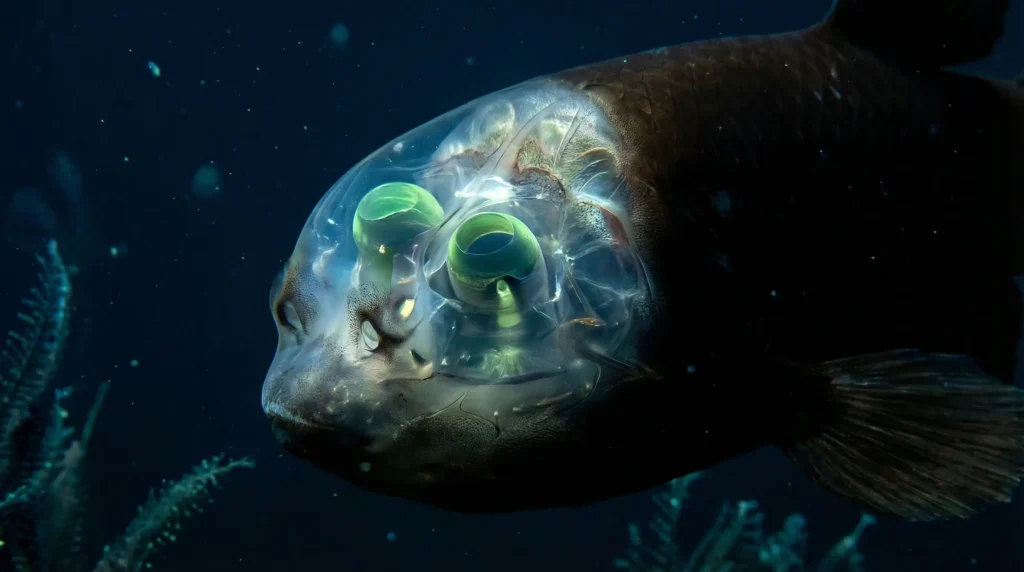
The Barreleye fish (Macropinna microstoma) is arguably one of the most Bizarre Deep Sea Creatures ever discovered. Found at depths of 2,000 to 2,600 feet, it is famous for having a completely transparent head filled with fluid. The two glowing green orbs visible inside its head are actually its eyes, which can rotate to look upward for the silhouettes of prey or forward to eat. This unique adaptation allows the Barreleye to steal food from jellyfish without stinging its eyes.
For decades, scientists only knew about this creature from mangled specimens brought up in nets, which destroyed the fragile transparent shield. It wasn’t until 2004 that the Monterey Bay Aquarium Research Institute (MBARI) filmed a live one using a remote-controlled vehicle (ROV). Its transparency allows its eyes to collect maximum light in the pitch-black ocean, giving it a distinct hunting advantage over other Bizarre Deep Sea Creatures inhabiting the twilight zone.
2. The Goblin Shark (Living Fossil)
The Goblin Shark looks like a mistake of evolution, earning its place among the scariest Bizarre Deep Sea Creatures. This pink-skinned shark is the only surviving member of a family that dates back 125 million years. It is listed as a “living fossil” because its physical structure has barely changed since the Cretaceous period. Its most terrifying feature is its feeding mechanism: its jaws are not fixed to its skull.
When it detects prey, the Goblin Shark can slingshot its jaws forward at a speed of 3.1 meters per second to snatch the victim. This elastic action allows it to catch fish that would otherwise swim out of reach. It lives in deep waters near Japan and the Gulf of Mexico, using its long, flattened snout to sense the weak electrical fields of other animals in the darkness. Seeing one of these Bizarre Deep Sea Creatures feed is a sight you will never forget.
3. The Bigfin Squid (Magnapinna)
Few videos have terrified the internet as much as the footage of the Bigfin Squid. Captured by deep-sea oil rig cameras in the Gulf of Mexico, this creature looks like a long-legged alien striding through the water. It is one of the most elusive Bizarre Deep Sea Creatures, characterized by extremely long, thin tentacles that hang down from its body like elbows.
These tentacles can reach lengths of up to 26 feet (8 meters), while the body mantle remains relatively small. Scientists believe they drag these sticky tentacles along the seafloor to entrap prey, much like a moving spider web. Sightings of Magnapinna are incredibly rare, making every new video a significant scientific event in the study of Bizarre Deep Sea Creatures.
4. The Vampire Squid (From Hell)
Its scientific name, Vampyroteuthis infernalis, literally means “Vampire Squid from Hell.” Despite the scary name, this is a relatively small and passive member of the Bizarre Deep Sea Creatures list. It lives in the Oxygen Minimum Zone (OMZ), an area where oxygen levels are too low for most other predators to survive, roughly 2,000 to 3,000 feet deep.
It doesn’t suck blood; instead, it eats “marine snow” (dead organic matter falling from above). When threatened, it doesn’t shoot ink like other cephalopods. Instead, it pulls its webbed arms over its head, turning itself inside out to expose menacing-looking spines called cirri. This “pineapple posture” is a bluff to scare away attackers, showcasing the unique defense mechanisms of Bizarre Deep Sea Creatures.
5. The Anglerfish
Made famous by the movie Finding Nemo, the Anglerfish is the icon of the deep. It uses a bioluminescent lure extending from its forehead to attract curious prey in the pitch black. Once the prey gets close enough, the Anglerfish snaps its massive, tooth-filled jaws shut. It is one of the deadliest and most recognizable Bizarre Deep Sea Creatures in the abyss.
The reproduction method of the Anglerfish is even stranger than its appearance. The tiny male bites onto the much larger female and fuses with her body, eventually losing his eyes and internal organs until he becomes nothing more than a parasite providing sperm. A single female can carry multiple males on her body at once, ensuring the survival of these Bizarre Deep Sea Creatures in the vast ocean.
6. The Gulper Eel (Pelican Eel)
The Gulper Eel, also known as the Pelican Eel, has a mouth that is disproportionately huge compared to its body. It can unhinge its jaw to swallow prey much larger than itself. This adaptation is crucial because food is scarce in the deep ocean, so these Bizarre Deep Sea Creatures cannot afford to be picky eaters.
Normally, the eel looks like a thin ribbon with a large head. However, when it takes a gulp of water and prey, its mouth expands like a balloon. It swims at depths of up to 10,000 feet and has a glowing organ at the end of its tail to attract unsuspecting victims. This unique feeding strategy highlights the extreme adaptations of Bizarre Deep Sea Creatures.
7. The Giant Squid
For centuries, the Giant Squid was considered a myth, the “Kraken” that sank ships. It wasn’t until 2004 that Japanese researchers captured the first images of a live one in the wild. Growing up to 43 feet (13 meters) long, it is a true monster and one of the largest Bizarre Deep Sea Creatures on the planet.
These invertebrates engage in epic battles with Sperm Whales, their only natural predator. Whales are often found with circular scars from the squid’s serrated suction cups. The Giant Squid has eyes the size of dinner plates—the largest in the animal kingdom—to spot bioluminescent whales approaching in the dark. It remains the king of Bizarre Deep Sea Creatures.
8. The Frilled Shark
Looking more like a sea serpent than a fish, the Frilled Shark is often called a “living fossil” because it hasn’t changed much in 80 million years. It has a primitive, eel-like body and frilly gills that wrap around its throat. It is one of the most primitive Bizarre Deep Sea Creatures found in the Atlantic and Pacific oceans.
Its mouth is lined with 300 trident-shaped teeth arranged in 25 rows. These needle-sharp teeth face backward, making it impossible for prey to escape once bitten. It hunts by lunging forward like a snake to snatch squid and other sharks. Encountering one of these Bizarre Deep Sea Creatures is like stepping back in time to the age of dinosaurs.
9. The Japanese Spider Crab
If you are afraid of spiders, you might want to skip this one. The Japanese Spider Crab has the largest leg span of any arthropod, reaching up to 12 feet (3.7 meters) from claw to claw. These massive Bizarre Deep Sea Creatures roam the ocean floor around Japan, looking like something out of a sci-fi movie.
Despite their terrifying size and armored appearance, they are gentle giants. They are scavengers, picking at dead animals and plants on the seabed. They can live up to 100 years, making them one of the longest-living marine species. To camouflage themselves, these Bizarre Deep Sea Creatures often adorn their shells with sponges and anemones.
10. The Mariana Snailfish
How deep can life exist? The Mariana Snailfish holds the record. It was discovered swimming at a depth of 26,800 feet (8,178 meters) in the Mariana Trench. At this depth, the water pressure is 1,000 times greater than at sea level—equivalent to an elephant standing on your thumb. It is the deepest living of all Bizarre Deep Sea Creatures discovered so far.
Unlike other Bizarre Deep Sea Creatures that look scary, the snailfish looks cute, pale, and tadpole-like. It has translucent skin and no scales. Its bones are not fully calcified, which allows it to withstand the immense crushing pressure that would instantly kill a surface fish. It dominates the food chain at these extreme depths.
The Alien World Below
The ocean floor is truly the final frontier on Earth. These Bizarre Deep Sea Creatures show us that life is incredibly resilient and can adapt to the most hostile environments imaginable. Just like the Terrifying Space Phenomena above us, the world below holds endless secrets.
Every time we send a rover down into the trench, we discover new species. Who knows what other monsters are lurking in the 95% of the ocean we haven’t explored yet? Studying these Bizarre Deep Sea Creatures helps us understand the limits of life itself. Read more about deep-sea exploration at the Monterey Bay Aquarium Research Institute.