
10 Most Expensive Abandoned Megaprojects That Wasted Billions (2026)
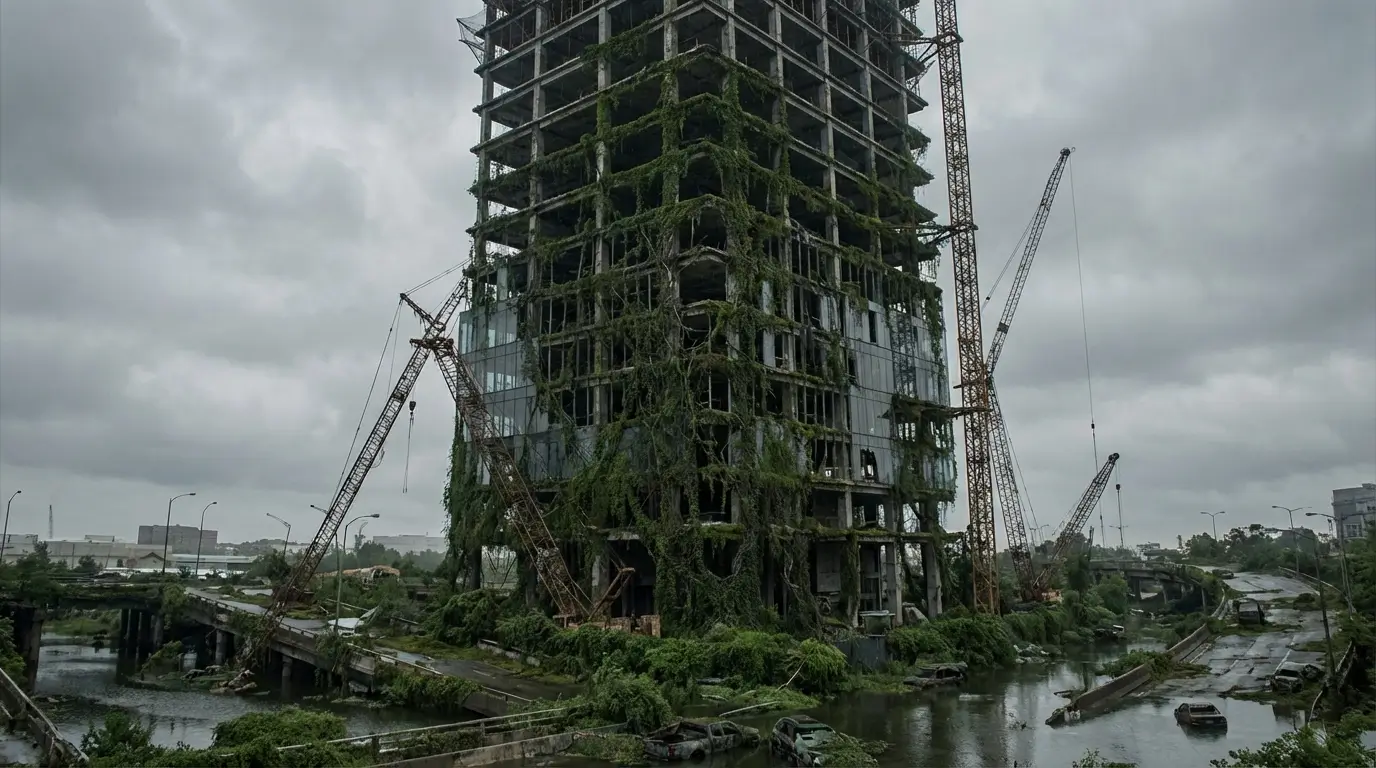
Human ambition is responsible for the greatest architectural achievements in history, but it is also responsible for some of the most spectacular financial disasters. For every successful skyscraper or suspension bridge, there are monumental failures left to rot in the sun. These expensive abandoned megaprojects represent trillions of dollars in wasted capital, political hubris, and catastrophic planning. They are modern-day ruins, standing as concrete tombstones to ideas that were simply too big to succeed.
From fake islands melting back into the ocean to underground scientific tunnels flooded with groundwater, these failed construction projects are a stark reminder of economic fragility. Just as we analyzed the most expensive business mistakes in history, we must look at how entire cities and infrastructures can collapse before they even open. According to financial analysts at Forbes, the global cost of stalled infrastructure exceeds $1 trillion annually. Prepare to explore the 10 most expensive abandoned megaprojects that defy logic.
Why Do Multi-Billion Dollar Projects Fail?
Expensive abandoned megaprojects typically fail due to a catastrophic combination of sudden economic recessions, drastic political regime changes, or severe environmental miscalculations. When funding dries up or the original logistical premise proves scientifically impossible, investors pull out, leaving massive concrete superstructures permanently unfinished and useless.
Megaproject Failure Analysis
| Megaproject | Location | Estimated Sunk Cost |
|---|---|---|
| Forest City | Malaysia | $100 Billion (Budget) |
| The World Islands | Dubai, UAE | $14 Billion |
| Yucca Mountain Repository | Nevada, USA | $15 Billion |
| Superconducting Super Collider | Texas, USA | $2 Billion |
| Ryugyong Hotel | North Korea | $750 Million+ |
Table of Contents

1. Forest City (Malaysia)
Marketed as a futuristic eco-utopia, Forest City in Malaysia is perhaps the most glaring example of modern expensive abandoned megaprojects. Backed by a Chinese development giant with a staggering $100 billion budget, the city was built on four artificial islands. It was designed to house 700,000 residents, featuring self-watering gardens, pristine beaches, and luxury amenities.
Today, it is a sprawling ghost town. Changing political tides, strict capital controls out of China, and the global economic downturn severely crippled the project. Less than 15% of the massive undertaking was completed, and the few towering apartment blocks that were finished sit in total darkness at night, slowly being reclaimed by the jungle.
2. The World Islands (Dubai)
Dubai is famous for pushing architectural boundaries, but “The World” proved to be a step too far. Conceived in 2003, the project involved dredging 321 million cubic meters of sand to create 300 artificial islands shaped like a map of the globe. The estimated cost was $14 billion, targeting billionaires who wanted to own a piece of “Britain” or “Antarctica” just off the coast of the UAE.
The 2008 financial crisis brought the project to a grinding halt. Without constant maintenance and development, the ocean began to erode the sand away. Today, the vast majority of the islands remain entirely undeveloped, sinking slowly back into the Persian Gulf, making it one of the most visible expensive abandoned megaprojects from space.
3. Superconducting Super Collider (USA)
Long before CERN built the Large Hadron Collider in Europe, the United States planned to build the ultimate physics machine in Waxahachie, Texas. The Superconducting Super Collider (SSC) was designed to be a 54-mile ring, three times more powerful than CERN’s machine. Construction began in 1991, with politicians promising it would unlock the secrets of the universe.
However, extreme budget overruns, shifting political priorities, and a lack of public understanding doomed the project. By 1993, after $2 billion had already been spent and 14 miles of tunnel had been bored underground, the US Congress cancelled the funding. It remains one of the most intellectually tragic expensive abandoned megaprojects in science history.
4. Yucca Mountain Nuclear Waste Repository (USA)
The problem with nuclear power is what to do with the radioactive waste. In 1987, the US government designated Yucca Mountain in Nevada as the nation’s sole permanent deep geological repository for spent nuclear fuel. Over the next two decades, the Department of Energy poured an estimated $15 billion into studying and excavating the mountain.
Despite the massive investment and the creation of a massive subterranean tunnel network, intense political pushback from Nevada residents and lawmakers halted the project. Defunding began under the Obama administration, and the massive fortress remains empty, serving as a monument to bureaucratic gridlock.
5. Ryugyong Hotel (North Korea)
Dominating the skyline of Pyongyang, the Ryugyong Hotel is a 105-story pyramid-shaped skyscraper that has never hosted a single guest. Construction began in 1987, heavily subsidized by the Soviet Union, with the goal of showcasing North Korean engineering supremacy to the world.
When the Soviet Union collapsed in 1991, North Korea plunged into economic ruin, and construction halted. For 16 years, the building was a concrete shell without windows, earning the nickname the “Hotel of Doom.” Although foreign investors later added glass panels to the exterior to make it look finished, the interior remains an empty, hollow concrete cavern.
6. Ciudad Real Central Airport (Spain)
During the early 2000s economic boom in Spain, investors poured over €1 billion into building Ciudad Real Central Airport. Intended as a massive alternative hub to Madrid’s busy Barajas airport, it featured a state-of-the-art terminal and a runway long enough to accommodate the massive Airbus A380.
Unfortunately, it opened in 2008, just as the global financial crisis devastated the Spanish economy. Almost no airlines booked flights there. By 2012, the airport was entirely bankrupt and abandoned. It became a prominent symbol of Spain’s real estate bubble and ranks high among the most expensive abandoned megaprojects in Europe.
7. Bataan Nuclear Power Plant (Philippines)
In response to the 1970s oil crisis, Philippine President Ferdinand Marcos ordered the construction of the Bataan Nuclear Power Plant. Costing an astronomical $2.3 billion, it was supposed to usher the nation into a new era of energy independence. The plant was structurally completed in 1984.
However, following the 1986 Chernobyl disaster and the overthrow of the Marcos regime, investigators discovered the plant was built dangerously close to a major fault line and an active volcano. It was never fueled and never generated a single watt of electricity. It stands today as a heavily guarded, incredibly expensive concrete relic.
8. Goldin Finance 117 (China)
China is no stranger to massive construction, but the Goldin Finance 117 tower in Tianjin takes the crown for the world’s tallest unoccupied building. Designed to be 117 stories (nearly 2,000 feet) tall, it was meant to be the crown jewel of a multi-billion dollar luxury real estate development project.
The developers ran into severe financial trouble during the 2015 Chinese stock market crash. While the building was topped out structurally, the interior was never finished, and the diamond-shaped observation deck remains an empty steel frame. It is the most vertical of all the expensive abandoned megaprojects, casting a long shadow over Tianjin.
9. Sathorn Unique Tower (Thailand)
Known locally as the “Ghost Tower,” the Sathorn Unique is a 49-story skyscraper in the heart of Bangkok. Designed to offer 600 ultra-luxury condominiums, construction was roughly 80% complete when the catastrophic 1997 Asian Financial Crisis struck, bankrupting the developers overnight.
Because the building’s massive concrete superstructure is already in place on prime real estate, it is too expensive to safely demolish, yet too damaged by decades of weather exposure to complete. It has become a dark monument to economic ruin and a highly illegal hotspot for urban explorers and BASE jumpers.
10. Athens Olympic Venues (Greece)
The 2004 Summer Olympics were meant to be a glorious homecoming for the games to Greece. The government spent an estimated €9 to €11 billion building state-of-the-art stadiums, aquatic centers, and Olympic villages. However, there was absolutely no post-game strategy for how to utilize these massive facilities in a country of just 11 million people.
When the Greek debt crisis hit a few years later, maintaining the venues became mathematically impossible. Today, the baseball/softball stadiums, kayaking centers, and massive concrete plazas are completely derelict, covered in graffiti and weeds. They represent the ultimate cautionary tale for cities bidding to host the Olympic games.
Conclusion
The world’s most expensive abandoned megaprojects teach us a painful lesson: having the money to start a massive project does not guarantee the ability to finish it. Economic tides turn, political regimes fall, and nature reclaims its territory. If you are fascinated by places left behind by humanity, be sure to explore our list of 10 forbidden places you are not allowed to visit. Sometimes, the most awe-inspiring structures are the ones we fail to complete.