
I sometimes find myself staring at a rock or a tree and wondering just how deep the story goes. We live our lives on a planet with a history so vast and strange it can feel like a different world entirely. Looking for the absolute best facts about prehistoric nature mysteries? You’re in the right place.
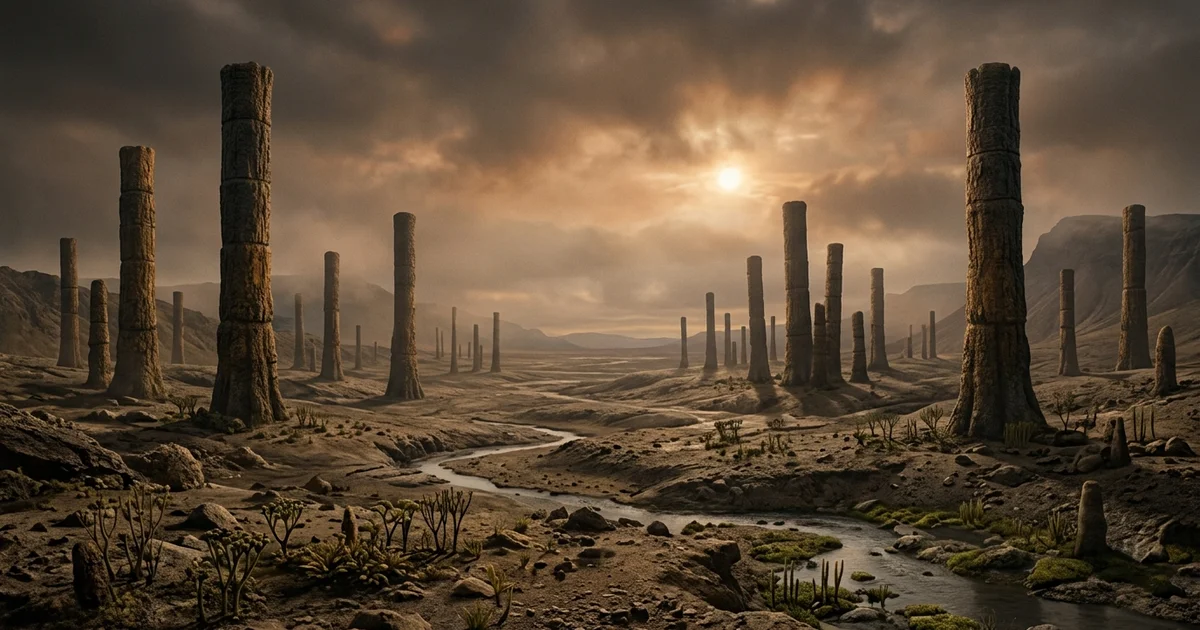
The clues to that world are buried right under our feet, presenting us with some of the most profound **prehistoric nature mysteries** imaginable.
These aren’t just questions about dinosaurs; they’re puzzles about the very rules of life and the bizarre forms it took long before humans ever walked the Earth. We’re talking about food webs we can barely comprehend and organisms that defy classification.
It’s a journey into a past that’s more alien than any science fiction story, and many of these puzzles are connected to our list of other 10 Bizarre Prehistoric Food Mysteries That Predate Human Civilization.
So, what makes these ancient enigmas more than just old, cold cases?
It’s because each one challenges our fundamental understanding of evolution, geology, and our own place in the timeline of life. Solving them isn’t just about knowing the past; it’s about understanding the resilience and sheer strangeness of life itself, revealing how the world as we know it came to be.
Why prehistoric nature mysteries Matters
Before we dive in, let’s establish why prehistoric nature mysteries is so fascinating.
In this deep-dive, we evaluate the top details for anyone searching for prehistoric nature mysteries. Let’s explore everything about prehistoric nature mysteries.
Table of Contents
- Overview
- 1. The Reign of the Giant Fungi
- 2. The Creature That Breaks the Family Tree
- 3. Darwin’s ‘Abominable Mystery’ of Flowers
- 4. The Alien Garden Before Animals
- 5. The Billion Years Earth Forgot to Record
- 6. The Switch from Scavenger to Hunter
- 7. How the Seas Grew Such Giants
- 8. The Explosion of Life Itself
- 9. The True Colors of a Lost World
- 10. The Missing Pieces of the T-Rex’s Dinner Plate
- Frequently Asked Questions
Overview
I’ve dug into some of the most baffling questions that predate civilization itself. From giant fungi that ruled the land to a billion years of missing time, here are ten bizarre food and nature mysteries that scientists are still trying to solve.
| # | Name | Key Fact |
|---|---|---|
| 1 | The Reign of the Giant Fungi | Before trees were common, the tallest things on land were likely Prototaxites, 26-foot-tall organisms that scientists now believe were colossal fungi. |
| 2 | The Creature That Breaks the Family Tree | The Tully Monster (Tullimonstrum gregarium) is a 300-million-year-old fossil so strange that scientists can’t agree if it was a vertebrate (with a backbone) or an invertebrate. |
| 3 | Darwin’s ‘Abominable Mystery’ of Flowers | Flowering plants (angiosperms) seem to appear very suddenly in the fossil record around 130 million years ago, a puzzle that Charles Darwin himself called an ‘abominable mystery’. |
| 4 | The Alien Garden Before Animals | The Ediacaran Biota were the first large, multicellular organisms on Earth, living around 575 million years ago. They look so alien that we don’t know if they were early animals, fungi, or a completely failed kingdom of life. |
| 5 | The Billion Years Earth Forgot to Record | Known as the Great Unconformity, there is a gap in the geological record in many parts of the world where over a billion years of rock layers are simply missing. |
| 6 | The Switch from Scavenger to Hunter | There is no clear moment in the fossil record that shows when our early human ancestors transitioned from primarily scavenging meat to actively hunting large animals. |
| 7 | How the Seas Grew Such Giants | The Cretaceous seas were home to multiple groups of enormous marine reptiles, like Mosasaurs and Plesiosaurs, and scientists are still debating the unique environmental factors that allowed them to get so big. |
| 8 | The Explosion of Life Itself | The Cambrian Explosion, around 541 million years ago, was a period where most major animal groups appeared in the fossil record in a ‘mere’ 20 million years—an evolutionary blink of an eye. |
| 9 | The True Colors of a Lost World | While we know some dinosaurs had feathers and patterns, the actual color of most prehistoric creatures is a complete mystery, as pigments rarely fossilize. |
| 10 | The Missing Pieces of the T-Rex’s Dinner Plate | Fossils from places like the Hell Creek Formation give us apex predators like T-Rex, but the full food web—including the smaller animals, plants, and insects they relied on—is poorly understood. |
1. The Reign of the Giant Fungi
Found exclusively in Illinois, the Tully Monster is the stuff of paleontological nightmares. This soft-bodied creature had a long, trunk-like snout ending in a claw, and its eyes were mounted on stalks extending from its body. It’s so bizarre that it doesn’t fit neatly into any known animal group.
The debate rages on: was it a primitive fish, a type of mollusk, or something else entirely? Every study seems to contradict the last. To me, the Tully Monster represents the limits of the **fossil record**.
It’s a perfect example of a creature that thrived in its time but left behind a puzzle so confusing that it breaks our modern systems of classification.
3. Darwin’s ‘Abominable Mystery’ of Flowers – A Prime Example of prehistoric nature mysteries
Long before the Cambrian Explosion brought familiar animal shapes, the seafloor was covered with organisms that look like they belong on another planet. These were the Ediacaran Biota—frond-like shapes, quilted mattresses, and immobile discs. They had no obvious heads, guts, or limbs.
The central mystery is what they *were*. Did they absorb nutrients through their skin? Were they photosynthetic? What I find so incredible is that this might have been life’s first major experiment with large bodies, and it seemingly vanished just as animals with mouths and stomachs appeared.
It’s a lost chapter of evolution that we’re still struggling to read.
5. The Billion Years Earth Forgot to Record
For millions of years, our ancestors were largely plant-eaters, occasionally scavenging leftovers from other predators. But at some point, they made a critical leap: they started hunting for themselves. This shift provided the calorie-rich foods needed to grow our large brains, but the ‘how’ and ‘when’ are incredibly murky.
Was it a sudden innovation driven by climate change, or a slow, gradual process over a million years? The evidence, like cut marks on animal bones, is hard to interpret.
It makes me think about the sheer courage and ingenuity it must have taken for a small hominin to decide to take on an animal many times its size. That shift in mindset is one of the most important, and mysterious, events in our history.
7. How the Seas Grew Such Giants – A Prime Example of prehistoric nature mysteries
For three billion years, life on Earth was mostly single-celled and simple. Then, during the Cambrian period, things went wild. Suddenly, the **fossil record** is filled with animals that have legs, antennae, shells, and spines. It’s the moment life became visibly complex, and the trigger remains one of science’s biggest questions.
Was it a rise in oxygen levels? The evolution of predation, kicking off an evolutionary arms race? Or a combination of factors? I think the most amazing part is the sheer creativity of it. It’s as if life had been holding its breath and then suddenly exhaled, trying out every body plan imaginable.
Many of those designs were dead ends, but the survivors set the stage for every animal that followed, including us.
9. The True Colors of a Lost World
We have the superstars of the late Cretaceous: Tyrannosaurus, Triceratops, and Ankylosaurus. But an ecosystem is more than its largest inhabitants. What were the smaller mammals hiding in the undergrowth? What insects pollinated the plants? What was the dominant type of ground cover?
These ‘boring’ details are crucial for understanding how the whole system worked, yet they rarely fossilize. Without them, it’s like trying to understand the African savanna by only studying lions and elephants.
It’s a constant reminder for paleontologists that for every incredible skeleton they find, there’s a ghost ecosystem of countless other organisms that are lost forever.
Final Thoughts on prehistoric nature mysteries
The Earth’s distant past is a puzzle with most of the pieces missing, and that’s exactly what makes it so exciting. These prehistoric nature mysteries show us that life has always been weird, experimental, and far more complex than we can imagine from the few clues it left behind.
Each new fossil doesn’t just answer a question; it usually asks several more, inviting us to keep digging.

Written by the List of Ten Team
We verify every fact using peer-reviewed sources.
Frequently Asked Questions
What is the biggest challenge in solving prehistoric mysteries?
The biggest challenge is the incompleteness of the fossil record. Soft-bodied organisms, behaviors, colors, and entire ecosystems rarely preserve, leaving scientists to piece together the story from very limited evidence.
Are new prehistoric creatures still being discovered?
Yes, all the time! New species of dinosaurs, mammals, insects, and other prehistoric life are discovered and named every year as paleontologists explore new sites and re-examine old museum collections.
How do scientists date these ancient fossils and rocks?
Scientists use radiometric dating. By measuring the decay of radioactive isotopes in volcanic rock layers above and below a fossil, they can determine a precise age range for when the organism lived.
For more on this topic, visit National Geographic and Smithsonian Magazine.