
Our planet is a spectacular, unpredictable, and sometimes deeply confusing place. While we go about our daily lives, there are stunning and bizarre natural phenomena occurring across the globe that seem entirely out of this world.
From skies that crackle with endless lightning to lakes that bleed a deep crimson, Mother Nature possesses a portfolio of mysteries that continue to baffle researchers and captivate travelers. Whether caused by rare geological shifts or highly specific atmospheric conditions, these bizarre natural phenomena challenge our foundational understanding of logic and science.
If you were fascinated by our exploration of the 10 Terrifying Space Phenomena That Could Destroy Earth, you will quickly realize that you do not need to look to the stars to find the extraordinary. com/environment/” target=”_blank” rel=”noopener”>National Geographic that showcase how strange our environment can truly be.
Today, we are taking a deep dive into the top ten bizarre natural phenomena that actually exist. Prepare to have your mind completely blown.
What Exactly Are Bizarre Natural Phenomena?
Bizarre natural phenomena are highly unusual, naturally occurring events that challenge our traditional understanding of science, biology, and geography. Examples include bioluminescent tides, volcanic lightning, and self-moving desert stones. These strange occurrences are typically caused by incredibly rare atmospheric, chemical, or geological conditions converging in specific geographic locations.
Ranking the World’s Most Bizarre Natural Phenomena
To help you understand just how incredible our world is, we have compiled a data table outlining these bizarre natural phenomena, detailing where you can find them and the core scientific cause behind each one.
| Phenomenon | Location | Scientific Trigger |
|---|---|---|
| Catatumbo Lightning | Venezuela | Methane & Atmospheric Winds |
| Blood Falls | Antarctica | Iron-Rich Subglacial Brine |
| Sailing Stones | USA | Thin Ice & Wind Currents |
| Volcanic Lightning | Global Volcanos | Ash Friction & Static |
| Frozen Methane Bubbles | Canada | Decaying Organic Matter |
1. The Everlasting Storm: Catatumbo Lightning
Imagine a thunderstorm that never truly ends. Above the mouth of the Catatumbo River at Lake Maracaibo in Venezuela, an atmospheric marvel takes place. This is one of the most intense bizarre natural phenomena ever recorded, producing near-continuous lightning for up to 160 nights a year. The sky is illuminated for up to 10 hours a day, with lightning striking up to 280 times per hour.
Scientists theorize that the unique topography of the surrounding Andes Mountains creates a collision course for warm, moist winds from the Caribbean and cold mountain air. Combined with methane gas evaporating from the marshes below, the conditions become an unstoppable electrical generator. It is truly a brilliant, if terrifying, display of Earth’s raw power.
2. The Bleeding Glacier: Blood Falls, Antarctica
The continent of Antarctica is a barren, frozen wasteland, but it hides one of the most visually shocking bizarre natural phenomena in existence. Spilling out from the Taylor Glacier onto the ice-covered surface of Lake Bonney is a five-story, blood-red waterfall. Discovered in 1911, early explorers believed the water was stained by red algae.
Modern science has revealed a much more fascinating truth. The water originates from a subglacial lake trapped under the ice for over a million years. This ancient brine is incredibly rich in iron. When it finally escapes through fissures in the glacier and makes contact with the oxygen in the air, the iron immediately oxidizes—essentially rusting instantly and painting the pristine white ice with an unsettling, blood-like hue.
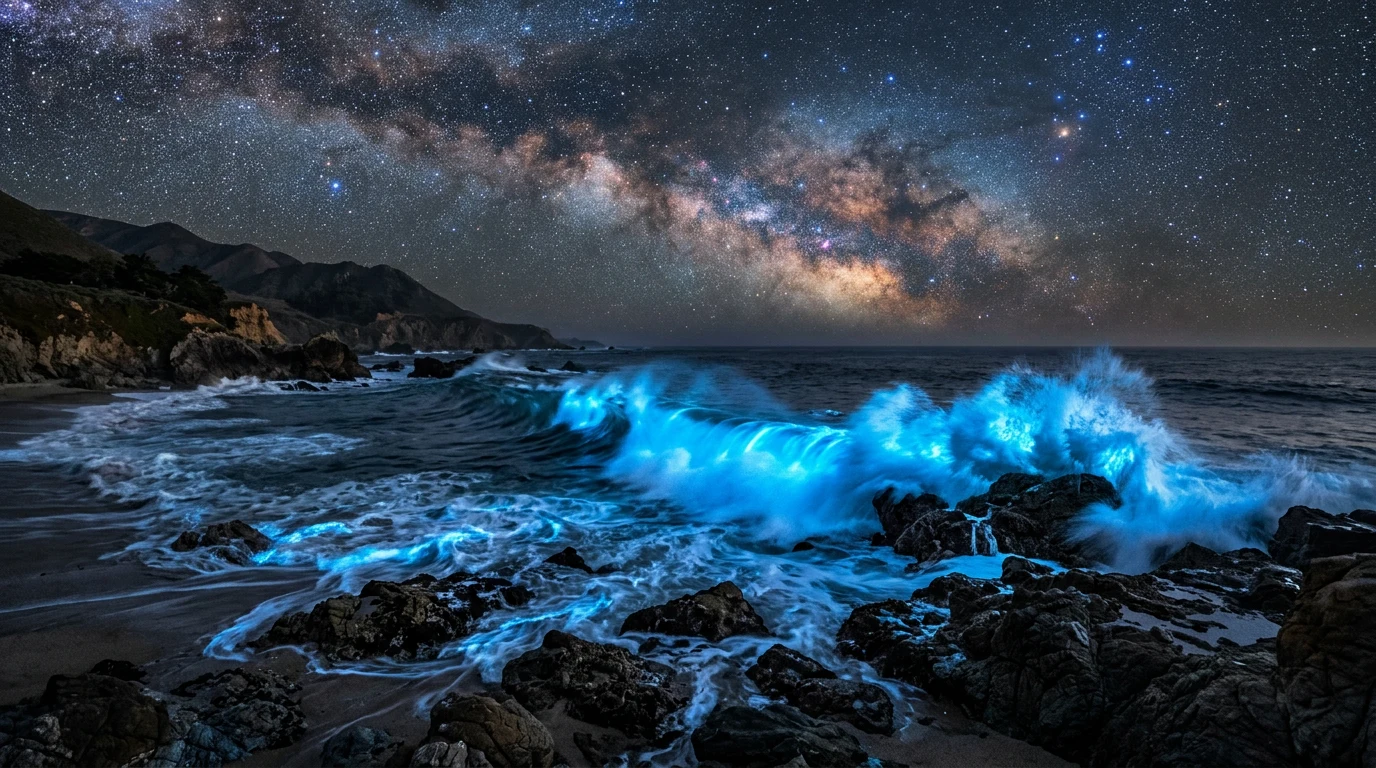
3. The Glowing Ocean: Bioluminescent Shores
Walking along a beach at night and watching the waves glow with a neon blue light feels like stepping into a science fiction film. However, this is one of the most beautiful bizarre natural phenomena found in places like the Maldives, Puerto Rico, and California. The ocean waters light up whenever they are disturbed by waves, boats, or swimmers.
This glowing effect is caused by a massive concentration of microscopic marine organisms known as dinoflagellates. When agitated, these tiny plankton emit a flash of light through a chemical reaction involving a molecule called luciferin. It is a defense mechanism meant to startle predators, but to human eyes, it transforms the nighttime ocean into a breathtaking sea of stars.
4. The Moving Rocks: Sailing Stones of Death Valley
In the dry lakebed of Racetrack Playa in California’s Death Valley, heavy rocks weighing hundreds of pounds seem to move entirely on their own. They leave long, winding trails in the cracked mud behind them. For decades, these sailing stones were counted among the most unexplained bizarre natural phenomena on the planet.
The mystery was finally solved in 2014 when researchers placed GPS trackers on the stones. During winter, a shallow layer of rainwater freezes over the playa. When the morning sun slightly thaws this “windowpane ice,” gentle winds are able to push the floating ice panels—and the heavy stones trapped within them—across the slick mud, leaving behind their iconic tracks once the water evaporates.
5. The Door to the Underworld: Darvaza Gas Crater
Deep in the Karakum Desert of Turkmenistan lies a massive, fiery pit that has been burning continuously for decades. Known locally as the “Gateway to Hell,” the Darvaza Gas Crater is a terrifying spectacle of heat and flame. While it qualifies as one of the world’s most intense bizarre natural phenomena, its origins are partially anthropogenic (human-caused).
In 1971, Soviet engineers were drilling for natural gas when the ground collapsed into an underground cavern, releasing toxic methane. To prevent the deadly gas from spreading to nearby towns, they set it on fire, expecting it to burn out in a few days. More than half a century later, the inferno continues to rage, fueled by a seemingly endless subterranean gas reserve.
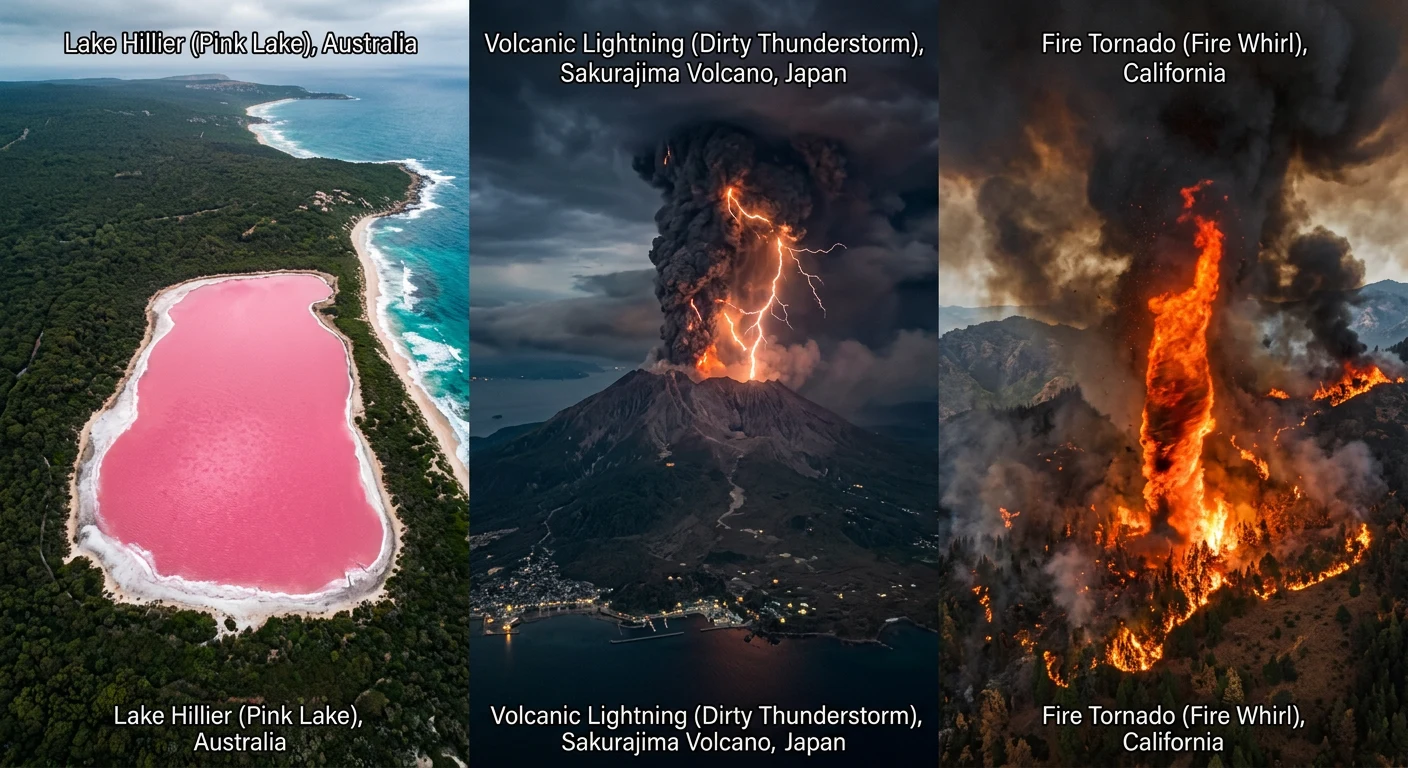
6. The Ash Storm: Volcanic Lightning
A volcanic eruption is formidable enough, but when accompanied by crackling lightning bolts shooting out of the ash cloud, it reaches an apocalyptic level of awe. Termed a “dirty thunderstorm,” volcanic lightning is a premier example of bizarre natural phenomena that combines two deadly forces of nature into one chaotic event.
This phenomenon occurs because the violently erupting ash and rock particles collide with immense friction within the volcanic plume. This rapid collision generates massive amounts of static electricity. Once the charge builds up sufficiently, it releases as a massive web of lightning right inside the suffocating ash cloud, creating a truly terrifying spectacle.
7. The Endless Waves: Morning Glory Clouds
Looking up at the sky in Northern Australia during the transition from dry to wet season, you might witness massive, tube-shaped clouds rolling across the horizon. These roll clouds, known as the Morning Glory, can stretch for up to 600 miles long and travel at speeds of 35 miles per hour. It is one of the most majestic bizarre natural phenomena visible from the ground.
These atmospheric waves are formed when conflicting sea breezes from the Gulf of Carpentaria collide over the Cape York Peninsula. The collision forces moist air upwards to cool and form the cloud, while descending air at the back creates the distinct tubular shape. Glider pilots actually travel to Australia specifically to “surf” the updrafts of these enormous cloud formations.
8. The Polka-Dot Water: Spotted Lake
Located in British Columbia, Canada, the Spotted Lake is a serene body of water in the winter. However, in the height of summer, it undergoes a radical transformation into one of North America’s premier bizarre natural phenomena. As the summer sun evaporates the water, hundreds of circular, colorful pools are left behind, creating a giant polka-dot pattern across the landscape.
This happens because the lake is heavily concentrated with various minerals, including magnesium sulfate, calcium, and sodium sulfates. When the water level drops, these minerals crystallize and form hard natural walkways between the pools. Depending on the specific mineral composition in each pool, the spots can appear yellow, green, or vibrant blue.
9. The Sky’s Canvas: Fire Rainbows
A “fire rainbow” sounds like something out of a fantasy novel, and when you see one, it certainly looks the part. Technically called a circumhorizontal arc, these bizarre natural phenomena appear as massive bands of brilliant rainbow colors painted horizontally across high-altitude clouds. They do not involve fire, nor are they traditional rainbows.
They occur under highly specific parameters: the sun must be very high in the sky (over 58 degrees), and high-altitude cirrus clouds must contain plate-shaped ice crystals aligned horizontally. When sunlight passes through these hexagonal ice crystals, they act like prisms, refracting the light and spreading it into a spectacular, wide spectrum of vibrant colors.
10. The Time Bombs: Frozen Methane Bubbles
During the winter, Lake Abraham in Alberta, Canada, becomes an enchanting landscape filled with what looks like thousands of frozen, glowing orbs trapped just beneath the surface of the ice. While visually stunning, these frozen bubbles are actually highly flammable bizarre natural phenomena waiting to escape into the atmosphere.
These bubbles are pure methane gas. They are created when dead organic matter (like leaves and animals) falls into the lake and is consumed by bacteria at the bottom. The bacteria excrete methane gas, which rises to the top. When the lake freezes over in winter, the bubbles become trapped in suspended animation. As the ice thaws in spring, these volatile bubbles pop, releasing the potent greenhouse gas into the air.
Conclusion
Our world is teeming with incredible secrets. From bleeding Antarctic glaciers to the fiery depths of underground gas craters, these bizarre natural phenomena remind us of the chaotic, beautiful forces shaping our planet.
If you are captivated by the strange wonders of nature, do not forget to read our guide on 10 Beautiful But Deadly Plants You Should Never Touch. Nature is as fascinating as it is perilous, and every geographical anomaly serves to reinforce just how much we still have left to discover.
Frequently Asked Questions
What are bizarre natural phenomena?
Bizarre natural phenomena are unusual, scientifically verifiable occurrences in nature that result from highly specific combinations of geographical, atmospheric, and chemical factors. They often appear unnatural or mysterious to the casual observer.
Where is the best place to see bizarre natural phenomena?
Because bizarre natural phenomena require unique conditions, there is no single best place to find them. However, remote locations like Antarctica, Death Valley, and the untouched wilderness of Canada host some of the most famous global anomalies.
Are bizarre natural phenomena dangerous?
Some are harmless, like bioluminescent shores and sailing stones, while others, like volcanic lightning and methane gas craters, are highly dangerous and deadly to approach without professional safety gear.
For more fascinating discoveries, explore the latest research at National Geographic and Smithsonian Magazine.