
For most of human history, we have placed ourselves on a lonely pedestal, assuming that true cognitive complexity belongs strictly to our own species. But as researchers delve deeper into the natural world, they are uncovering genuine “wow” moments that completely shatter our long-held assumptions.
When you look closely at the evidence, the reality of highly intelligent animal behaviors is far more extraordinary than any science fiction story. From insects doing complex mathematics to marine mammals establishing cultural trends, the line between human and animal cognition is blurring at an astonishing rate.
I was genuinely shocked to learn just how calculated, emotional, and deliberately clever some of these creatures can be, and it completely changed my perspective on the animals we share this planet with.
To understand the full scope of this, you only need to look at the extensive field research published by , which continuously documents species breaking the “rules” of biology.
Why does this list matter? Because recognizing the profound intellect of wildlife challenges us to treat our environment with far more respect. We are finding out that animals don’t just react on base instinct; they plot, they hold grudges, they exhibit empathy, and they even create optical illusions.
Scientists now estimate that certain bird species possess a neuronal density rivaling primates, allowing for incredible problem-solving capabilities in a brain the size of a walnut.
If you enjoyed reading about the bizarre adaptations in our feature on 10 Bizarre Deep Sea Creatures You Won’t Believe Exist, you will be utterly fascinated by the cognitive gymnastics happening right in our backyards.
What Are the Most Surprising Highly Intelligent Animal Behaviors Documented?
The most surprising highly intelligent animal behaviors include crows holding multi-generational grudges, pigs playing joystick video games, honeybees understanding the mathematical concept of zero, and bowerbirds building forced-perspective optical illusions. These astonishing behaviors prove that advanced cognition, tool use, and complex emotional responses are widely distributed across the animal kingdom.
📋 Table of Contents
- Overview of Highly Intelligent Animal Behaviors
- 1. Orcas — Establishing Cultural Fads and Trends
- 2. Prairie Dogs — Their Highly Intelligent Animal Behaviors Include a Complex Language
- 3. Bowerbirds — Masters of Forced-Perspective Optical Illusions
- 4. Crows — Facial Recognition and Multi-Generational Grudges
- 5. Rats — Genuine Empathy and Selfless Rescues
- 6. Octopuses — Highly Intelligent Animal Behaviors Driven by Spite and Mischief
- 7. Pigs — Mastering Joystick-Based Video Games
- 8. Honeybees — Understanding the Mathematical Concept of Zero
- 9. Elephants — Complex Mourning Rituals and Self-Awareness
- 10. Dolphins — Passing Around Toxic Pufferfish to “Get High”
- Frequently Asked Questions
Overview of Highly Intelligent Animal Behaviors Across Species
To truly appreciate the breadth of animal cognition, it helps to see just how wildly these talents vary from species to species. From the deep ocean to the open savanna, advanced intellect manifests in ways uniquely suited to each animal’s survival.
Below is a quick breakdown of the creatures featured on this list, highlighting the specific cognitive skills that have left biologists utterly baffled. What fascinated me most is that these aren’t isolated incidents—they are well-documented, species-wide phenomena.
| # | Animal | Key Cognitive Fact | Scientific Category |
|---|---|---|---|
| 1 | Orcas | Cultural fads and synchronized hunting | Marine Mammals |
| 2 | Prairie Dogs | Complex syntax and descriptive language | Rodents |
| 3 | Bowerbirds | Creating optical illusions to attract mates | Birds (Aves) |
| 4 | Crows | Facial recognition and generational grudges | Corvids |
| 5 | Rats | Demonstrating empathy by freeing companions | Rodents |
| 6 | Octopuses | Tool use, puzzle solving, and spiteful behavior | Cephalopods |
| 7 | Pigs | Understanding abstract on-screen video games | Mammals |
| 8 | Honeybees | Comprehending the concept of zero | Insects |
| 9 | Elephants | Self-recognition in mirrors and deep mourning | Pachyderms |
| 10 | Dolphins | Recreational drug use and sponge tool crafting | Marine Mammals |
1. Orcas — Establishing Cultural Fads and Trends
What fascinated me most about Orcas, commonly known as killer whales, is that they don’t just hunt intelligently—they actually participate in pop-culture fads. In the summer of 1987, a female orca in the Puget Sound area was suddenly spotted carrying a dead salmon on her head like a bizarre aquatic hat.
Within weeks, this utterly pointless, purely aesthetic behavior spread to two other nearby pods. For an entire summer, dozens of orcas were swimming around wearing dead fish as hats. Then, just as quickly as the trend started, it vanished.
This proves a level of cultural transmission and social mimicry previously thought to be exclusive to human teenagers.
Beyond fashion trends, orcas demonstrate staggering tactical brilliance. ” They locate a seal resting on an ice floe, then line up side-by-side and swim forcefully toward the ice, diving at the last possible second. This creates a massive, synchronized wave that literally washes the seal into the waiting mouths of the pod.
Furthermore, mothers spend years actively teaching these specialized techniques to their calves, proving that their knowledge isn’t instinctual—it is learned, passed down, and culturally protected.
2. Prairie Dogs — Their Highly Intelligent Animal Behaviors Include a Complex Language
” I was genuinely shocked to learn that the humble prairie dog possesses what is arguably the most sophisticated animal language ever decoded. Dr. Con Slobodchikoff, a researcher who spent decades analyzing their chirps, discovered that these rodents aren’t just making noise. They are using nouns, verbs, and adjectives.
” It communicates specific sentences describing exactly what the threat looks like.
” If the human changes their shirt color from blue to yellow, the prairie dog changes the specific acoustic structure of its chirp to reflect the new color. They even have distinct sounds to differentiate between a coyote, a domestic dog, a hawk, and a human carrying a gun versus a human with no weapon.
This astonishing level of descriptive syntax rivals the communication skills of early hominids.
3. Bowerbirds — Masters of Forced-Perspective Optical Illusions
In the art world, utilizing forced perspective to manipulate how large or small an object appears is considered a clever, sophisticated technique. I was completely stunned to discover that male great bowerbirds independently invented this architectural trick millions of years ago.
To attract a female, the male builds a complex tunnel-like structure out of twigs, called a bower. He then decorates the courtyard extending outward from the bower using bones, shells, and pebbles. However, he doesn’t just scatter them randomly. He deliberately arranges them in a highly calculated gradient.
The bowerbird places the smallest objects closest to the bower entrance and the largest objects furthest away. Because the female sits inside the bower looking out, this specific arrangement creates a forced-perspective optical illusion.
It makes the courtyard look perfectly uniform in size, and crucially, it makes the male bird standing in the center look significantly larger and more imposing than he actually is.
If a researcher maliciously messes up the arrangement, the bowerbird will meticulously move every single piece back to its correct mathematical position to restore the illusion.
4. Crows — Facial Recognition and Multi-Generational Grudges
It is impossible to discuss highly intelligent animal behaviors without bringing up corvids. The cognitive abilities of crows have fascinated researchers for decades, but one particular experiment at the University of Washington completely changed our understanding of animal memory. Researchers wore specific “caveman” rubber masks while safely trapping and tagging crows.
After releasing the birds, the researchers would occasionally walk across campus wearing those exact same masks. To their shock, the crows recognized the faces and would furiously dive-bomb and scold the masked individuals.
However, the story gets much stranger. Years later, crows that had not even been born when the original trapping took place were joining in on the attacks.
The original crows had communicated the specific visual identity of the “dangerous” mask to their flock, and then passed that grudge down to their children, and even their grandchildren. They had effectively created a generational oral history of an enemy.
Alongside their ability to solve complex multi-step puzzles and bend wire into hook tools, this capacity to hold long-term communal grudges proves their intellect is remarkably close to our own.
5. Rats — Genuine Empathy and Selfless Rescues
Rats have long been viewed as vermin, driven only by an insatiable instinct to feed and breed. Yet, scientific studies consistently reveal a deeply compassionate side to these rodents that rivals human empathy. In a groundbreaking study conducted at the University of Chicago, researchers placed two rats in an arena.
One rat was free to roam, while the other was locked inside a restrictive, transparent acrylic tube. The free rat could hear its cagemate in distress. Without any training or promise of a reward, the free rat would actively work to figure out how to unlatch the door and free its companion.
To make the experiment even more challenging, researchers introduced a second tube containing a highly desirable pile of chocolate chips. The free rat now had a choice: free the companion, or ignore the companion and feast on the chocolate. Astonishingly, the majority of the rats chose to open both tubes.
Even more remarkable, the rescuer rat intentionally saved at least one chocolate chip to share with the newly freed companion. This selfless decision to prioritize a distressed friend over a monopoly on highly-valued food demonstrates a stunning level of emotional intelligence.
6. Octopuses — Highly Intelligent Animal Behaviors Driven by Spite and Mischief
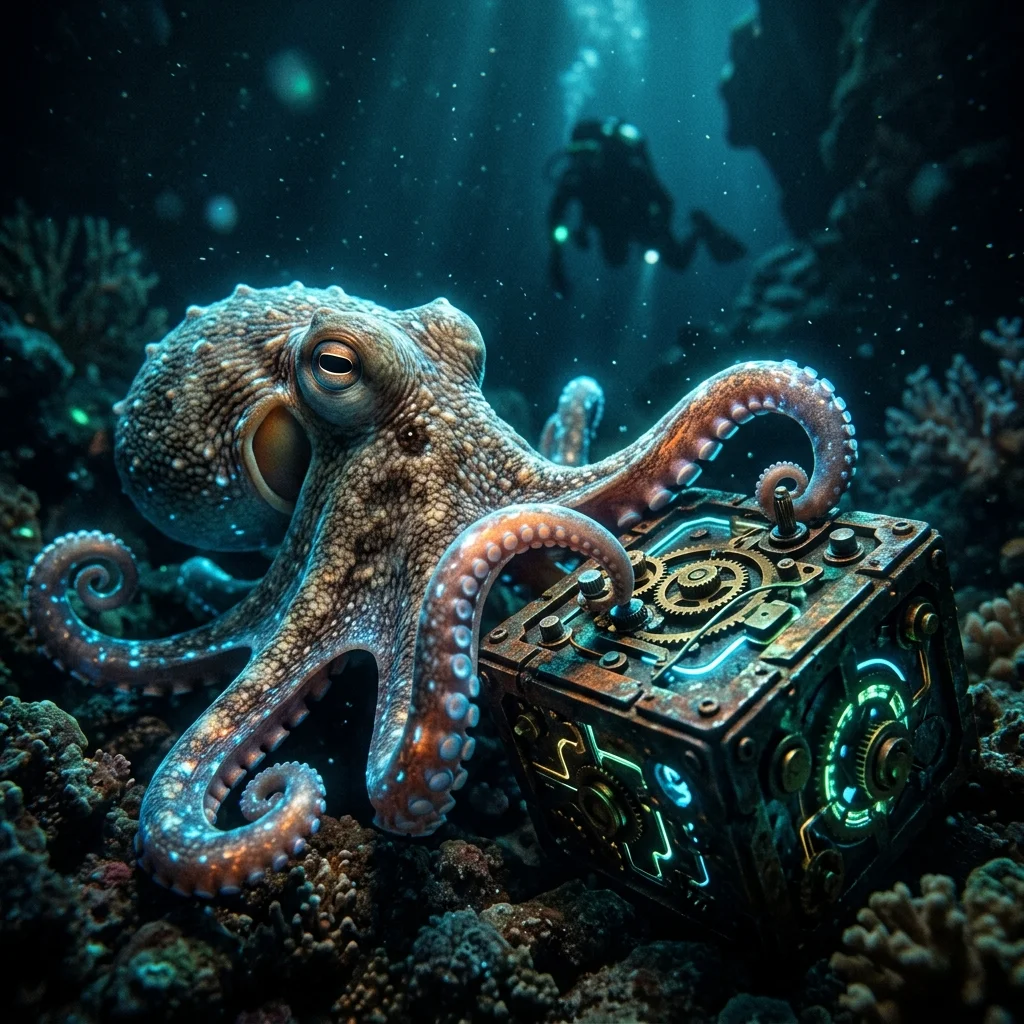
With their brains distributed throughout their eight tentacles, octopuses represent an entirely alien form of intelligence on Earth. They are famous for escaping tightly screwed jars and breaking out of complex aquarium enclosures, but what really amazed me is their profound capacity for mischief and downright spite.
Aquariums around the world have documented octopuses taking a strong, unexplained dislike to specific human staff members. When that particular person walks by the tank, the octopus will accurately shoot a high-pressure jet of freezing water directly at the back of their neck.
Their mischievous intellect extends to their environment as well. In a famous incident at a German aquarium, the electricity kept mysteriously short-circuiting every night, plunging the facility into darkness.
After setting up hidden cameras, staff discovered that an octopus named Otto was intentionally crawling to the top of his tank and squirting water at an overhead halogen lamp. He had figured out that water broke the hot bulb, which shut off the annoying bright lights so he could sleep in peace.
They also frequently observe octopuses punching fish out of pure frustration, exhibiting complex moods and temperaments.
7. Pigs — Mastering Joystick-Based Video Games
If you have ever doubted the mental capacity of livestock, you need to look at a remarkable experiment conducted at Purdue University. Researchers taught four pigs—Hamlet, Omelet, Ebony, and Ivory—to use an arcade-style joystick with their snouts. The pigs were tasked with playing an abstract, cursor-based video game on a digital monitor.
The objective was to move a cursor so that it collided with up to four target walls on the screen. Doing so successfully dispensed a small food pellet reward from a nearby machine.
The implications of this are extraordinary. For a pig to play this game, it must comprehend that its physical manipulation of a joystick directly controls the movement of a digital pixel on a 2D screen—a massive conceptual leap.
Even more incredibly, when the automatic food dispenser broke during the trials, the pigs continued to play the game successfully just for the verbal encouragement and social praise of the researchers. Their performance was well above random chance, proving they possess the visual-motor coordination and abstract conceptualization usually attributed only to non-human primates.
8. Honeybees — Understanding the Mathematical Concept of Zero
Historically, we rarely associate insects with highly intelligent animal behaviors, assuming their actions are entirely governed by robotic, hardwired instinct. However, scientists recently proved that honeybees are capable of understanding one of the most abstract concepts in mathematics: the concept of zero.
Human children usually don’t grasp the idea that “nothing” is a quantifiable numerical value until they are in preschool. Yet, an insect with a brain smaller than a sesame seed can process this complex abstract thought flawlessly.
In a controlled experiment, researchers trained bees to fly toward pieces of paper featuring different numbers of black shapes. They were rewarded with sugar water if they correctly flew to the paper with the lowest number of shapes.
Once the bees understood the rule of “choose the smaller number,” the researchers introduced a completely blank piece of paper—representing zero. Astoundingly, the bees consistently chose the blank paper over a paper with just one shape.
They independently recognized that “zero” was a numerical value smaller than “one,” showcasing a level of brainpower that completely upends our understanding of insect cognition.
9. Elephants — Complex Mourning Rituals and Self-Awareness
The saying “an elephant never forgets” barely scratches the surface of their mental capabilities. Elephants are one of the very few species on Earth to consistently pass the mirror self-recognition test.
When researchers secretly placed a white X on an elephant’s forehead, the animal walked up to a mirror, recognized the reflection as itself, and immediately used its trunk to touch the white mark on its own head.
This proves they possess a sophisticated sense of self and an internal consciousness, distinguishing their own bodies from the rest of the world.
But what truly demonstrates their incredible intelligence is how they process grief and loss. Elephants show a profound fascination with the skeletal remains of their own species. If a herd comes across the bones of an elephant—even one completely unrelated to them—they will stop in silence.
They gently stroke the bones, particularly the tusks and skulls, with their trunks in a ritualistic manner. Matriarchs have been observed leading their families on vast detours simply to visit the exact spot where a loved one died years earlier. It is an undeniable display of emotional depth and historical memory.
10. Dolphins — Passing Around Toxic Pufferfish to “Get High”
Dolphins have long been celebrated for their intelligence, specifically their use of tools—like breaking off marine sponges to protect their snouts while foraging in sharp coral. However, documentary crews for captured a completely unexpected behavior that reveals just how close to human nature they actually are.
Teenage dolphins were caught on film intentionally seeking out toxic pufferfish. Rather than trying to eat the fish, they very gently squeezed it in their mouths.
Pufferfish defend themselves by releasing a highly potent neurotoxin. In large doses, it is fatal. But in very small, controlled doses, the toxin induces a narcotic state.
The young dolphins were observed carefully chewing the pufferfish just enough to release a tiny amount of toxin, and then passing the fish around their social circle like a joint. Afterward, the dolphins were seen floating in a trance-like state right at the water’s surface, mesmerized by their own reflections.
Engaging in recreational drug use for social bonding shows a level of curiosity and boundary-pushing that continues to shock marine biologists.
Final Thoughts on These Highly Intelligent Animal Behaviors
Diving into the world of animal cognition has been an eye-opening journey. Honestly, I find it incredibly humbling to realize that the behaviors we prize as strictly “human”—from empathy and abstract mathematics to holding grudges and creating art—are thriving all around us in the wild.
Studying highly intelligent animal behaviors forces us to abandon our ego and look at nature with a profound new level of respect.
If a bird can create optical illusions and a tiny honeybee can grasp the concept of zero, it makes you wonder what else is happening in the natural world that we simply haven’t noticed yet.
If you are captivated by these bizarre biological quirks, you might also find yourself intrigued by the darker side of nature in our look at 10 Terrifying Mind-Controlling Parasites That Actually Exist. Which one of these brilliant animals shocked you the most? Drop a comment below!

Written by the List of Ten Team
We research and verify every fact in our lists using peer-reviewed sources, official records, and expert interviews. Our goal: content that genuinely surprises and educates curious readers worldwide.
🕒 Last updated: 2026-05-18 — Facts verified and list reviewed for accuracy.
Frequently Asked Questions
Why do scientists study highly intelligent animal behaviors?
Scientists document highly intelligent animal behaviors to better understand the evolutionary origins of human cognition. By studying how animals like crows or dolphins solve problems, biologists can map out how intelligence develops across different branches of the evolutionary tree and learn more about brain elasticity.
Can animals actually learn human language?
While animals cannot speak complex human languages due to anatomical differences in their vocal cords, many species can learn human syntax. Apes like Koko the gorilla mastered sign language, and dogs can routinely learn hundreds of vocabulary words, demonstrating a deep comprehension of our communications.
What is considered the smartest animal in the world?
Intelligence is difficult to rank because different species are specialized for their environments. However, chimpanzees, dolphins, elephants, and crows are consistently ranked at the top. Chimpanzees excel at tool use and memory puzzles, while dolphins possess incredible social intelligence and communication skills.
Do animals actually experience human-like emotions?
Yes, extensive research confirms that many animals experience a vast array of emotions including grief, joy, frustration, and empathy. Elephants visibly mourn their dead, rats will sacrifice treats to save their friends, and dogs experience significant spikes in oxytocin (the “love hormone”) when interacting with their owners.
For more on this topic, visit National Geographic and Smithsonian Magazine.