
The universe is vastly more bizarre, expansive, and terrifying than the human brain evolved to comprehend. From the invisible forces binding atomic nuclei to the monstrous gravitational wells of dead stars, our reality is built upon a foundation of mind-blowing scientific concepts that sound closer to science fiction than actual peer-reviewed physics.
As our telescopes peer further into the cosmic dark and our particle accelerators smash matter at light speed, we continue to uncover truths about our existence that shatter everything we thought we knew about the rules of nature. Finding the boundaries of our universe requires looking beyond simple mechanics and diving headfirst into the impossible.
org, the scale of these mind-blowing scientific concepts will force you to question your place in the cosmos. Some of these phenomena are theoretical structures mathematically guaranteed to exist, while others are cosmic engines currently raging in the vast void of space.
If you’ve previously marveled at terrifying space facts, strap in. We are about to explore ten ideas that will permanently alter how you perceive the flow of time, the structure of space, and the ultimate destiny of humanity.
What are the most mind-blowing scientific concepts in modern physics?
The most mind-blowing scientific concepts in modern physics include string theory, supermassive black holes, wormholes, and the Fermi paradox. These ideas challenge our fundamental understanding of time, space, and existence, suggesting that reality is far stranger and more complex than what human perception allows us to see on Earth.
Comparing the Scale of Mind-Blowing Scientific Concepts
Before diving into the detailed breakdown of these mind-blowing scientific concepts, it helps to understand exactly what kind of scale we are dealing with. Some of these theories dictate the behavior of the universe at a subatomic scale, while others govern the macro-architecture of entire galactic superclusters. Let’s look at the data:
| Concept | Primary Domain | Scale of Impact | Current Status |
|---|---|---|---|
| String Theory | Quantum Physics | Subatomic | Theoretical |
| Supermassive Black Holes | Astrophysics | Galactic | Proven / Observed |
| Wormholes (Einstein-Rosen) | Relativity | Universal | Mathematical Reality |
| Dyson Spheres | Astroengineering | Stellar | Hypothetical Future Tech |
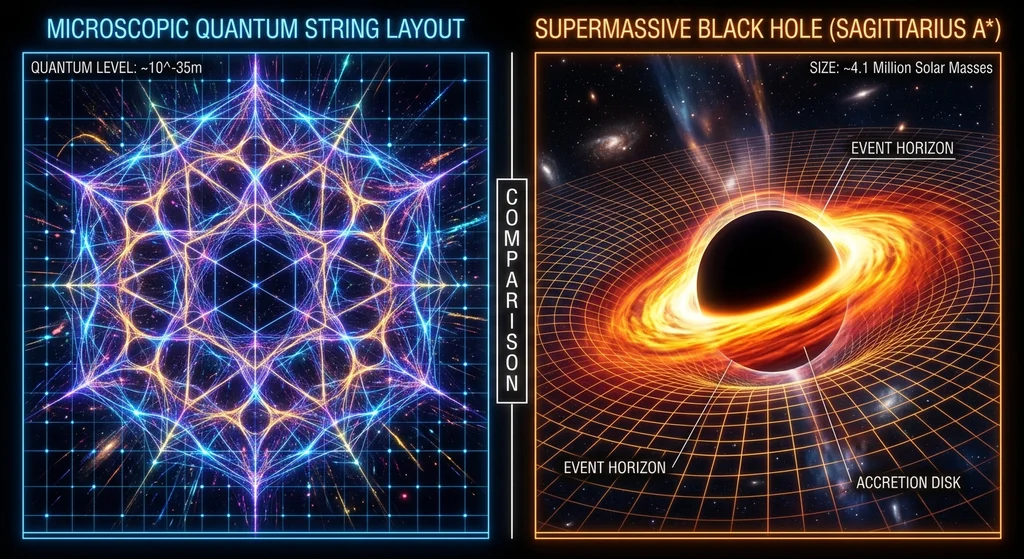
As illustrated in the chart, the pursuit of these mind-blowing scientific concepts requires physicists to seamlessly transition between the impossibly small and the impossibly large. Here is our breakdown of the top ten concepts that will completely flip your perspective of the world.
1. String Theory: The Symphony of the Universe
For decades, physicists have been trying to bridge the gap between quantum mechanics (how tiny things work) and general relativity (how massive things work). One of the most fascinating and mind-blowing scientific concepts attempting to solve this is String Theory. Instead of viewing elementary particles as tiny dots, String Theory proposes that the fundamental ingredients of the universe are unimaginably small, vibrating loops of energy called strings.
Depending on how these strings vibrate, they manifest as different particles—just as different vibrations on a violin string produce different musical notes. For the math of String Theory to work, the universe cannot simply have three dimensions of space and one of time. It requires at least ten dimensions, with the extra six being curled up so tightly that we cannot perceive them.
2. Supermassive Black Holes: The Monsters at the Center
Black holes are undeniably one of the most terrifying and mind-blowing scientific concepts humans have ever confirmed. Created when massive stars collapse under their own gravity, black holes are regions of space where the gravitational pull is so intense that nothing—not even light—can escape once it crosses the event horizon. Time literally slows down the closer you get to this cosmic trap.
But supermassive black holes take this nightmare to a whole new level. Residing at the center of almost every large galaxy, including our own Milky Way, these titans contain the mass of millions or even billions of suns. The sheer gravitational dominance of a supermassive black hole is what anchors entire galaxies, keeping billions of stars locked in a slow, cosmic orbit over billions of years.
3. Neutron Stars: The Densest Matter in Reality
When a massive star goes supernova, but isn’t quite massive enough to form a black hole, it leaves behind a neutron star. This is where the laws of physics are pushed to their absolute breaking point. A neutron star packs the mass of our Sun into a sphere no larger than a typical Earth city, around 12 miles across. The gravity crushes atoms so fiercely that protons and electrons fuse into pure neutrons.
These stellar corpses spin at dizzying speeds, sometimes rotating hundreds of times per second. Their magnetic fields are trillions of times stronger than Earth’s. If you were to drop an object from just one meter above the surface of a neutron star, it would accelerate so fast that it would hit the surface at millions of miles per hour. Truly, this is one of the most mind-blowing scientific concepts visible in the night sky.
4. Wormholes: The Cosmic Shortcuts
Einstein’s theory of general relativity allows for the existence of Einstein-Rosen bridges, better known to the public as wormholes. Out of all the mind-blowing scientific concepts debated by theoretical physicists, the idea that the fabric of space-time can be folded to connect two infinitely distant points is perhaps the most exciting for the future of interstellar travel. Imagine folding a piece of paper in half and punching a pencil through it—that is a wormhole.
However, mathematical models suggest that wormholes would be incredibly unstable. The moment they form, gravity would cause them to collapse instantly. Keeping a wormhole open would require “exotic matter” with negative mass, a substance we have yet to discover. Despite the hurdles, the math absolutely permits them, making wormholes a tantalizing cosmic possibility.
5. The Dyson Sphere: Harvesting the Stars
As human civilization advances, our energy needs will eventually exceed the output of planet Earth. Enter the Dyson Sphere, a hypothetical megastructure that completely encompasses a star to capture a large percentage of its solar power output. Conceptualized by physicist Freeman Dyson, this is a prime example of engineering mind-blowing scientific concepts that could define the ultimate endgame of an advanced civilization.
Instead of a solid shell, a more realistic approach would be a “Dyson Swarm,” an immensely complex network of millions of solar satellites orbiting the star in tight formation. Building this would require tearing apart planets for raw materials. If humanity ever hopes to conquer the galaxy, constructing a Dyson Sphere will likely be our mandatory first step to achieving infinite energy.
6. The Fermi Paradox: The Great Cosmic Silence
With billions of stars in our galaxy alone, many orbited by Earth-like planets, mathematical probability dictates that intelligent life should be abundant. Yet, when we point our telescopes at the cosmos, we hear absolutely nothing. This terrifying contradiction is known as the Fermi Paradox, and it remains one of the most philosophical and mind-blowing scientific concepts in astronomy.
There are many dark explanations for this silence. Perhaps there is a “Great Filter”—a catastrophic evolutionary hurdle that almost all civilizations fail to pass, resulting in their extinction. Alternatively, advanced civilizations might intentionally hide from cosmic predators, or we might simply be the very first intelligent species in the universe to reach this level of technology. The implications of the silence are deeply unsettling.
7. Red Dwarfs: The Last Stars Burning
When you look at the night sky, almost all the stars you see are incredibly massive and bright. However, they are entirely unrepresentative of the universe. Up to 75% of all stars in existence are Red Dwarfs—tiny, dim, and incredibly resilient engines. Exploring the lifespan of these stars introduces mind-blowing scientific concepts regarding the distant future of the universe.
Unlike massive stars that burn through their fuel in a few million years, Red Dwarfs burn so slowly and efficiently that a single one can shine for up to ten trillion years. Long after our Sun expands into a red giant and dies, and long after the era of bright galaxies is over, Red Dwarfs will be the final glowing embers of warmth in an increasingly dark, expanding universe.
8. The Illusion of Time: The Block Universe Theory
We experience time as a flowing river, constantly moving from the past, through the present, and into the future. But according to Einstein’s theories of relativity, this perception is a stubborn illusion. In physics, one of the most jarring mind-blowing scientific concepts is the “Block Universe” theory, which suggests that the past, present, and future all exist simultaneously in a massive, four-dimensional block of spacetime.
Because the speed of light is absolute and time is relative, observers moving at different speeds will disagree on the order of events. From the universe’s perspective, your birth, your current reading of this article, and the end of the world are all occurring at the same “time” mathematically. Our consciousness simply moves through this block, experiencing events sequentially.
9. Asteroid Mining: The Trillion-Dollar Frontier
While many of these ideas are deeply theoretical, asteroid mining is one of the mind-blowing scientific concepts that will likely become reality in our lifetimes. Earth’s resources are rapidly depleting, but space is infinitely abundant. The asteroid belt between Mars and Jupiter holds untold wealth, composed of iron, nickel, water, and precious metals like platinum and gold.
Extracting these resources and bringing them to Earth—or using them to build space stations in orbit—would entirely revolutionize human economics. A single metal-rich asteroid could contain more precious metals than have ever been mined in human history. The first entity to successfully establish an asteroid mining operation will likely trigger an economic paradigm shift unseen since the Industrial Revolution.
10. Space Elevators: The Stairway to the Stars
Escaping Earth’s gravity with chemical rockets is wildly expensive and deeply inefficient. The ultimate solution is the Space Elevator, a towering tether stretching from the Earth’s equator all the way up to a counterweight past geostationary orbit. It stands as one of the greatest mind-blowing scientific concepts in engineering, promising to reduce the cost of space travel from thousands of dollars per kilogram to mere pennies.
The problem? The materials needed to build a 22,000-mile-long cable must be incredibly strong yet lightweight. Standard steel would snap under its own weight instantly. Currently, scientists look toward carbon nanotubes or graphene as the only known materials theoretically capable of surviving the immense tension. Once built, humanity will truly become a space-faring species.
Conclusion: The Endless Pursuit of Truth
Our journey through these mind-blowing scientific concepts highlights how remarkably strange reality truly is. From the vibrating strings of quantum physics to the world-ending mass of a supermassive black hole, human logic is constantly tested by the very universe we inhabit. We are standing on the precipice of technological and cosmological breakthroughs that will make the 21st century the most exciting era in human history.
If these ideas have pushed the boundaries of your imagination, you are not alone. Exploring the universe forces us to confront our own insignificance while simultaneously highlighting the absolute brilliance of the human mind. If you want to dive deeper into the rabbit hole of reality-breaking phenomena, you should definitely read up on the mind-blowing paradoxes that continue to keep quantum physicists awake at night.
Frequently Asked Questions (FAQ)
What are the most fascinating and mind-blowing scientific concepts currently being researched?
Currently, the most heavily researched mind-blowing scientific concepts include quantum entanglement, dark matter, dark energy, and the unified theory of physics (String Theory). Scientists are aggressively using tools like the James Webb Space Telescope and the Large Hadron Collider to decode these mysteries.
Are wormholes mathematically proven to exist?
Yes, the mathematics of general relativity allow for the existence of wormholes (Einstein-Rosen bridges). However, they have never been observed in reality, and creating or sustaining one would require hypothetical negative mass energy, which remains purely theoretical at this point in modern physics.
Could a Dyson Sphere actually be built by humans?
Building a full Dyson Sphere around our Sun is currently impossible with modern technology and would require completely disassembling planets like Mercury and Venus for raw materials. However, a less dense “Dyson Swarm” of solar satellites is a highly plausible long-term goal for an advanced future human civilization.
Why is the Fermi Paradox considered so terrifying?
The Fermi Paradox is terrifying because it implies a “Great Filter”—a catastrophic event or evolutionary barrier that prevents advanced civilizations from expanding through the galaxy. If this filter exists, it means humanity either miraculously survived it in our past, or it awaits us in our near future.
For more on this topic, visit National Geographic and Smithsonian Magazine.