
If you’re anything like me, you probably think you have a pretty good handle on how the physical world works. Water flows downward, fire burns orange, and lakes don’t instantly turn animals to stone.
But while going down a massive internet rabbit hole recently, I discovered that there are a handful of places that defy the laws of nature so aggressively, they’ll make you question reality. I was genuinely shocked to learn that some of these locations haven’t just baffled everyday travelers, but have left top-tier geologists scratching their heads for decades.
Our planet is hiding some truly bizarre secrets. ” But they are very real, and they perfectly complement some of the alien-like places on Earth we’ve talked about before. From a river that literally boils its victims alive to a frozen glacier that bleeds red, the planet we live on is a lot weirder than we give it credit for.
National Geographic has some brilliant extensive research. But for now, let’s jump right into the strangest spots on the globe.
How Do These Weird Locations Even Exist?
These locations exist due to rare combinations of extreme geological, chemical, and atmospheric conditions. From highly concentrated mineral deposits and hyper-alkaline waters to exposed geothermal vents and subglacial volcanic activity, Earth’s most bizarre environments are created when natural forces interact in isolated, highly specific ways.
The Ultimate Natural Wonders Comparison
| Location | Country | Bizarre Phenomenon |
|---|---|---|
| Blood Falls | Antarctica | Bleeding rust-red water from a glacier |
| Lake Natron | Tanzania | Alkaline water that calcifies animals |
| Kawah Ijen | Indonesia | Volcano that erupts neon blue fire |
| Darvaza Crater | Turkmenistan | A fiery pit burning since 1971 |
1. Blood Falls, Antarctica
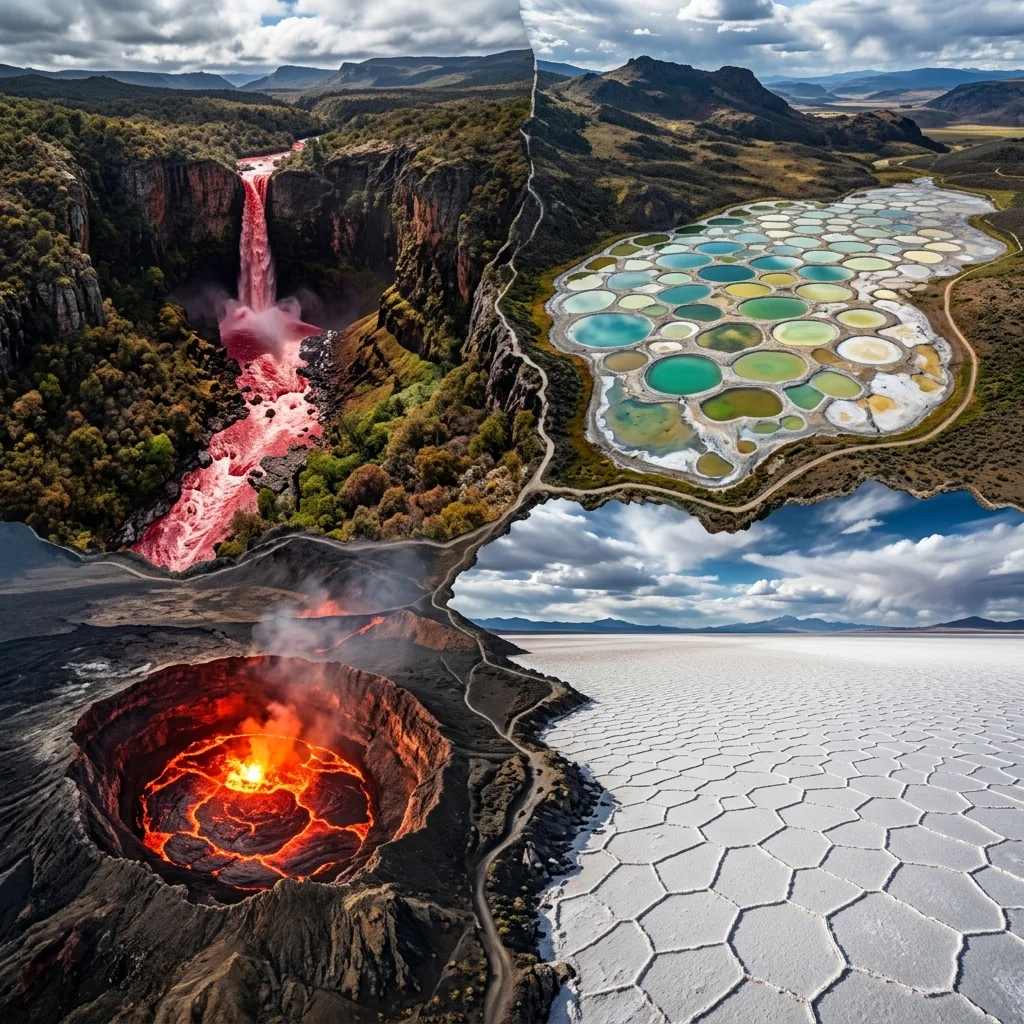
When I first saw a picture of Blood Falls, I honestly thought it looked like a crime scene from a horror movie. Imagine a pristine, stark white Antarctic glacier slowly oozing a thick, blood-red liquid down its icy face into the ocean.
Discovered in 1911 by an Australian geologist, it took scientists decades to figure out exactly what was happening here. Originally, they thought red algae was responsible for the gruesome coloring, but the truth is actually much cooler—and much weirder.
What fascinated me most is that the “blood” is actually hyper-saline water rich in iron. Deep beneath the Taylor Glacier lies a massive, ancient subglacial lake that has been sealed off from light and oxygen for over a million years. When this extremely salty, iron-rich water finally squeezes its way through fissures in the ice and hits the open air, the iron instantly oxidizes.
Basically, the glacier is rusting. It’s a completely mind-blowing display of chemistry happening in one of the most inhospitable environments on Earth.
2. The Boiling River of the Amazon
Deep in the Peruvian Amazon lies a river that literally cooks anything that falls into it. Known by locals as Shanay-Timpishka (which roughly translates to “boiled with the heat of the sun”), this is an anomaly that left even seasoned geologists baffled. Normally, a river this hot would need to be located right next to an active volcano. The catch? The nearest active volcano is more than 400 miles away.
I was totally hooked when I read about how this river actually functions. The water temperature routinely hits 200°F (93°C), which is hot enough to instantly kill and boil frogs, rodents, and insects that accidentally slip in. Scientists believe the water is heated deep underground by the earth’s geothermal gradient, then thrust up to the surface through fault lines at terrifying speeds. It’s essentially a massive, natural pressure cooker hidden in the jungle.
3. Mount Roraima, Venezuela
If you’ve ever seen the Pixar movie *Up*, you already know what Mount Roraima looks like. This massive “tepui” (table-top mountain) rises straight up out of the jungle floor like a giant stone altar. Its sheer vertical cliffs are over 1,300 feet high, completely cutting off the summit from the forest below. When you look at it, it genuinely feels like gravity forgot to pull the top of the mountain down.
Because the summit has been physically isolated for millions of years, evolution just took its own weird path up there. It has an entirely unique ecosystem. Walking on top of Roraima is like walking on another planet—the landscape is littered with bizarre rock formations, carnivorous pitcher plants, and tiny black frogs that roll into balls and bounce away when threatened. It is one of the few places on Earth where humans truly feel like alien invaders.
4. Lake Natron, Tanzania
This one surprised even me. Lake Natron sounds like something pulled straight out of Greek mythology—a lake that turns living creatures into stone. While that sounds like an exaggeration, it’s uncomfortably close to the truth. The lake is filled with natron, a natural compound composed mainly of sodium carbonate, which makes the water highly alkaline and incredibly corrosive.
The pH of the water can reach up to 10.5, which is close to the chemical makeup of household ammonia. If a bird or bat crashes into the lake, the extreme chemicals burn their skin and eyes. When the animals inevitably die and wash ashore, the salts in the water perfectly calcify their bodies, preserving them in horrifying, statue-like poses. Despite this deadly environment, it is paradoxically the only regular breeding area for East Africa’s 2.5 million Lesser Flamingos.
5. The Richat Structure, Mauritania
Also known as the “Eye of the Sahara,” the Richat Structure is a massive bullseye pattern in the middle of the desert that you can only fully appreciate from outer space. In fact, astronauts use it as a visual landmark because it stands out so vividly against the barren landscape of Mauritania. For a long time, scientists assumed it was the impact crater from a massive asteroid because of its perfect circular shape.
However, what blew my mind is that it’s actually a geological dome that was formed by magma swelling under the Earth’s crust over 100 million years ago. As the dome rose, wind and water eroded the top away like layers of an onion, exposing concentric rings of different rock types.
It looks like a giant, ancient crop circle made of stone. Some internet sleuths even try to claim it’s the lost city of Atlantis, but geologists assure us it’s just nature flexing its artistic muscles.
6. Spotted Lake, Canada
If you drive through the Okanagan Valley in British Columbia during the winter, Spotted Lake (Khiluk) looks like any other ordinary body of water. But if you visit during the scorching heat of summer, the lake undergoes a transformation that makes it look like a giant sheet of polka-dotted bubble wrap. As the water evaporates, it leaves behind hundreds of massive, colorful pools separated by natural walkways of crystalized minerals.
The colors of the spots—ranging from yellow and green to bright blue—depend on the specific mineral concentration in that particular pool. The lake contains some of the highest quantities of magnesium sulfate, calcium, and sodium sulfates in the world. It’s an incredibly striking visual reminder of the dense chemicals hiding just beneath the surface of the water we usually take for granted.
7. Cave of the Crystals, Mexico
Buried 1,000 feet beneath the town of Naica in Mexico lies a cavern that looks like Superman’s Fortress of Solitude. The Cave of the Crystals was discovered entirely by accident by miners in the year 2000. When I first saw footage of this place, I thought it had to be a movie set. The cavern is crisscrossed with colossal, glowing selenite gypsum crystals that dwarf the human explorers standing next to them.
But the true mind-bending part of this cave isn’t just its size—it’s the extreme danger. The cave is situated directly above an underground magma chamber. The ambient air temperature inside hovers around 136°F (58°C) with 90 to 99 percent humidity. Without specialized cooling suits, a human can only survive inside the cave for about 10 minutes before their internal organs begin to fail. According to the Smithsonian, these massive pillars took over 500,000 years to grow in mineral-rich, hyper-heated water.
8. Kawah Ijen Volcano, Indonesia
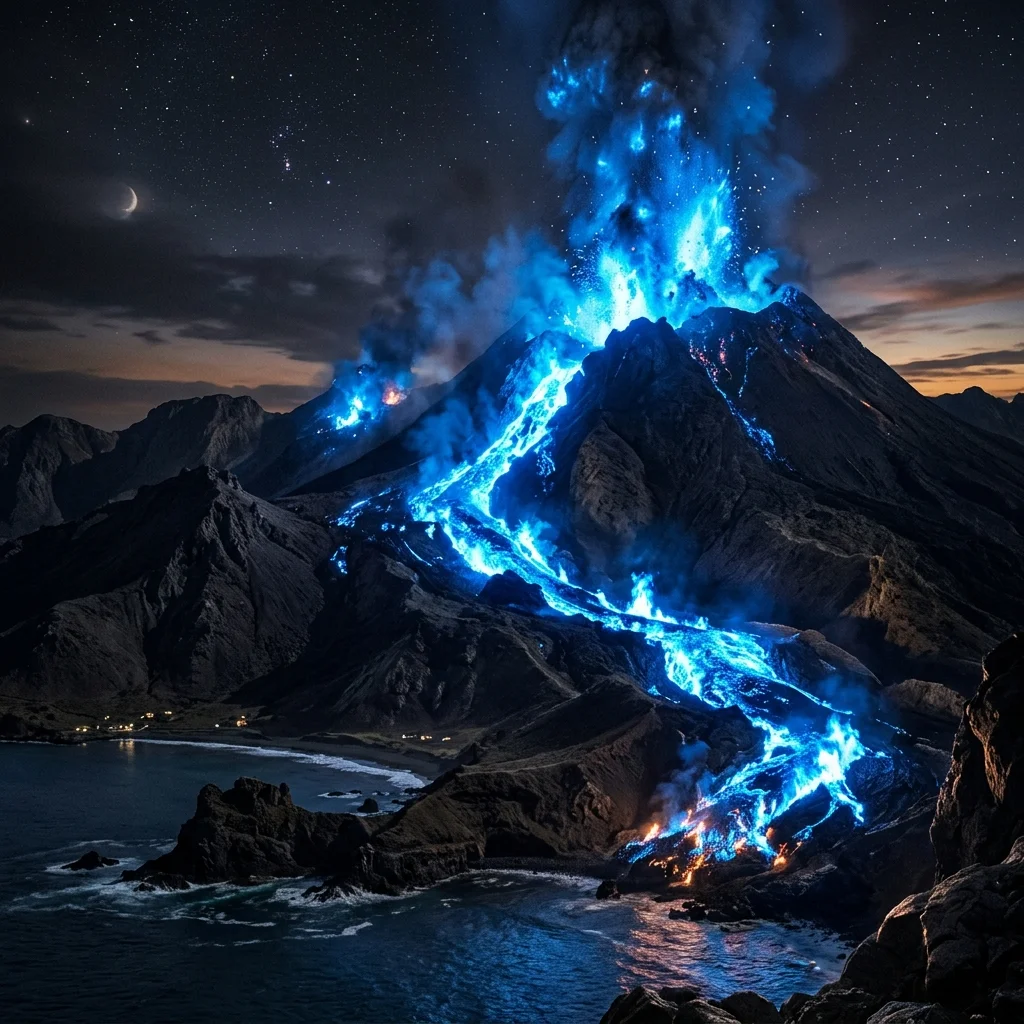
Volcanoes are already terrifying, but a volcano that erupts glowing blue fire takes things to an entirely different level. Located on the island of Java in Indonesia, Kawah Ijen is famous for its mesmerizing, neon-blue flames that ignite at night. While it looks like the volcano is erupting blue lava, the truth is actually a bizarre chemical reaction.
The volcano emits insanely high levels of sulfuric gas alongside the molten rock. When these highly pressurized, super-heated gases (reaching up to 1,112°F / 600°C) hit the oxygen-rich air, they instantly ignite. The result is flames that shoot up to 16 feet into the night sky, giving the illusion of electric-blue lava flowing down the mountain. It’s beautiful, but breathing in the fumes is incredibly toxic.
9. Darvaza Gas Crater, Turkmenistan
Appropriately nicknamed the “Gates of Hell,” the Darvaza Gas Crater is a 226-foot-wide burning sinkhole in the middle of the Karakum Desert. What makes this place so fascinating is that it isn’t entirely natural—it’s the result of a colossal human mistake colliding with the laws of nature. In 1971, Soviet engineers were drilling for oil when the ground beneath their rig suddenly collapsed into a massive cavern filled with natural gas.
Fearing that the poisonous methane gas would spread to nearby towns, the geologists made a fateful decision: they set it on fire, expecting it to burn out in a few weeks. Well, nature had other plans. That was over 50 years ago, and the crater is still burning brightly today. The intense heat radiates so strongly that you can feel it from the edge of the crater, creating an apocalyptic glow that lights up the desert sky for miles.
10. The Hessdalen Lights, Norway
Our final entry is something that literally happens right in front of scientists’ eyes, yet they still cannot fully explain it. For nearly a century, residents of the remote Hessdalen valley in Norway have reported seeing massive, unexplained orbs of light floating in the sky. Sometimes they are white, sometimes yellow or red. They can hover completely still for over an hour, dart around wildly, or shoot across the sky at impossible speeds.
While UFO hunters naturally went crazy over this, scientists have set up permanent monitoring stations to study the phenomena. The prevailing theory is that the valley itself acts like a giant, natural battery. The local rocks are incredibly rich in zinc and copper on one side of the river, and iron on the other.
Combined with sulfuric acid leaching from old mines, researchers believe the valley might be naturally generating massive sparks of atmospheric plasma. It’s a stunning reminder that Earth still has plenty of secrets.
Our planet is undeniably a masterpiece of extreme geology, chemistry, and physics. Whether it’s a glacier bleeding rust or an underground cavern so hot it could kill you in minutes, these environments remind us how tiny and fragile we really are. Which of these places that defy the laws of nature would you actually want to visit?
For me, checking out the blue flames of Kawah Ijen is definitely on the bucket list. If you loved these weird natural phenomena, you should definitely check out our guide on beautiful but deadly plants you should never touch—nature is just full of dangerous surprises!
Frequently Asked Questions
Can you safely visit the Boiling River in the Amazon?
Yes, you can visit the Boiling River, but it requires a guided tour. Tourists must stay safely on designated paths, as a single slip into the 200°F water is fatal. Swimming is strictly prohibited in the active boiling zones.
Why don’t the flamingos die in Lake Natron?
Lesser flamingos have evolved incredibly tough, leathery skin on their legs that protects them from the highly corrosive alkaline water. The harsh environment actually helps them by keeping predators away from their nests.
Will the Darvaza Gas Crater ever stop burning?
Eventually, the natural gas supply feeding the crater will be depleted, but geologists cannot accurately predict when. The Turkmenistan government has also discussed plans to artificially extinguish the crater to harvest the remaining gas.