
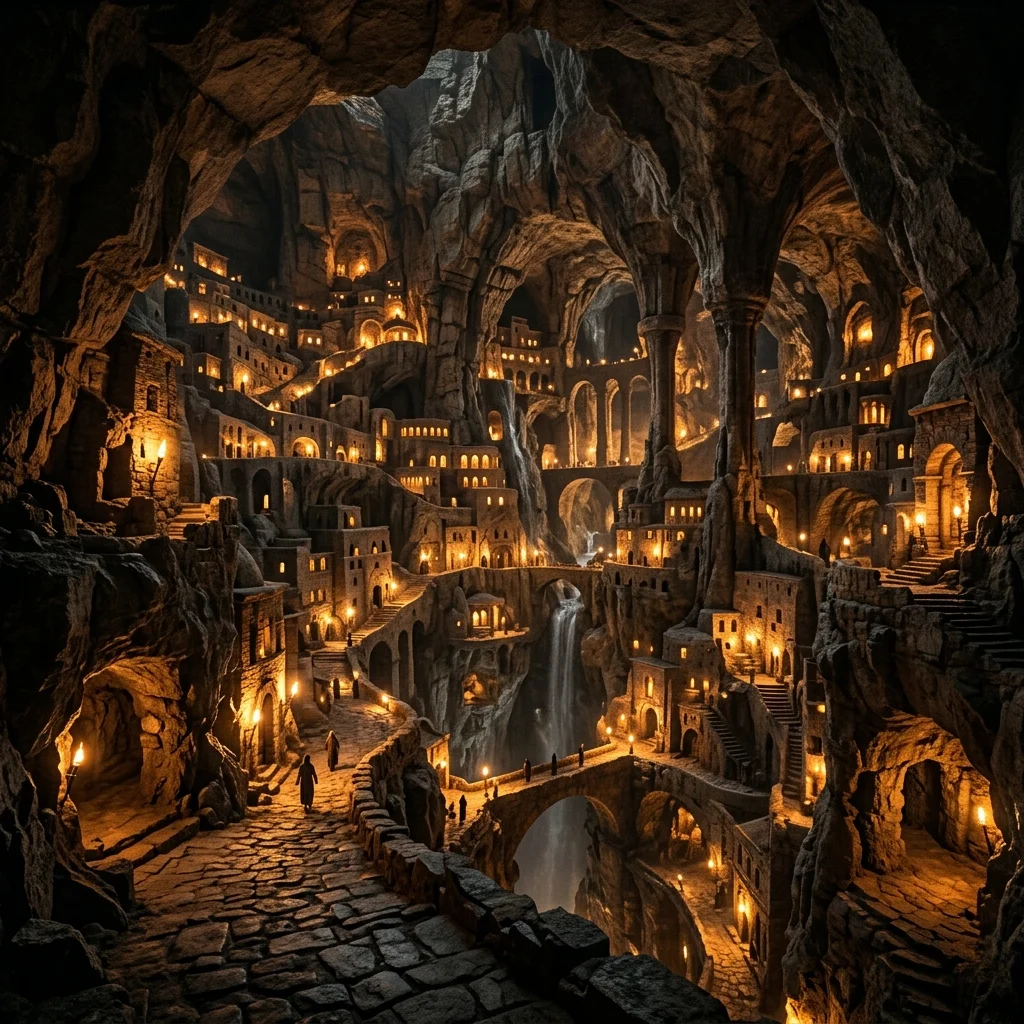
I remember the exact moment I realized that human civilization doesn’t just scrape the sky—it burrows deep into the earth. I was reading up on ancient survival tactics when I stumbled upon the fact that millions of people throughout history have quite literally taken their entire lives below the surface. Before digging into the research for these incredible underground cities, I genuinely thought subterranean living was something reserved for science fiction movies, survivalist bunkers, or perhaps the odd subway system.
I couldn’t have been more wrong. Our ancestors—and even modern engineers—have built massive, fully functioning metropolises completely shielded from the sun.
What fascinated me most about these hidden realms is how vastly different they all are. Some were carved out by ancient civilizations desperate to escape invading armies, while others were constructed in the 20th century to survive blistering heat or freezing winters. com National Geographic, the sheer engineering required to ventilate and support these massive subterranean structures defies belief.
I was genuinely shocked to learn that one man even discovered a massive ancient city just by knocking down a wall in his basement! If you are captivated by things hidden from plain sight, much like those 10 Forbidden Places You Are Not Allowed To Visit, you are going to absolutely love exploring these hidden worlds with me.
What Are The Most Incredible Underground Cities Ever Built?
The most incredible underground cities in the world include Derinkuyu in Turkey, which could house up to 20,000 people across 18 levels, and Montreal’s Underground City (RESO) in Canada, a modern network stretching over 32 kilometers. These subterranean marvels feature complex ventilation shafts, living quarters, chapels, and full commercial centers built entirely beneath the surface.
Comparing Our Hidden Subterranean Wonders
Before we dive deep into the darkness to explore each of these fascinating locations in detail, I’ve put together a quick comparison. This helps put into perspective just how varied these underground settlements actually are. From freezing Canadian winters to the scorching Australian outback, humanity’s drive to survive knows no bounds.
| City Name | Location | Depth/Size | Primary Purpose |
|---|---|---|---|
| Derinkuyu | Turkey | 85 Meters Deep | Defense / Refuge |
| Coober Pedy | Australia | Town-Wide | Heat Protection |
| Montreal RESO | Canada | 32 km Network | Weather Escape |
| Wieliczka Mine | Poland | 327 Meters Deep | Salt Mining |
| Dixia Cheng | China | 30 km Network | Cold War Bunker |
1. Derinkuyu: The Accidental Basement Discovery
This one surprised even me, mostly because of how it was rediscovered. In 1963, a man in the Cappadocia region of Turkey was renovating his house. He knocked down a basement wall and found a mysterious tunnel. That single swing of a sledgehammer uncovered Derinkuyu, an ancient multi-level subterranean settlement that is absolutely massive. I honestly can’t imagine looking for a plumbing leak and accidentally discovering an 18-story deep historical marvel.
What makes Derinkuyu so fascinating is how perfectly engineered it is. The city was carved entirely out of soft volcanic rock and contained everything a society would need to survive a long siege: wine and oil presses, stables, cellars, storage rooms, refectories, and chapels. The designers even included a 55-meter-deep ventilation shaft to ensure the 20,000 residents had fresh air. The level of sophisticated civil engineering achieved by ancient people is humbling, to say the least.
2. Coober Pedy: The Opal Capital of the World
If you head into the blistering heat of the South Australian outback, you’ll eventually stumble upon Coober Pedy. On the surface, it looks like a desolate, dusty mining camp with a few scattered buildings and heaps of dirt. But the real magic happens below ground. I was amazed to learn that because summer temperatures regularly soar past 120°F (49°C), the residents simply decided to build their homes directly into the earth.
These subterranean homes, known locally as “dugouts,” remain at a comfortable, constant temperature of around 75°F (24°C) all year round without any need for air conditioning. But it’s not just houses down there. Coober Pedy features subterranean hotels, bookstores, churches, and bars. It genuinely looks like a bustling modern town that was just pushed downward by a giant hand. The sheer adaptability of the people who live here is incredibly inspiring.
3. Montreal’s RESO: The Modern Winter Escape
When we think of subterranean civilizations, we usually picture ancient history or post-apocalyptic survival. I completely overlooked the fact that millions of people in modern Canada use a subterranean network every single day. Montreal’s Underground City, officially known as RESO, was explicitly built to help locals survive the brutally cold Canadian winters. Why walk in a blizzard when you can shop, eat, and commute in climate-controlled bliss?
This massive network spans over 32 kilometers of interconnected tunnels, linking shopping malls, apartment buildings, hotels, banks, offices, museums, and seven different metro stations. I find it fascinating that a modern metropolis essentially mirrored its downtown core below the street level. During the harshest winter months, over half a million people navigate this complex daily without ever needing to put on a heavy winter coat.
4. Wieliczka Salt Mine: The Subterranean Art Gallery
Located in southern Poland, the Wieliczka Salt Mine is easily one of the most breathtaking places I’ve ever researched. First opened in the 13th century, it operated continuously until 2007. Over the centuries, the miners didn’t just extract salt; they slowly carved a sprawling, magnificent world beneath the surface. I am completely blown away by the level of artistry hidden hundreds of meters underground.
The miners carved chapels, grand halls, and dozens of statues directly out of the rock salt. The undisputed crown jewel of Wieliczka is the Chapel of St. Kinga. Every single element inside this massive cathedral—the intricate floor tiles, the altars, the religious reliefs, and even the spectacular, glowing chandeliers—is meticulously carved from pure salt crystals. It’s a surreal, sparkling underworld that feels like stepping onto another planet.
5. Dixia Cheng: Beijing’s Secret Cold War Bunker
During the height of the Cold War in the 1970s, fear of a nuclear strike was a global panic. But while many countries built specialized military bunkers, the Chinese government decided to build an entire hidden replica of Beijing beneath the actual city. Known as Dixia Cheng (the Underground City), this massive project was constructed largely by regular citizens using nothing but shovels and bamboo baskets. The scale of human labor involved here is staggering to me.
Designed to house up to 300,000 people for a prolonged period, Dixia Cheng was equipped with everything a society might need to rebuild: schools, hospitals, roller skating rinks, movie theaters, and a staggering 70 water wells. While it was never needed for its original apocalyptic purpose, parts of it were later repurposed into cheap housing, hostels, and even theaters. It remains a haunting, fascinating monument to Cold War paranoia.
6. The Seattle Underground: The City Built on Top of Itself
I always find it highly amusing when humanity’s solution to a massive disaster is simply to pave over it. That’s exactly what happened in Seattle. Following the devastating Great Seattle Fire of 1889, city officials realized their original town was built entirely too close to the muddy sea level, causing constant flooding. Instead of relocating, they made a bold decision: they built retaining walls, filled the streets with dirt, and simply raised the entire city by up to 30 feet.
For several years, citizens had to use ladders to get from the newly raised streets down to the old storefronts that were suddenly sitting below ground level. Eventually, the old ground floor was entirely abandoned and boarded up. Today, this massive forgotten sub-level is known as the Seattle Underground. It’s a creepy, dusty labyrinth of old 19th-century storefronts, bank vaults, and saloons frozen in time, sitting right beneath the modern shoes of oblivious tourists.
7. The Edinburgh Vaults: Scotland’s Dark Secret
If you’re into dark history and chilling atmospheres, the Edinburgh Vaults will absolutely thrill you. Completed in 1788 beneath the arches of the South Bridge, these subterranean chambers were initially designed to house bustling taverns, cobblers, and storage space for local merchants. But the bridge was poorly constructed. It constantly leaked, making the vaults damp, miserable, and foul-smelling. I was genuinely shocked to learn how quickly polite society abandoned them.
Once the legitimate businesses left, the dark, dripping tunnels were taken over by the city’s poorest residents, illegal gambling rings, and illicit whiskey distillers. The conditions were horrific. There are even rumors that the infamous serial killers Burke and Hare stored bodies down here before selling them to medical schools. The vaults were eventually sealed off entirely in the mid-19th century and forgotten, only to be rediscovered in the 1980s.
8. Cheyenne Mountain Complex: The Invincible Fortress
When a government decides it needs to protect its most critical personnel from a literal apocalypse, they don’t mess around. The Cheyenne Mountain Complex in Colorado is perhaps the most famous, heavily fortified subterranean military installation in human history. Burrowed deep beneath 2,000 feet of solid granite, this complex was constructed during the 1960s to host the North American Aerospace Defense Command (NORAD).
What blew my mind about this facility is the extreme engineering involved. Inside the mountain cavern, a sprawling grid of freestanding buildings is mounted on over 1,300 massive steel springs. According to the engineers, this bizarre design ensures that if a nuclear bomb detonates directly above the mountain, the buildings will simply bounce and absorb the shockwave rather than shattering. It is an awe-inspiring, slightly terrifying testament to human survival instincts.
9. Plzen Historical Underground: The Czech Beer Tunnels
Underneath the picturesque city of Plzen in the Czech Republic lies one of the most extensive and complex subterranean networks in Central Europe. Starting in the 14th century, the citizens began digging multi-level cellars beneath their homes. Over the generations, these cellars expanded and intersected, eventually forming a massive, continuous labyrinth beneath the entire town.
I find it delightful that one of the primary reasons these tunnels were expanded was for the brewing and storing of beer! Plzen is the birthplace of Pilsner, and the cool, constant temperature of the tunnels was perfect for fermentation. However, the tunnels also served a much darker purpose. During times of war and siege, the townspeople used these subterranean paths to move freely without being seen, access fresh water from deep wells, and wait out invading armies in safety.
10. Burlington Bunker: The UK’s Secret Nuclear City
I’ve saved one of the most secretive entries for last. For decades, the British government vehemently denied that they had constructed a massive fallout shelter beneath the quaint town of Corsham. In 2004, the truth finally came out. Known code-named “Burlington,” this sprawling complex was designed entirely to ensure the survival of the Prime Minister and 4,000 key government officials in the event of a Soviet nuclear strike.
Built in a former stone quarry, the 35-acre subterranean facility was fully equipped with underground lakes for fresh water, a hospital, immense kitchens, a subterranean railway station, and the second-largest telephone exchange in Britain. What I find incredibly haunting is that Burlington was kept fully stocked and operational until 1991. Dedicated staff would go down every day, test the equipment, and replace expired food for an apocalypse that thankfully never came.
Exploring these incredible underground cities proves that human ingenuity and determination have no limits. Whether they were carving through salt, digging out soft volcanic ash, or pouring thousands of tons of concrete, our ancestors and modern engineers found ways to thrive in the dark.
It really makes you wonder what else might be hiding right beneath our feet, completely undetected. If you love deep dives into massive human achievements, you should definitely check out our piece on 10 Mysterious Ancient Structures That Defy Explanation next.
Frequently Asked Questions
What is the largest underground city in the world?
The largest continuous modern underground network is the RESO in Montreal, Canada, which stretches over 32 kilometers. However, historically, Derinkuyu in Turkey is the deepest and most populated ancient subterranean city discovered so far.
Can tourists visit Derinkuyu?
Yes! A significant portion of Derinkuyu in Cappadocia, Turkey, is open to the public. Visitors can explore multiple levels, viewing ancient chapels, kitchens, and the impressive ventilation shafts.
Are people still living in Coober Pedy?
Absolutely. Today, roughly 70% of the residents in Coober Pedy, Australia, continue to live in modern subterranean “dugouts” to escape the extreme heat of the Outback.
Why was the Seattle Underground abandoned?
After the city raised its street level by up to 30 feet to prevent flooding, the original ground-floor businesses became difficult to access. Over time, fear of the bubonic plague and general disrepair led officials to condemn and seal off the old street level.
For more on this topic, visit National Geographic and Smithsonian Magazine.