
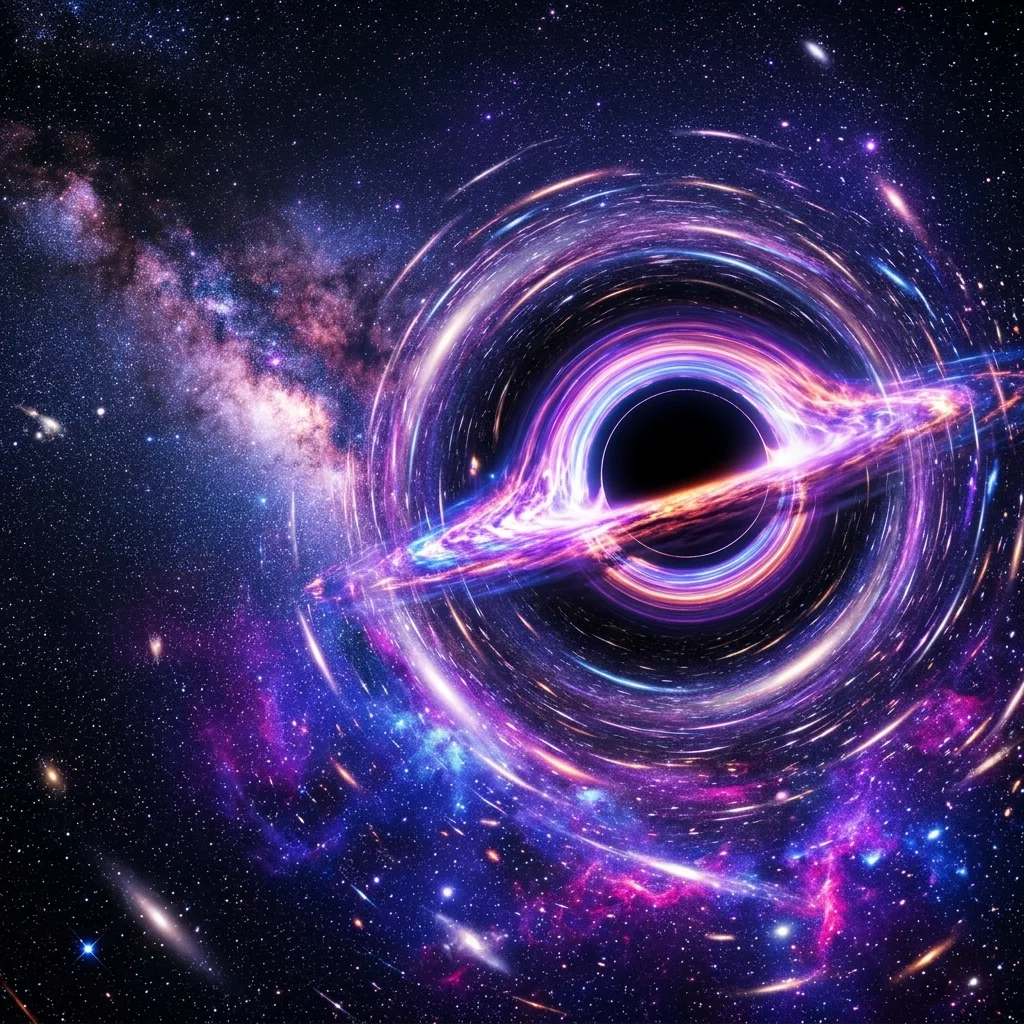
I’ll admit it—I used to think science was just a collection of boring rules and dry equations we were forced to memorize in high school. But recently, I tumbled down an absolute rabbit hole of scientific mysteries, and it completely shattered my understanding of the universe.
NASA, you realize that the universe is far stranger than any sci-fi movie could ever invent. Some of the concepts out there don’t just bend the rules; they completely break reality as we know it.
What fascinated me most during my late-night reading sessions through Smithsonian Magazine archives were the ideas that sound like pure magic but are actually grounded in rigorous math. From materials that can turn stars into liquid soup to the terrifying realization that time itself might just be an elaborate illusion, these concepts left me staring at my ceiling for hours. If you loved reading about mind-blowing paradoxes, you are going to be completely obsessed with these unbelievable bizarre physics phenomena.
What Are Bizarre Physics Phenomena?
Bizarre physics phenomena refer to scientifically observed events or mathematical models that directly contradict our everyday understanding of reality. These include concepts like time behaving as a physical block, objects existing in multiple states at once, and invisible matter that makes up most of the universe.
Comparing the Universe’s Weirdest Secrets
| Phenomenon | Field of Science | Mind-Blowing Feature |
|---|---|---|
| Strange Matter | Astrophysics | Can “infect” and convert normal matter |
| Block Universe | Quantum Mechanics | Past, present, and future exist simultaneously |
| Dark Matter | Cosmology | Invisible gravity holding galaxies together |
| Banach-Tarski | Theoretical Math | Creating two identical spheres from one |
1. The Black Hole Information Paradox
I always thought black holes were just cosmic vacuum cleaners, sucking up everything in their path. But I was genuinely shocked to learn that they create one of the biggest headaches in modern science. Stephen Hawking discovered that black holes aren’t completely black—they actually emit tiny particles, now known as Hawking Radiation, and slowly evaporate over trillions of years. But here is the terrifying part: if a black hole evaporates entirely, what happens to all the stuff it swallowed?
In quantum mechanics, information cannot be destroyed. If you burn a book, the ashes, smoke, and heat theoretically still contain the “information” of that book. You could, with perfect technology, put it back together. But a black hole seemingly erases this information from the universe entirely. This paradox pits the two greatest theories in physics—General Relativity and Quantum Mechanics—in a deathmatch, and scientists still have no idea which one is wrong.
2. The Great Filter (Fermi Paradox)
Have you ever looked up at the night sky and wondered why it’s so quiet? The universe is over 13.8 billion years old, and there are billions of Earth-like planets just in our Milky Way galaxy. Statistically, there should be advanced alien civilizations everywhere. Yet, we see absolutely nothing. This terrifying silence is the core of the Fermi Paradox, and the most chilling explanation for it is called The Great Filter.
The Great Filter theory suggests that there is a specific, nearly impossible evolutionary step that stops life from becoming a space-faring civilization. The terrifying question is: have we already passed the filter (meaning we are incredibly rare and lucky), or is the filter still ahead of us?
If the filter is in our future, it means nearly every civilization inevitably destroys itself before colonizing the stars. This one surprised even me—finding ancient ruins on Mars would actually be terrible news, because it would mean the Great Filter is likely still waiting for us.
3. Dark Matter’s Invisible Web
Imagine walking into a room, feeling the breeze of a fan, seeing objects being pushed around, but the fan is completely invisible and untouchable. That is essentially what scientists are dealing with when it comes to Dark Matter. I was blown away when I discovered that everything we can see, touch, or interact with—every star, planet, and person—makes up only about 5% of the universe. The rest is completely unknown.
When astronomers measure how fast galaxies spin, the math simply doesn’t work. There isn’t enough visible stuff to generate the gravity needed to hold these galaxies together. They should fly apart.
To fix the math, scientists realized there must be an invisible “Dark Matter” that doesn’t interact with light but exerts a massive gravitational pull. It forms an invisible cosmic web that holds the universe together, and despite decades of searching, no one has ever isolated a single particle of it.
4. Multidimensional String Theory
I have a hard enough time trying to visualize four dimensions, let alone eleven. But if you want to dive into the absolute deep end of modern physics, you have to talk about String Theory. For decades, scientists have tried to combine gravity with quantum mechanics. The only way the math elegantly solves this problem is if the universe is fundamentally made of unimaginably tiny, vibrating strings of energy instead of solid particles.
But here is the catch that completely broke my brain. For the mathematics of String Theory to work, the universe cannot just have the three dimensions of space and one of time that we experience. It requires at least ten or eleven dimensions.
Where are the other six? Physicists believe they are “curled up” so microscopically tight that we simply glide past them without ever noticing. We are essentially living in a high-dimensional reality but only have the sensory equipment to perceive a fraction of it.
5. The Illusion of the “Self” (Emergence)
This is where biology and physics blur into something deeply philosophical. When you look in the mirror, you see one cohesive organism. You have memories, personality, and consciousness. But from a physics standpoint, “you” don’t really exist as a single entity. You are an emergent property. Emergence is a phenomenon where simple, mindless parts work together to create a complex behavior that none of the parts possess individually.
Think about it: not a single cell in your body is self-aware. A neuron doesn’t know it’s thinking. A skin cell doesn’t know it’s protecting a body. Yet, when 37 trillion of these blind, robotic cells communicate through basic chemistry, human consciousness suddenly sparks into existence. What fascinated me most is that every few years, almost all the atoms in your body are swapped out for new ones. You are basically a persistent pattern, not a permanent physical object.
6. Strange Matter in Neutron Stars
If you think black holes are terrifying, let me introduce you to strange matter. Deep inside the incredibly dense cores of neutron stars, the laws of physics are crushed under such unimaginable pressure that protons and neutrons literally dissolve. They melt into a chaotic soup of fundamental particles called quarks. In this extreme environment, a completely new, theoretical type of matter can form, aptly named “strange matter.”
Strange matter is perfectly dense, indestructible, and completely stable. But what makes it a bizarre physics phenomenon is its infectious nature. If strange matter is ever ejected from a neutron star—perhaps during a collision—it could float through space as a “strangelet.” If a single microscopic strangelet touches ordinary matter, such as our Earth, it theoretically converts everything it touches into more strange matter in an apocalyptic chain reaction.
7. Einstein-Rosen Bridges (Wormholes)
We’ve all seen wormholes in sci-fi movies—ships fly into a glowing tunnel and instantly appear on the other side of the galaxy. But I was totally shocked to learn that wormholes aren’t just Hollywood plot devices; they are legitimate mathematical solutions to Albert Einstein’s equations of general relativity. Co-authored with Nathan Rosen in 1935, the math shows that space-time can be folded, connecting two distant points via a bridge.
However, the real physics of wormholes is incredibly tricky. Even if they exist naturally, they are inherently unstable. The moment a wormhole forms, gravity would cause it to instantly collapse, crushing anything inside it. To keep a wormhole open, you would need “exotic matter”—a highly theoretical substance with negative mass. While it sounds impossible, the math absolutely permits it, meaning our universe could secretly be riddled with invisible shortcuts.
8. The Block Universe Theory of Time
This is the concept that literally kept me awake for a week. We all experience time as a flowing river. The past is gone, the present is happening right now, and the future hasn’t been written yet. Right? Well, Einstein’s Theory of Relativity suggests our intuition is entirely wrong. According to the physics of the “Block Universe,” time does not flow at all.
In a Block Universe, space and time are fused together into a four-dimensional structure. Every event that has ever happened—and every event that will ever happen—exists simultaneously. Your birth, your present moment reading this article, and the end of the universe are all equally real, static points in this giant block. The sensation of “now” moving forward is just an illusion created by human consciousness navigating through the block. Mind-blowing, isn’t it?
9. The Unmeasurable Speed of Light
We all learned in school that the speed of light is 299,792 kilometers per second. It is the ultimate speed limit of the universe. But what if I told you that no human being in history has ever actually measured the one-way speed of light? I refused to believe this until I dug deep into the science. Because light dictates the flow of time and synchronization, it is physically impossible to measure how fast it travels in just one direction.
Every experiment ever designed actually measures the “two-way” round trip speed of light. We bounce a laser off a mirror and divide the total time by two. But relativity tells us that light could theoretically travel at half the speed in one direction, and instantaneously in the opposite direction, and our math would still look identical. We just assume it’s the same speed both ways because it’s convenient, but we can never truly prove it.
10. The Banach-Tarski Paradox
To end our list, let’s step slightly away from pure physics and into the terrifying world of infinite mathematics, which underpins quantum theory. The Banach-Tarski paradox is a mathematical theorem that proves you can take a solid 3D object, like a sphere, cut it into a finite number of pieces, reassemble those pieces, and create two identical spheres of the exact same size as the original.
It sounds completely impossible, right? You can’t create something from nothing. However, this paradox relies on the concept of infinity. Because space is infinitely divisible, the “pieces” you cut out don’t have a traditional volume. By rotating and reassembling these infinitely complex, jagged pieces, the math works perfectly. While you can’t do this with an apple (because atoms aren’t infinitely divisible), understanding this paradox is crucial for scientists working with the infinite properties of quantum fields.
The True Limits of Our Reality
Exploring these bizarre physics phenomena has completely changed the way I look at the world around me. It’s humbling to realize that the solid ground beneath our feet, the ticking clock on the wall, and the stars in the night sky are all governed by rules that we barely comprehend. Humanity has come incredibly far, yet we are still just standing on the shore of a vast cosmic ocean.
If you’re as obsessed with these concepts as I am, and want to keep your mind spinning, you definitely need to check out our list of mind-blowing scientific concepts next. The universe is weird, terrifying, and utterly spectacular, and I honestly wouldn’t want it any other way.
Frequently Asked Questions (FAQ)
Can we travel through wormholes?
Currently, no. While wormholes are mathematically possible according to general relativity, they are incredibly unstable. Any regular matter passing through one would cause it to immediately collapse. You would need highly theoretical “exotic matter” with negative mass to keep the tunnel open.
Is the Block Universe theory proven?
The Block Universe theory is not definitively proven, but it is a leading interpretation of Einstein’s Theory of Relativity. It logically explains how time dilation works across different speeds and gravities, although it remains heavily debated by quantum physicists.
What happens if strange matter hits Earth?
Theoretically, if a negatively charged “strangelet” touches normal matter, it would initiate a chain reaction, converting every proton and neutron into more strange matter. Ultimately, the entire planet would be compressed into a perfectly dense, hot sphere of strange matter.