
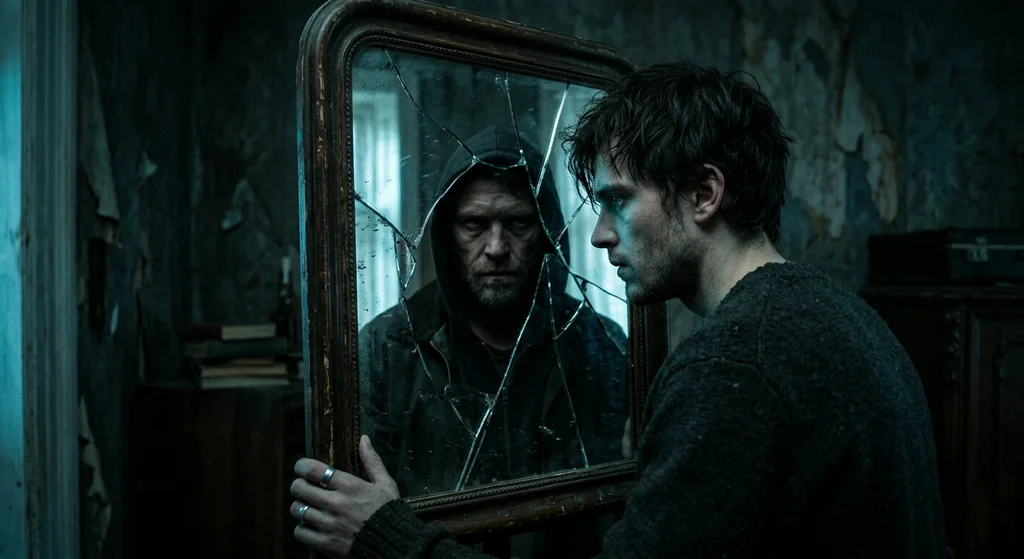
I was genuinely shocked to learn just how fragile the human mind actually is. Our brains are essentially supercomputers, but even the most advanced hardware can experience spectacular, reality-bending glitches. Investigating these bizarre psychological syndromes completely changed how I view human consciousness.
Most of us trust our own senses implicitly. We believe what we see, hear, and feel represents objective reality. But according to the , our perception of reality is constantly being reconstructed, and sometimes the blueprints get completely scrambled.
Reading about these conditions reminded me of trying to understand mind-blowing paradoxes that will break your brain. You realize that reality is highly subjective. What happens when the biological wiring that keeps you grounded simply misfires?
Why Does the Human Brain Create Strange Delusions?
The brain creates bizarre psychological syndromes when specific neural pathways miscommunicate. If the visual recognition center disconnects from the emotional processing center, the brain invents wild, illogical explanations to rationalize the conflicting data it receives.
📋 Table of Contents
Exploring the Edges of Human Consciousness
I spent weeks reading through medical journals and case studies to put this list together. What fascinated me most was that these aren’t just wild fictional tropes from horror movies. They are documented, highly specific neurological misfires.
People suffering from these conditions are not making things up. Their brains are feeding them a false reality with absolute, terrifying conviction. It really makes you wonder how much we can actually trust our own thoughts.
| # | Name | Key Fact |
|---|---|---|
| 1 | Cotard’s Syndrome | Patients genuinely believe they are dead or decaying. |
| 2 | Alien Hand Syndrome | One hand acts independently with a mind of its own. |
| 3 | Capgras Delusion | Belief that loved ones were replaced by identical impostors. |
| 4 | Alice in Wonderland Syndrome | Severe distortion of physical size and spatial perception. |
| 5 | Fregoli Delusion | Belief that strangers are actually one person in disguise. |
| 6 | Clinical Lycanthropy | The delusion of physically transforming into an animal. |
| 7 | Boanthropy | A rare state where a human believes they are a cow or ox. |
| 8 | Reduplicative Paramnesia | The belief that a physical location has been cloned. |
| 9 | Erotomania | The absolute certainty that a famous person is in love with you. |
| 10 | Stendhal Syndrome | Physical illness caused by exposure to immense beauty or art. |
1. Cotard’s Syndrome (Walking Corpse Syndrome)
I find Cotard’s Syndrome to be one of the most chilling concepts in medical history. People afflicted with this condition wake up with the unshakable belief that they have already died. They literally feel like walking corpses.
The patient might believe their internal organs are missing or actively rotting away. No amount of logical reasoning can convince them otherwise. If you point out that they are bleeding, they might simply claim that dead people bleed too.
Neurologists believe this happens when regions of the brain responsible for recognizing emotions completely detach from areas recognizing the body. Without that emotional connection, the brain concludes the physical body must no longer exist.
Studies published by the show that the brain activity of a Cotard’s patient resembles someone in a vegetative state. The metabolic rate in their frontal lobe plummets dramatically.
This leaves the person feeling entirely hollow and disconnected from the physical world. Some even stop eating entirely, arguing that a dead body does not require any sustenance.
2. Alien Hand Syndrome
Imagine sitting at your desk, trying to type an email, while your left hand actively tries to close your laptop. Alien Hand Syndrome sounds like pure science fiction, but I assure you it is frighteningly real.
People with this condition lose conscious control over one of their limbs. The “alien” hand acts entirely on its own accord. It performs complex actions without the person’s permission or awareness.
There are documented cases where a patient’s rogue hand has unbuttoned their shirt immediately after their normal hand buttoned it. Some patients even have to physically restrain their rogue hand to stop it from striking them.
This usually occurs after a surgery that severs the corpus callosum, the bridge between the brain’s two hemispheres. It can also happen following a severe stroke or brain infection.
The separation of the brain hemispheres means the motor cortex issues commands that the conscious mind doesn’t approve. It is a stunning example of how fragmented human consciousness can become.
3. The Capgras Delusion
The Capgras Delusion absolutely breaks my heart to read about. It causes a person to look directly at their spouse, child, or parent, and genuinely believe they are an identical impostor.
They recognize the physical face perfectly. They know the person looks exactly like their loved one, sounds like them, and has all their memories. Yet, they feel zero emotional connection to them.
Normally, when you see someone you love, your brain’s visual center sends a signal to the amygdala, triggering a warm emotional response. In Capgras patients, this internal wire is essentially snipped.
Because they see a familiar face but feel nothing, the logical part of the brain tries to solve the mystery. The brain’s only rational explanation is that this person must be a highly advanced fake or a malicious clone.
This can lead to intense paranoia and sometimes violence, as the patient feels trapped with an alien mimic. It shows how much of our love is reliant on unseen neurological signals.
4. Alice in Wonderland Syndrome
I always loved the story of Alice shrinking and growing in Wonderland. But experiencing that distortion in real life is a disorienting neurological condition called Todd’s Syndrome, better known as Alice in Wonderland Syndrome.
People suffering from this episodic condition experience severe visual and spatial distortions. Objects around them suddenly appear impossibly massive or frighteningly tiny.
A normal coffee mug might suddenly look the size of a building. Conversely, their own hands might feel as though they are shrinking away to the size of a doll’s hands.
It is not an issue with their actual eyes, but rather how the brain interprets visual data. It frequently affects young children and is highly associated with severe migraines or the Epstein-Barr virus.
Fortunately, these terrifying episodes usually only last for a few minutes to an hour. Many people naturally outgrow the condition by the time they reach their late teens.
5. The Fregoli Delusion
The Fregoli Delusion is essentially the exact opposite of Capgras. Instead of thinking a loved one is a stranger, the patient believes entirely different strangers are actually one person in disguise.
I cannot imagine the paranoia this would cause. The patient becomes convinced that a single persecutor is following them around, rapidly changing faces and clothes like a master spy.
They might go to the grocery store and think the cashier, the person behind them in line, and the mailman are all the exact same individual. They see malicious intent everywhere they look.
Neurologists attribute this to an overactive connection between the visual recognition areas and the emotional processing centers. The brain aggressively forces false facial recognition onto completely innocent bystanders.
This hyper-familiarity causes a deep sense of dread. The world shrinks down to a single, claustrophobic conspiracy against the patient.
6. Clinical Lycanthropy
Werewolves have dominated folklore for centuries, but the clinical reality behind the myth is fascinating. Clinical Lycanthropy is a rare psychiatric syndrome where a person believes they are transforming into an animal.
I was amazed to find that this isn’t just a metaphor for them. Patients genuinely feel their physical bodies changing. They report feeling fur growing on their skin or their teeth sharpening into fangs.
Some sufferers will begin to grunt, growl, or attempt to walk on all fours. They might even retreat to the woods and try to hunt raw meat, completely losing touch with their humanity.
Brain imaging shows that this condition affects the regions responsible for physical body mapping. Their internal sense of body shape gets totally overwritten by animalistic traits.
While wolves are the most commonly reported animal, documented cases include people believing they are turning into frogs, cats, horses, and even birds.
7. Boanthropy
Closely related to lycanthropy, Boanthropy is an incredibly specific and baffling delusion. The sufferer firmly believes they are a cow or an ox.
Unlike other psychiatric disorders that might involve rapid mood swings or violence, Boanthropy is weirdly peaceful. The afflicted person often just wants to wander out into a pasture.
They might drop to their hands and knees and begin chewing on grass for hours. They completely abandon human speech, opting instead for bovine sounds and behaviors.
Historians trace the most famous case of this all the way back to the Biblical King Nebuchadnezzar. Ancient texts describe him being driven from human society to eat grass like an ox.
Modern psychiatrists suggest this may begin as a dream state that heavily bleeds into waking reality. The condition is extremely rare, but those affected are totally consumed by the bovine lifestyle.
8. Reduplicative Paramnesia
If you have ever experienced déjà vu, you know how weird spatial memory can be. But Reduplicative Paramnesia takes spatial confusion to an entirely different and terrifying level.
I read about a patient lying in a hospital bed in New York who genuinely believed the entire hospital had been duplicated and relocated to her hometown in Ohio. She thought she was in a perfect replica.
It is the delusional belief that a specific physical location has been cloned and exists in two places at once. The brain recognizes the familiar room but fundamentally fails to connect it to the correct geographic location.
This usually occurs after severe trauma to the right cerebral hemisphere, often caused by a stroke or a traumatic brain injury. The spatial memory gets wildly desynchronized from physical reality.
When doctors tried to prove to the patient she was in New York by showing her the skyline, her brain simply rationalized it. She argued that the doctors built a fake skyline outside her window.
9. Erotomania
Erotomania is a deeply disturbing delusion where someone believes with absolute certainty that another person is secretly in love with them. The target is almost always someone of higher social status, like a celebrity.
What blew me away is the mental gymnastics the afflicted person’s brain will perform. If the celebrity publicly denies knowing them, the patient interprets it as a secret coded message of affection.
They see hidden romantic signals in everything. A news anchor wearing a blue tie might be interpreted as a direct proposal of marriage to the person watching at home.
This delusion often leads to intense stalking behaviors. The person believes they are just playing their part in a grand, star-crossed romance that the rest of the world refuses to understand.
It is incredibly difficult to treat because the patient’s self-esteem becomes totally reliant on the fantasy. Breaking the delusion means forcing them to face a crushing, lonely reality.
10. Stendhal Syndrome
Can a painting be so beautiful that it physically hurts you? According to Stendhal Syndrome, being exposed to immense beauty can trigger a massive psychological and physiological breakdown.
I find it fascinating that art can essentially short-circuit the human nervous system. Visitors to major art galleries in Florence, Italy, frequently experience rapid heartbeat, dizziness, fainting, and even hallucinations.
The sensory overload of seeing legendary Renaissance masterpieces in person completely overwhelms their emotional processing centers. Their brains simply cannot handle the sheer magnitude of the historical beauty.
Staff at the Uffizi Gallery are actually trained to deal with tourists collapsing in front of Botticelli or Michelangelo artworks. They have to escort victims out into the fresh air to recover.
It proves that profound aesthetic experiences are not just intellectual. They trigger deep, primitive biological responses that we still barely understand.
Final Thoughts
Exploring these conditions really highlights how delicate our perception of the world is. These bizarre psychological syndromes prove that the brain is entirely capable of rewriting reality at a moment’s notice.
If you found these mental glitches fascinating, you will definitely want to read about the unexplained scientific mysteries that continue to baffle researchers today. The unknown is always closer than we think.
Written by the List of Ten Team
We verify every fact using peer-reviewed sources.
Frequently Asked Questions
Can bizarre psychological syndromes be cured?
Many of these syndromes can be managed or cured through cognitive behavioral therapy, antipsychotic medications, or treating underlying neurological damage like tumors or brain injuries.
How common are these psychological delusions?
Most of these conditions, such as Boanthropy and Clinical Lycanthropy, are exceedingly rare. Only a few dozen clinical cases exist in documented medical history for some of these disorders.
Can a normal person suddenly develop Capgras delusion?
It is highly unlikely for a healthy individual to suddenly develop it. It almost always follows severe head trauma, dementia, schizophrenia, or significant neurological events.
For more on this topic, visit National Geographic and Smithsonian Magazine.
1 thought on “10 Bizarre Psychological Syndromes Most People Don’t Know About”