
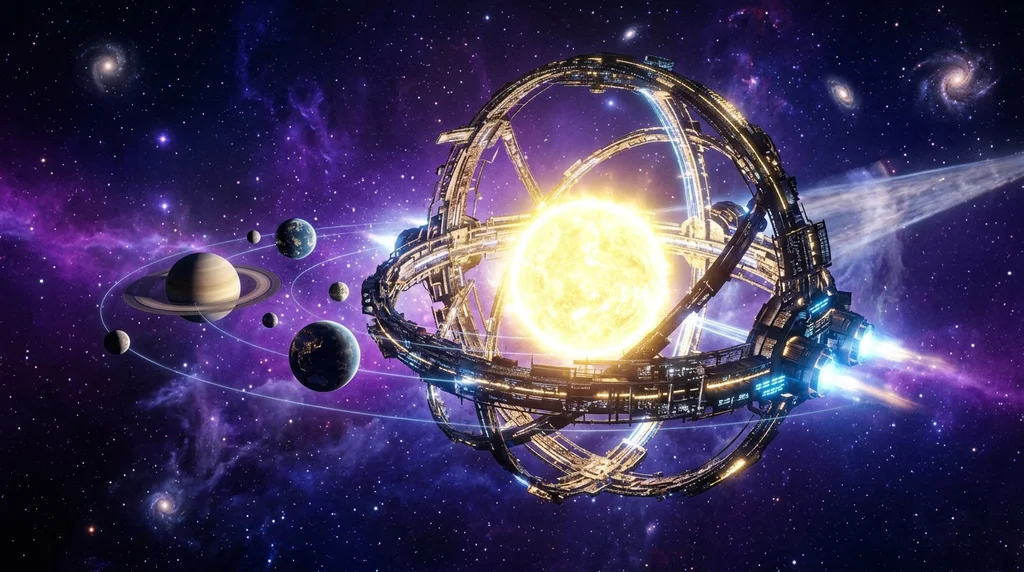
The universe is an infinitely expanding theater of the unknown, filled with mysteries that challenge the very limits of human comprehension. When astronomers and physicists gaze into the cosmic void, they don’t just see distant stars; they uncover bizarre space concepts that redefine everything we thought we knew about reality.
From invisible forces ripping galaxies apart at unimaginable speeds to theoretical megastructures designed to harvest the energy of black holes, the cosmos is far stranger than any science fiction novel could portray. Agencies like dedicate billions of dollars and decades of research trying to untangle these complex webs of spacetime, yet the universe continues to surprise us with mechanisms that defy traditional logic.
If you’ve ever read about the 10 Terrifying Space Facts That Will Keep You Awake, you already know that the cosmos isn’t exactly a peaceful sanctuary. However, beyond the known dangers of asteroid impacts and solar flares lies a deeper layer of theoretical physics that borders on the absurd.
Exploring these bizarre space concepts requires letting go of earthly common sense and embracing a reality where time loops, space tears, and fundamental particles can rewrite the laws of existence. Let’s dive deep into the void and explore the most reality-breaking cosmic theories ever formulated by mankind.
What Are The Most Bizarre Space Concepts Known To Science?
The most bizarre space concepts include theoretical megastructures like Dyson Spheres and Stellar Engines, devastating cosmic phenomena such as Vacuum Decay and Strange Matter, and mind-bending physics theories like String Theory and the Great Filter. These bizarre space concepts challenge our understanding of reality, astrophysics, and the ultimate fate of the universe.
Comparing Bizarre Space Concepts and Theories
| Rank | Cosmic Theory | Classification | Existential Threat Level |
|---|---|---|---|
| 1 | Dyson Spheres | Theoretical Megastructure | Low |
| 2 | Stellar Engines | Cosmic Propulsion | Low |
| 3 | Black Hole Bombs | Energy Harvesting | Extreme |
| 4 | Vacuum Decay | Quantum Event | Apocalyptic |
| 5 | Strange Matter | Particle Physics | Apocalyptic |
1. Dyson Spheres: Capturing the Power of a Star
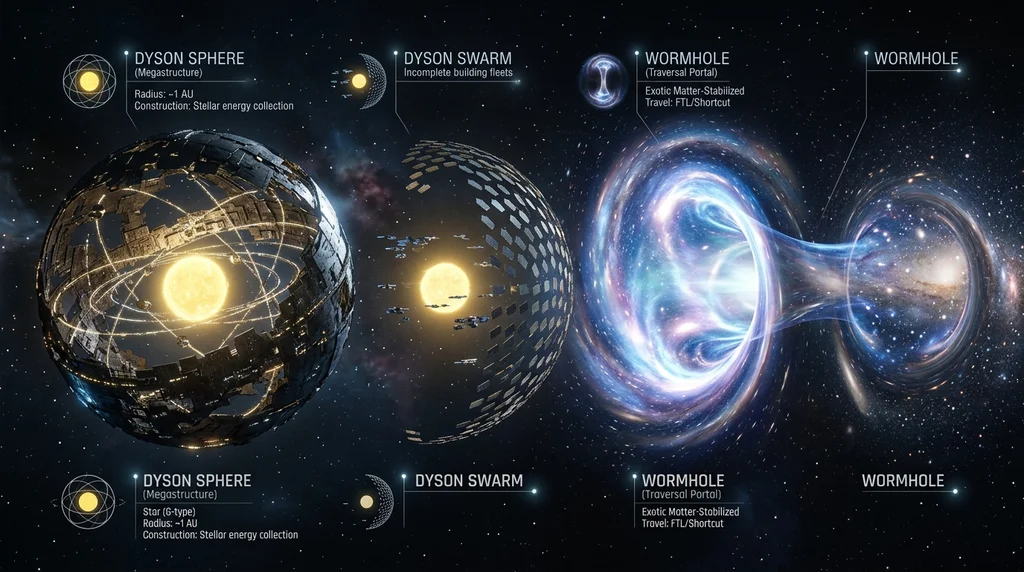
When considering the trajectory of advanced civilizations, physicists inevitably point toward Dyson Spheres as one of the most fascinating bizarre space concepts ever hypothesized. Originally proposed by theoretical physicist Freeman Dyson, this megastructure involves completely enclosing a star with a massive shell or a dense swarm of solar satellites. The goal is to capture 100% of the star’s energy output, providing an advanced alien race with the nearly infinite power required to run planetary-sized computers or traverse the galaxy.
Building a Dyson Sphere would require disassembling entire planets just to gather enough raw materials. In fact, publications like often explore the sheer scale of such engineering feats, noting that humanity would need to consume Jupiter to construct a viable shell around our Sun.
While we have yet to detect a Dyson Sphere in our universe, the concept remains a staple in the search for extraterrestrial intelligence, as a completely enclosed star would emit a highly distinct infrared radiation signature that our telescopes could potentially spot.
2. Stellar Engines: Driving the Solar System
If you think moving a mountain is impressive, Stellar Engines take the prize as one of the most incredibly bizarre space concepts involving cosmic engineering. A Stellar Engine is a theoretical megastructure designed to literally move an entire solar system through the galaxy. Why would a civilization want to drive their star system like a spaceship? To dodge cosmic disasters, such as a supernova explosion or a wandering black hole that is on a collision course with their home world.
The most famous design is the Shkadov Thruster, which uses a massive parabolic mirror placed over one pole of a star. By reflecting the star’s radiation back at itself, the mirror creates an imbalance in radiation pressure, slowly generating thrust. Over millions of years, this gentle push would accelerate the star—and all the planets gravitationally bound to it—allowing an advanced civilization to steer their entire cosmic neighborhood out of harm’s way.
3. The Black Hole Bomb: Harvesting Infinite Energy
Black holes are usually considered the ultimate destroyers, but advanced physics presents them as a potential source of unlimited energy. The Black Hole Bomb is one of those highly bizarre space concepts that blends advanced quantum mechanics with apocalyptic danger. The concept relies on a phenomenon called superradiant scattering. By encasing a rapidly rotating black hole in a massive spherical mirror, a civilization could fire a beam of electromagnetic radiation inside the enclosure.
As the light wave passes through the black hole’s ergosphere, it steals some of the black hole’s immense rotational energy. The amplified wave bounces off the mirror, passes the black hole again, gets amplified further, and repeats the process. The energy grows exponentially. If the civilization doesn’t open a window to let the harvested energy out, the resulting pressure will shatter the mirror, resulting in an explosion equivalent to a supernova—hence the name “Black Hole Bomb.”
4. Vacuum Decay: The Ultimate Reset Button
Of all the existential threats lurking in the cosmos, Vacuum Decay is arguably the most terrifying. This theory suggests that the universe as we know it might be existing in a “false vacuum” state—a temporary level of stability.
If the Higgs field, which gives mass to everything in reality, suddenly drops into its lowest possible energy state (a “true vacuum”), it would trigger a chain reaction that unravels the very fabric of existence. This is a prime example of why bizarre space concepts can sometimes keep physicists awake at night.
If vacuum decay were triggered—perhaps by an ultra-high-energy cosmic ray collision or quantum tunneling—a bubble of true vacuum would expand outward at the exact speed of light. Because it moves at light speed, we would never see it coming. The bubble would instantly rewrite the laws of physics, incinerating everything it touches and replacing our universe with a strange, unrecognizable void where atoms cannot form.
5. Strange Matter: The Ultimate Contagion
Deep inside the incredibly dense cores of neutron stars, the immense pressure might be strong enough to break protons and neutrons down into a “soup” of subatomic particles called quarks. This leads us to one of the most uniquely bizarre space concepts in quantum physics: Strange Matter.
This perfectly stable state of matter is made entirely of up, down, and strange quarks. If a neutron star collides with another object, it could theoretically eject tiny droplets of strange matter, known as “strangelets,” into the dark void of space.
The danger of a strangelet lies in its infectious nature. According to the strange matter hypothesis, it is the most perfectly stable state of matter in the universe. If a submicroscopic strangelet were to float through space and strike Earth, its perfect stability would “infect” regular matter. Every atom it touches would be instantly converted into more strange matter. Over a very short period, the entire Earth would be reduced to a hot, dense, asteroid-sized lump of strange matter.
6. The Great Filter: The Solution to the Fermi Paradox
The universe contains hundreds of billions of galaxies, each packed with billions of stars and countless habitable planets. Mathematically, the cosmos should be teeming with alien life, yet our telescopes observe nothing but dead silence. To explain this eerie phenomenon, scientists developed the Great Filter—one of the most philosophical and bizarre space concepts to date. The Great Filter is a theoretical evolutionary barrier that is extremely difficult, or perhaps impossible, for life to overcome.
The ultimate question is: Are we ahead of the filter, or is the filter still in our future? If the filter is behind us, it means the jump from single-celled organisms to complex life was a miracle, and we are alone in the universe.
If the filter is in our future, it means practically all advanced civilizations inevitably destroy themselves through nuclear war, climate collapse, or artificial intelligence before they can colonize the stars. Finding ruins on Mars would be terrifying, as it would heavily imply the filter is ahead of us.
7. Wormholes: Tunnels Through Spacetime
Officially known as Einstein-Rosen bridges, wormholes are mathematical solutions to the equations of general relativity that suggest the fabric of spacetime can be folded, creating a shortcut between two incredibly distant points. When discussing bizarre space concepts, wormholes are the holy grail of interstellar travel, allowing a spaceship to bypass the universal speed limit of light by simply cutting through higher-dimensional space.
However, mathematically, standard wormholes are notoriously unstable. The moment any matter—even a single photon of light—enters the tunnel, the gravitational feedback causes the wormhole to instantly collapse and pinch shut. To keep a wormhole open, you would need “exotic matter” with negative mass, a substance that currently exists only in the equations of theoretical physicists. Even more mind-bending, if you move one end of a wormhole close to the speed of light, it transforms into a functional time machine.
8. String Theory: The Multidimensional Symphony
At the very limits of human understanding lies String Theory, an attempt to unify the chaotic world of quantum mechanics with the smooth, predictable rules of gravity. Instead of viewing fundamental particles like quarks and electrons as tiny 3D dots, String Theory is one of the bizarre space concepts that suggests they are actually microscopic, one-dimensional vibrating strings. Just as different vibrations on a violin string produce different musical notes, different vibrations of these cosmic strings produce different subatomic particles.
The catch? For the mathematics of String Theory to work without collapsing into contradictions, the universe cannot simply have the three dimensions of space and one dimension of time that we experience. It requires a mind-bending 11 dimensions.
The extra dimensions are theorized to be curled up so tightly on a microscopic scale that we cannot perceive them. Trying to wrap the human brain around 11 overlapping dimensions makes this one of the hardest concepts to visualize in all of astrophysics.
9. Dark Energy: The Force Tearing Reality Apart
We know the universe is expanding, but in the late 1990s, scientists discovered something truly horrifying: the expansion is actually accelerating. The mysterious force driving this acceleration has been dubbed Dark Energy, and it makes up roughly 68% of the total energy in the observable universe.
It is one of the most prominent bizarre space concepts because literally no one knows exactly what it is. It functions as a form of anti-gravity, pushing galaxies away from each other at ever-increasing speeds.
If Dark Energy continues to accelerate the universe without bound, it could lead to the ultimate doom scenario known as the “Big Rip.” In this hypothetical future, the expansion of space outpaces all gravitational and electromagnetic forces. Galaxies will be torn apart, then solar systems, then planets, and finally, even atoms and fundamental particles will be ripped to shreds, leaving the universe as an icy, dead void of nothingness.
10. Rogue Planets: Worlds Wandering in the Dark
When we picture planets, we imagine them safely orbiting the comforting warmth of a host star. However, the universe is chaotic, and gravitational billiards during the formation of solar systems often violently eject planets out into the deep void. These are Rogue Planets—nomadic worlds completely unbound to any star, drifting through the frozen, pitch-black expanses of interstellar space. They rank among the most isolated bizarre space concepts ever verified by astronomers.
Believe it or not, scientists estimate there are billions—perhaps trillions—of rogue planets wandering the Milky Way alone. Some of them might even harbor life! If a rogue Earth-sized planet had a thick enough atmosphere and high levels of geothermal activity, it could maintain vast subsurface oceans shielded under thick crusts of ice. Life could theoretically evolve in these dark, isolated waters, entirely unaware of stars, galaxies, or the broader universe outside their frozen shell.
Conclusion
From energy-harvesting megastructures that trap stars in metallic shells to particles capable of rewriting the molecular structure of our planet, the universe is packed with bizarre space concepts that test the boundaries of human imagination. Our understanding of physics continues to evolve, constantly pushing back the curtain on a reality that is infinitely weirder than we initially anticipated.
As we look toward the stars and dream of conquering these incredible phenomena, it’s worth exploring the 10 Incredible Future Technologies That Will Change the World by 2050, as humanity’s rapid advancement might one day turn these cosmic theories into practical science.
We are just getting started on our journey to decode these bizarre space concepts. As telescopes become more advanced and quantum computing pushes mathematical models to their limits, we may finally discover whether vacuum decay will inevitably swallow us whole or if we are the first advanced species to successfully pass the Great Filter. Until then, keep looking up—the universe has plenty of secrets left to reveal.
Frequently Asked Questions
What are bizarre space concepts?
Bizarre space concepts refer to cutting-edge theoretical physics and astronomical phenomena that challenge our standard understanding of reality. This includes ideas like Dyson Spheres, strange matter, vacuum decay, and wormholes that stretch the limits of astrophysics.
Can vacuum decay actually happen?
Theoretically, yes. If our universe is currently in a “false vacuum” state, a quantum tunneling event could trigger vacuum decay. However, physicists estimate the probability of this happening naturally is astronomically low and would likely take billions of years.
Are Dyson Spheres real?
Dyson Spheres are currently just bizarre space concepts that exist purely in theoretical blueprints. While astronomers actively search for the distinct infrared signatures that such a megastructure would produce, no concrete evidence of a Dyson Sphere has ever been discovered.
What is the most dangerous space concept?
Strange matter and vacuum decay are widely considered the most dangerous concepts. Both present scenarios where standard matter and the fundamental laws of physics are instantly converted or erased, moving at immense speeds that make survival impossible.