

For decades, science fiction has teased humanity with visions of galactic empires, orbital habitats, and colossal space stations, but what if these concepts aren’t just fantasy? As our technological capabilities rapidly evolve, physicists and engineers are beginning to draft blueprints for incredible megastructures that could profoundly alter the destiny of our species.
These awe-inspiring massive engineering projects have the potential to solve humanity’s energy crises, eliminate planetary overcrowding, and unlock the true depths of the cosmos. According to modern astrophysics supported by institutions like NASA, we are already acquiring the materials and theoretical knowledge needed to begin early prototyping.
The transition from a planetary civilization to an interstellar one requires us to think on a scale never before seen. Just as we marvel at the 10 Incredible Future Technologies That Will Change the World by 2050, we must look further ahead to the architectural marvels that will define our long-term survival.
From theoretical engines capable of moving entire solar systems to massive computers that harness the full power of a star, these incredible megastructures represent the ultimate test of human ingenuity. Researchers regularly publish papers on the novel materials—like carbon nanotubes and graphene—that might finally make these breathtaking concepts a tangible reality.
What Are Megastructures And Are They Possible?
Incredible megastructures are massive, hypothetical artificial constructions engineered on a stellar or planetary scale. Yes, many are scientifically possible because they rely on the known laws of physics rather than magic. While current constraints involve material strength and astronomical costs, future advancements in automated robotics and space mining could make building these colossal habitats and energy harvesters fully achievable.
Comparison of Proposed Incredible Megastructures
Before diving into the detailed mechanics of each concept, let’s look at how these different incredible megastructures compare in terms of their primary purpose, theoretical scale, and how close we actually are to making them a reality.
| Megastructure Name | Primary Function | Scale Factor | Scientific Feasibility |
|---|---|---|---|
| Space Elevator | Orbital Transport | Planetary | High (Near Future) |
| Dyson Sphere | Stellar Energy Harvesting | Solar System | Low (Distant Future) |
| O’Neill Cylinder | Space Colonization | Orbital | Medium |
| Skyhook | Momentum Launch System | Orbital | High (Currently Possible) |
| Stellar Engine | Moving the Solar System | Interstellar | Very Low |
1. The Space Elevator
One of the most heavily researched incredible megastructures is the Space Elevator. The concept is elegantly simple: a massive tether anchored to the Earth’s equator extending tens of thousands of kilometers into space, counterbalanced by a heavy mass in geosynchronous orbit. Using mechanical climbers, humans and cargo could be ferried into space for a fraction of the cost of traditional chemical rockets, permanently opening the solar system to industrialization and widespread colonization.
The primary barrier to building this technological marvel is material science. We currently lack a material with the necessary tensile strength to support its own weight over such massive distances without snapping. However, recent breakthroughs in carbon nanotubes and advanced graphene offer a promising path forward. Once built, the Space Elevator would drastically reduce the cost of lifting payloads into orbit, effectively turning space travel from an expensive governmental luxury into a daily commercial enterprise.
2. The Dyson Sphere
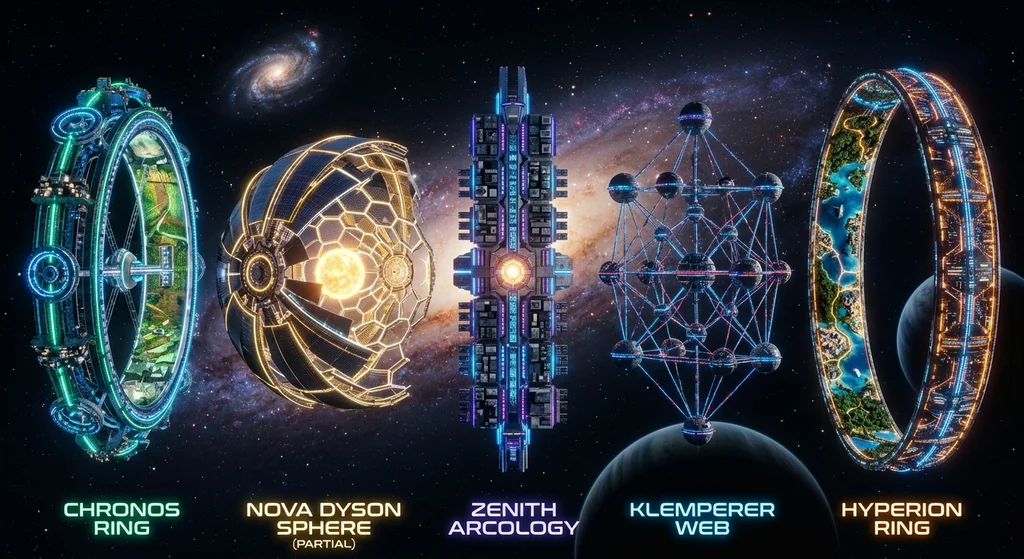
First popularized by theoretical physicist Freeman Dyson in 1960, the Dyson Sphere is the holy grail of incredible megastructures. It is a massive framework of solar satellites built completely around a star to capture a large percentage of its total energy output. Constructing a Dyson Sphere would instantly elevate humanity to a Type II civilization on the Kardashev scale, providing us with virtually unlimited energy to power vast interstellar expansions and computational networks.
Rather than a solid, rigid shell—which would be gravitationally unstable and require more material than exists in our entire solar system—the most realistic version is a “Dyson Swarm.” This involves millions of individual, tightly packed orbital mirrors and solar panels beaming energy back to Earth or other colonies. Building this structure would likely require humanity to dismantle an entire planet, such as Mercury, to harvest enough raw materials for construction.
3. The Skyhook
If the space elevator proves too difficult to manufacture with near-term materials, the Skyhook stands out as one of the most feasible incredible megastructures we could tackle this century. A skyhook is a massive rotating tether placed in low Earth orbit. As it spins, one end dips down into the upper atmosphere. Hypersonic aircraft flying at high altitudes could latch onto the hook, and the rotation of the tether would physically fling the spacecraft outward into the solar system.
What makes the Skyhook so highly appealing is that it acts as a momentum exchange battery. By catching incoming spacecraft returning from Mars or the Moon and dropping them into the atmosphere, the tether maintains its orbital energy, allowing it to throw departing ships outward without requiring continuous fuel. Unlike the Space Elevator, a Skyhook does not touch the ground and can be built using currently available, high-strength commercial aerospace polymers.
4. The Stellar Engine
Imagine needing to move our entire solar system out of the path of a deadly supernova or dangerous asteroid field. The Stellar Engine, specifically the Shkadov thruster, is among the most mind-bending incredible megastructures ever theorized. It involves building a gigantic, stationary mirror over one pole of the Sun. By reflecting solar radiation back onto the star itself, it generates a tiny, continuous thrust that slowly alters the trajectory of our entire solar system through the Milky Way galaxy.
Though the acceleration provided by a Stellar Engine would be microscopic in the short term, over thousands of years, the compounding speed would allow us to steer the Sun across the galaxy. Because the planets are gravitationally bound to the Sun, they would naturally follow along for the ride. It is a megastructure designed strictly for planetary survival on a timeline that spans millions of years, proving just how vast future engineering could become.
5. O’Neill Cylinders
Instead of terraforming harsh, hostile worlds like Mars, humanity could choose to build perfect, custom-made worlds from scratch. O’Neill Cylinders are undeniably some of the most practical incredible megastructures for future human habitation. Proposed by physicist Gerard K. O’Neill in the 1970s, these are paired, counter-rotating cylinders floating in space, each large enough to house millions of people, entire cities, and sprawling natural ecosystems.
The rotation of the cylinders creates artificial gravity along the inner curved surface through centrifugal force. Massive mirrors would reflect natural sunlight directly into the structure, creating controllable day-and-night cycles and perfect weather patterns year-round. Because these habitats are built in the weightlessness of space, they could theoretically be multiplied endlessly, removing any concerns about planetary overpopulation.
6. The Matrioshka Brain
Taking the concept of a Dyson Sphere to its absolute logical extreme gives us the Matrioshka Brain. While many incredible megastructures focus on housing humans or providing fuel, the Matrioshka Brain is entirely dedicated to computing. It is a massive supercomputer comprised of several nested spherical shells surrounding a star, heavily relying on the energy captured to process data on an unimaginable scale, limited only by the laws of thermodynamics.
The innermost shell operates at extreme temperatures, drawing immense energy directly from the star. The waste heat from the first shell is captured by the second, cooler shell to perform additional computing, and this process cascades down through several layers. A supercomputer of this magnitude could perfectly simulate trillions of distinct virtual universes or house the uploaded digital consciousness of billions of alien species.
7. The Alderson Disk
When it comes to the sheer absurdity of scale, the Alderson Disk ranks high among incredible megastructures. Proposed by Dan Alderson, this concept is a massive, flat platter shaped like a CD, with a star resting precisely in the center hole. The disk would be thousands of miles thick, extending outward past the equivalent orbits of Mars or Jupiter, providing more habitable surface area than billions of Earth-sized planets combined.
Gravity would not pull you down toward the surface naturally like on Earth; instead, the massive gravity of the disk itself would pull objects sideways toward the center line of the structure. The closer you got to the central star, the hotter the environment would become, naturally segregating the disk into frozen wastelands on the outer edges and scorching deserts on the interior, leaving a perfectly habitable Goldilocks ring in the middle.
8. The Stanford Torus
A slightly smaller, yet highly realistic alternative to the O’Neill Cylinder is the Stanford Torus. Out of all the incredible megastructures designed for human living, this massive, donut-shaped rotating space station was rigorously studied by NASA and Stanford University in 1975. Designed to comfortably house roughly 10,000 to 140,000 residents, the Torus relies on a massive central hub connected by spokes, mimicking a bicycle wheel.
The interior tube provides the habitat, complete with agricultural zones, dense residential areas, and recreational lakes. A complex system of angled mirrors hovers around the structure to constantly bathe the inner ring in sunlight. The relatively smaller scale of the Stanford Torus compared to a full O’Neill Cylinder makes it a prime candidate for humanity’s first true deep-space civilian city, entirely built from materials mined from lunar regolith and passing asteroids.
9. The Lunar Spacedock (Moon Base)
While deep space structures seem far off, the Lunar Spacedock represents a crucial stepping stone. Unlike other purely theoretical incredible megastructures, aggressive plans are already underway by global space agencies to construct permanent sprawling bases on the Moon. Utilizing massive underground lunar lava tubes for radiation protection, humanity could deploy robotic fleets to 3D-print immense habitats using raw lunar dust.
Because the Moon’s gravity is only one-sixth that of Earth’s, building a massive sprawling spacedock shipyard on the lunar surface is highly efficient. Spaceships designed for deep space travel to Mars and beyond could be entirely constructed on the Moon and launched with minimal fuel. This makes a sprawling Moon megabase not just a scientific curiosity, but an absolute economic necessity for the future expansion of the human race across the solar system.
10. The Ringworld (Niven Ring)
Perhaps the most visually stunning of all incredible megastructures is the Ringworld, famously conceptualized by science fiction author Larry Niven. Imagine an artificial ring boasting a radius equivalent to the Earth’s orbit, encircling a central star. The interior of the ring would face the sun, providing an unimaginably vast landscape complete with synthetic oceans, sprawling continents, and highly engineered weather systems.
To prevent the structure from tearing itself apart from extreme orbital tension, a Ringworld would require a foundational material far stronger than anything currently known to theoretical physics. Additionally, massive “shadow squares” would need to orbit closer to the star to create artificial night and day. If ever accomplished, a single Ringworld could house the population of millions of Earths, acting as the ultimate utopia for an advanced interstellar empire.
Conclusion
The universe is an incredibly vast and hostile place, but as humanity’s engineering prowess continues to scale, our ability to conquer it grows. These incredible megastructures are not mere pipe dreams; they represent the rigorous, calculated future of astrophysics and human survival.
Whether we begin by anchoring a Space Elevator to the equator or someday dismantling planets to construct a glowing Dyson Swarm, the architectural destiny of our species points definitively toward the stars. For more fascinating insights into the extreme possibilities of space, check out our piece on Most Extreme Planets: 10 Mind-Blowing Alien Worlds.
Frequently Asked Questions (FAQ)
What is the most realistic megastructure we could build?
The Skyhook and the Space Elevator are widely considered the most realistic incredible megastructures for near-term construction. Both rely on advanced materials like carbon nanotubes and could dramatically reduce the cost of space travel.
Could humanity actually build a Dyson Sphere?
While the physics behind a Dyson Sphere are sound, constructing one is far beyond our current capabilities. It would require advanced robotics, artificial intelligence, and the complete deconstruction of entire planets to harvest enough raw material.
Why do scientists study incredible megastructures?
Scientists and astrophysicists study incredible megastructures to understand the theoretical limits of engineering and to look for signs of advanced alien civilizations. If an alien race built a Dyson Sphere, for example, we might be able to detect its distinct infrared heat signature from Earth.
What material is needed for a Space Elevator?
A Space Elevator requires a tether material with extreme tensile strength to support its own weight over thousands of kilometers without snapping. Carbon nanotubes and graphene are currently the leading candidates being actively researched for this exact purpose.