

When humanity peers into the night sky, we are confronted by profound cosmic mysteries that challenge our understanding of reality, physics, and our very place in the universe. Despite our monumental advancements in technology and space exploration, the cosmos remains a vast ocean of unanswered questions. From the invisible forces expanding galaxies to the terrifying phenomena hiding in deep space, these phenomena remind us of how little we truly know about the fabric of spacetime.
As advanced telescopes like the James Webb Space Telescope probe deeper into the abyss, they uncover increasingly baffling cosmic mysteries. According to extensive research published by and global astronomical institutions, we can currently only observe about 5% of the known universe. To understand what lies in the shadows, scientists frequently study 10 Terrifying Space Phenomena That Could Destroy Earth.
For now, let us explore the greatest unexplainable anomalies of the stars. In this comprehensive guide, we will break down the true nature of these cosmic mysteries and the current scientific theories attempting to solve them.
What Are The Most Baffling Cosmic Mysteries in the Universe?
The most baffling cosmic mysteries include the existence of dark matter and dark energy, which make up 95% of the universe but remain completely invisible. Other profound cosmic mysteries involve the exact nature of black hole singularities, the origin of fast radio bursts, and the potential reality of the multiverse.
Comparison of the Greatest Universe Secrets
| Top Cosmic Mysteries | Primary Characteristic | Scientific Status |
|---|---|---|
| Dark Matter | Invisible Gravitational Pull | Unobserved, Mathematically Proven |
| Dark Energy | Accelerated Expansion | Theoretical Constant |
| Singularities | Infinite Density | Breaks Laws of Physics |
| The Great Attractor | Massive Gravity Anomaly | Hidden by Galactic Dust |
| Fermi Paradox | Lack of Alien Contact | Highly Debated Concept |
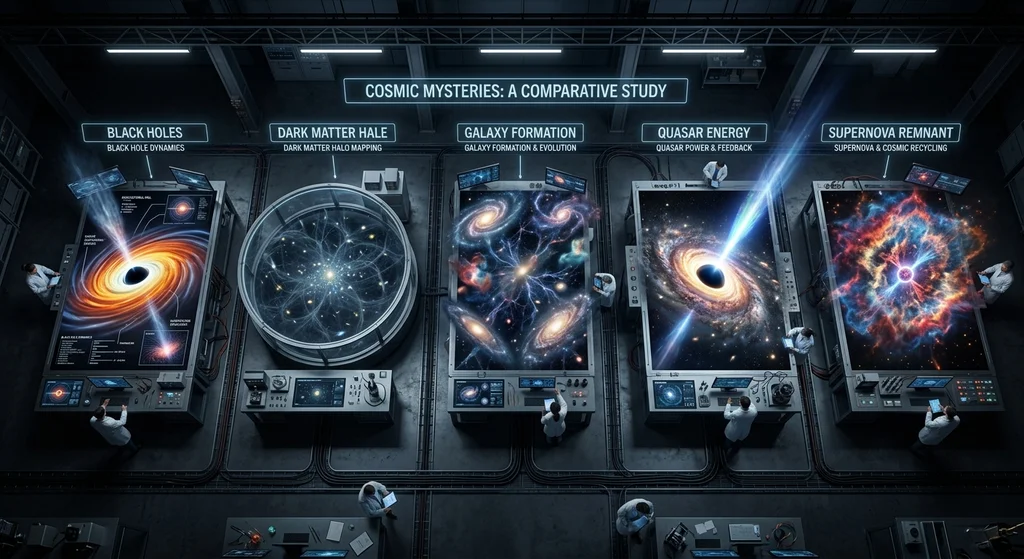
1. The Invisible Skeleton: Dark Matter
Making up approximately 27% of the known universe, dark matter is undoubtedly one of the longest-standing cosmic mysteries in astronomy. We cannot see it, touch it, or interact with it using standard light or radiation. Yet, physicists know it exists because of the gravitational effects it has on visible matter. Without dark matter acting as an invisible skeleton, galaxies would fly apart due to their rotational speeds.
2. The Expanding Void: Dark Energy
While dark matter acts as the cosmic glue holding galaxies together, dark energy does the exact opposite. It is the mysterious repulsive force responsible for the accelerated expansion of the universe. Accounting for roughly 68% of total energy density, dark energy is so pervasive yet so unexplained, elevating it to the top tier of cosmic mysteries.
Albert Einstein once proposed a “cosmological constant” as a mathematical placeholder, a concept he later called his biggest blunder. Ironically, modern astrophysics has resurrected this idea to explain why the universe’s expansion is speeding up rather than slowing down. If dark energy continues to dominate, it could eventually lead to the “Big Freeze” or the “Big Rip,” tearing apart the very fabric of existence.
3. The Point of Infinite Density: Black Hole Singularities
At the very heart of a black hole lies a singularity—a point where mass is compressed into zero volume, and gravitational pull becomes infinite. This paradox makes singularities one of the most impenetrable cosmic mysteries ever conceived. All known laws of physics simply break down at this point, leaving general relativity and quantum mechanics in completely unresolvable conflict.
Because no light can escape beyond a black hole’s event horizon, it is fundamentally impossible for us to observe a singularity directly. Theoretical physicists like Stephen Hawking dedicated their lives to understanding what happens to information swallowed by these cosmic giants. Does it disappear forever, or is it scrambled and released back into the universe?
4. The Missing Opposite: Antimatter Asymmetry
During the Big Bang, equal amounts of matter and antimatter should have been created. Since matter and antimatter annihilate each other in a burst of pure energy upon contact, the universe should be a sterile void filled only with light. The fact that anything exists at all remains one of the fundamental cosmic mysteries in physics.
For reasons that scientists cannot yet explain, a tiny fraction of normal matter survived the initial annihilation phase—about one extra matter particle for every billion antimatter particles. This phenomenon, known as Baryogenesis, is the sole reason why stars, planets, and human beings exist today. The search for where the antimatter went is currently a major focus at the Large Hadron Collider.
5. The Pull in the Dark: The Great Attractor
Our Milky Way galaxy, along with tens of thousands of other galaxies in our local supercluster, is hurtling through space at roughly 1.3 million miles per hour. We are all being pulled toward a specific region in space known as the Great Attractor. The inability to clearly see what is pulling us adds a haunting layer to these cosmic mysteries.
The problem is that the Great Attractor is located in the “Zone of Avoidance”—an area of the sky obscured by the dense dust and gas of our own Milky Way galaxy. Using X-ray and radio telescopes, astronomers have discovered a massive supercluster of galaxies in that direction known as the Norma Cluster, but its mass still isn’t enough to explain the immense gravitational pull we are experiencing.
6. Where Is Everybody? The Fermi Paradox
With billions of Earth-like planets in the Milky Way alone, mathematical probability strongly dictates that intelligent alien life should exist. Yet, when we scan the skies, we hear nothing but dead silence. Formulated by physicist Enrico Fermi, this glaring contradiction is known as the Fermi Paradox, solidifying its place among the greatest cosmic mysteries.
There are many grim solutions to this paradox. The “Great Filter” theory suggests that intelligent civilizations inevitably destroy themselves through nuclear war or climate change before they can become space-faring. Another theory suggests that the universe operates as a “Dark Forest,” where advanced species remain intentionally quiet to avoid drawing the attention of predatory galactic empires.
7. Signals from Nowhere: Fast Radio Bursts
Fast Radio Bursts (FRBs) are incredibly intense, millisecond-long pulses of radio energy originating from billions of light-years away. In a fraction of a second, an FRB can release as much energy as our Sun produces in three days. They are highly ranked among modern cosmic mysteries due to their erratic nature and sudden appearance.
Since their discovery in 2007, astronomers have detected hundreds of these signals. While many are single flashes, some repeat in unpredictable patterns. Theories regarding their origin range from colliding neutron stars and highly magnetized pulsars known as magnetars, to far more speculative ideas involving alien mega-structures powering interstellar spacecraft.
8. Infinite Realities: The Multiverse Theory
What if the entire observable universe is just a single bubble floating in an infinite ocean of other universes? The Multiverse Theory suggests that every possible outcome of every quantum event creates a separate timeline, making it the ultimate frontier of cosmic mysteries. In an infinite multiverse, there could be a universe where you made a different choice for breakfast, and another where humans never existed.
While often associated with science fiction, the multiverse is deeply rooted in modern quantum mechanics and string theory. Cosmic inflation theories suggest that the rapid expansion of spacetime during the Big Bang never actually stopped; instead, it continues eternally, constantly giving birth to new pocket universes with completely different laws of physics.
9. The Reverse Black Hole: White Holes
If black holes are cosmic vacuums that nothing can escape from, their mathematical opposites are white holes—regions of spacetime that matter and light can escape from, but nothing can enter. White holes exist perfectly within the framework of Einstein’s equations, making them purely mathematical cosmic mysteries that may never be observed in physical reality.
Some theoretical physicists propose that black holes and white holes might actually be deeply connected through wormholes. Matter that falls into a black hole might travel through a tunnel in spacetime and get violently expelled out of a white hole in a different galaxy, or perhaps an entirely different universe altogether.
10. The End of Everything: Vacuum Decay
Among all the apocalyptic scenarios imagined by humanity, false vacuum decay stands out as one of the most terrifying cosmic mysteries in physics. It proposes that the fundamental quantum field governing our universe might not be in a perfectly stable state. If a random quantum fluctuation were to trigger a collapse, a bubble of true vacuum would form and expand outward at the speed of light.
Inside this bubble, the laws of chemistry and physics would fundamentally change. Atoms would not hold together, and life as we know it would instantly cease to exist. Because this bubble would expand at the speed of light, it would be impossible to see it coming; everything would simply blink out of existence in an instant.
Final Thoughts on These Incredible Phenomenon
Ultimately, these cosmic mysteries serve as a humbling reminder of our species’ infancy on the galactic stage. While our telescopes grant us spectacular views of distant nebulae and colliding galaxies, the true fundamental mechanics of the universe remain veiled in shadow. As long as questions about dark matter and the Fermi Paradox exist, there will always be an insatiable drive for scientists to look upward and seek the truth.
If you found these concepts fascinating, you might also want to explore 10 Mind-Blowing Space Facts That Will Make You Feel Tiny to further expand your astronomical horizons. Which of these cosmic mysteries keeps you up at night? The silence of the universe, or the invisible forces pulling our galaxy through the dark?
Frequently Asked Questions
Why do cosmic mysteries like dark matter matter to us?
Understanding these cosmic mysteries is crucial because they govern the foundational physics of our universe. Solving them could unlock entirely new fields of energy, quantum computing, and perhaps even interstellar travel capabilities that we cannot currently fathom.
Will scientists ever solve these cosmic mysteries?
With the launch of advanced next-generation equipment like the James Webb Space Telescope and upgraded particle accelerators, many physicists believe we will solve several of these cosmic mysteries within the next few decades, particularly regarding the identification of dark matter particles.