
The ocean covers more than 70% of our planet, yet we have explored less than 5% of its dark, crushing depths. When researchers send submersibles down into the abyss, they often bring back footage of terrifying deep sea discoveries that completely challenge our understanding of biology, geology, and history.
From bizarre alien-like fish with transparent heads to massive underwater structures that look suspiciously man-made, the ocean floor is humanity’s final, most enigmatic frontier. Exploring these submerged realms often feels like visiting another planet, requiring cutting-edge technology and immense courage to brave the absolute darkness and freezing temperatures.
In recent years, advancements in sonar and robotic submersibles have uncovered a wave of new phenomena. Institutions like frequently fund expeditions that reveal creatures and landscapes that seem plucked straight out of a science fiction novel.
If you were fascinated by our look at 10 Bizarre Deep Sea Creatures You Won’t Believe Exist, you will be utterly captivated by this list. Today, we are diving into the most astonishing, spine-chilling, and downright terrifying deep sea discoveries that continue to baffle the world’s leading scientists in 2026.
Why Are There So Many Terrifying Deep Sea Discoveries?
Scientists constantly make terrifying deep sea discoveries because the ocean’s abyssal zones present extreme environments with crushing pressures, zero sunlight, and freezing temperatures. These harsh conditions force marine life to evolve bizarre, alien-like adaptations and preserve mysterious geological anomalies that remain completely untouched and unexplainable by modern mainstream science.
Comparing the Most Unexplained Ocean Mysteries
Before we explore the full list of these terrifying deep sea discoveries, it helps to look at the data. The ocean hides a vast array of secrets, categorized broadly into biological anomalies, unexplained geological formations, and baffling acoustic mysteries. The table below breaks down the depth, location, and primary scientific classification of some of the most famous deep-water enigmas ever recorded by mankind.
| Discovery | Location | Depth | Category |
|---|---|---|---|
| Baltic Sea Anomaly | Baltic Sea | 90 meters | Geological / Unexplained |
| Mariana Trench Sounds | Pacific Ocean | 10,900 meters | Acoustic Phenomenon |
| Yonaguni Monument | Japan Coast | 25 meters | Ancient Structure |
| Giant Squid (Architeuthis) | Global Oceans | 1,000+ meters | Biological Anomaly |
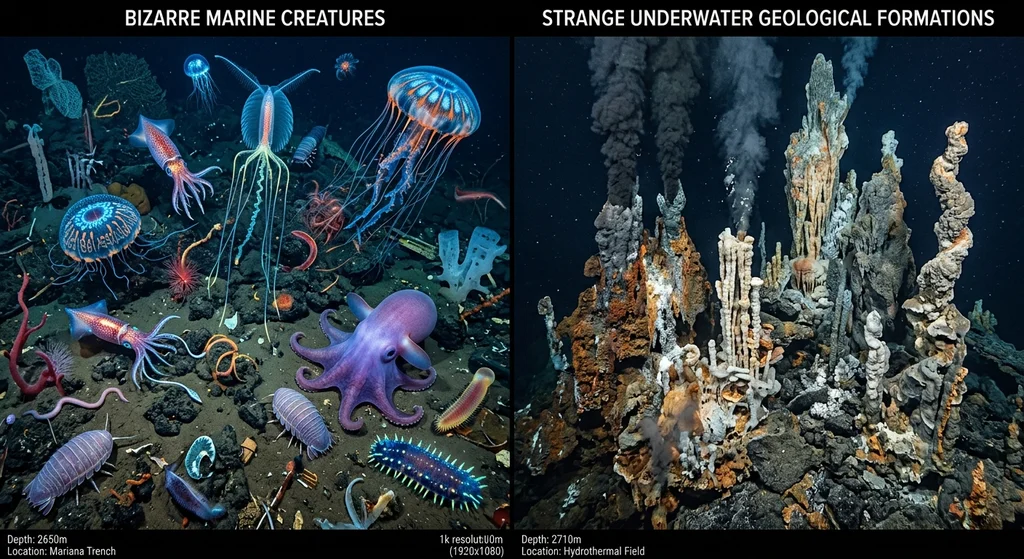
1. The Baltic Sea Anomaly
In 2011, a Swedish diving team known as “Ocean X” was scanning the floor of the Baltic Sea for shipwrecks when their sonar picked up something highly unusual. Resting at a depth of roughly 90 meters was a massive, circular object measuring 60 meters in diameter.
Its geometric shape bore a striking resemblance to the Millennium Falcon from Star Wars. As one of the most highly debated terrifying deep sea discoveries, the Baltic Sea Anomaly quickly sparked wild theories ranging from a sunken UFO to a top-secret World War II anti-submarine device.
Divers who eventually visited the site reported that their electrical equipment, including satellite phones and cameras, mysteriously stopped working when they got within 200 meters of the object. Geologists have attempted to explain it away as a glacial deposit left behind from the Ice Age, but the perfectly straight lines and right angles found on the structure continue to puzzle researchers. Until a massive excavation is funded, this strange formation remains shrouded in mystery.
2. The Mariana Trench Mysterious Sounds
The Mariana Trench is the deepest point on planet Earth, plunging nearly seven miles into the darkness of the Pacific Ocean. While the crushing pressure makes human exploration nearly impossible, autonomous hydrophones dropped into the trench have captured acoustic phenomena that rank among the most terrifying deep sea discoveries.
In 2014, scientists recorded a bizarre, metallic-sounding call echoing from the abyss. Dubbed the “Western Pacific Biotwang,” the sound lasted several seconds and featured a complex frequency sweep that sounded almost artificial.
For years, scientists debated the origin of this booming noise. Some theorized it was a top-secret submarine, while others suggested it could be a completely undiscovered species of colossal deep-water marine life.
Recently, researchers concluded it might be a new type of baleen whale call, but the immense depth and sheer volume of the sound leave plenty of room for doubt. The ocean’s acoustic landscape is full of unidentified groans, whistles, and low-frequency pulses that continually remind us how little we know.
3. The Giant Squid (Architeuthis)
For centuries, sailors whispered tales of the Kraken, a legendary sea monster capable of dragging entire ships beneath the waves. It wasn’t until the 21st century that scientists finally captured live footage of the creature that inspired the myth: the Giant Squid.
Growing up to 43 feet long with eyes the size of dinner plates, this elusive predator is undoubtedly one of the most terrifying deep sea discoveries. They dwell in the pitch-black bathypelagic zone, an area so hostile that humans can only visit inside heavily armored titanium spheres.
What makes the Giant Squid truly frightening is its arsenal of weapons. Its tentacles are lined with hundreds of sharp, serrated suction cups designed to latch onto prey and drag it toward a massive, razor-sharp beak capable of slicing through bone. Sperm whales are their only known natural predators, and the two massive beasts frequently engage in epic, unseen battles in the ocean’s depths, leaving the whales covered in massive circular scars.
4. Underwater Brinicles (The Ice Fingers of Death)
” A brinicle forms when extremely cold, highly saline water leaks out of sea ice and sinks downward into the warmer surrounding ocean. As this supercooled brine descends, it freezes the surrounding seawater, creating a descending tube of ice.
This deadly geological process represents one of the most visually stunning yet terrifying deep sea discoveries ever caught on camera.
When the brinicle finally reaches the seafloor, it doesn’t stop. The freezing brine spreads across the ocean bed like a web of ice, instantly flash-freezing any slow-moving marine life caught in its path. Starfish, sea urchins, and small bottom-dwellers are encased in ice within seconds, frozen solid in a macabre display of nature’s sheer power. The creeping death is silent, unstoppable, and completely unique to the polar abyss.
5. The Bimini Road
Located in the crystal-clear waters of the Bahamas, the Bimini Road is an underwater rock formation that has fueled debates about lost civilizations for decades. 8-kilometer stretch of massive, roughly rectangular limestone blocks arranged in a suspiciously straight line.
Many researchers immediately linked this site to the legendary lost city of Atlantis. As one of the most polarizing and terrifying deep sea discoveries, it raises the haunting question: are we looking at the ruins of an ancient human civilization swallowed by the sea?
Mainstream geologists argue that the Bimini Road is a completely natural phenomenon caused by the fracturing of sedimentary rock, a process known as tessellated pavement. However, alternative historians and some marine archaeologists point to the uniformity of the blocks and the presence of what appear to be supporting wedge stones underneath them. Whether it is nature playing tricks or a sunken relic of human history, it remains a heavily guarded ocean secret.
6. Submarine Sinkholes (Blue Holes)
Blue holes are massive submarine sinkholes that plunge hundreds of feet straight down into the ocean floor. The Great Blue Hole in Belize is perhaps the most famous, but similar formations exist around the globe. These submerged caverns rank among the most terrifying deep sea discoveries because they are effectively massive, underwater graves. The deeper you go into a blue hole, the more toxic the water becomes, eventually reaching a thick layer of hydrogen sulfide where absolutely no oxygen exists.
Divers who are brave (or foolish) enough to plunge below this toxic cloud report finding massive, perfectly preserved stalactites, proving that these caves were once above ground during the last Ice Age. Even more unsettling is what lies at the bottom. Expeditions have uncovered the remains of countless marine animals, and tragically, the preserved bodies of divers who ventured too deep and succumbed to nitrogen narcosis in the suffocating darkness.
7. The Macropinna Microstoma (Transparent Head Fish)
Evolution in the deep sea takes strange and disturbing paths. Meet the Macropinna Microstoma, a fish with a completely transparent, fluid-filled dome for a head. Captured by remotely operated vehicles in the dark depths of the Pacific Ocean, this creature represents one of the most shocking and visually terrifying deep sea discoveries in modern biology. The two dark spots on the front of its face, which look like eyes, are actually its olfactory organs used for smelling.
Its actual eyes are glowing green orbs suspended inside its transparent skull. These incredible, tubular eyes can rotate upward to scan the waters above for the silhouettes of prey, or point forward to see what it is eating. The haunting visual of seeing the inner workings of a living creature’s head as it swims through the pitch-black ocean proves that reality is often far stranger than science fiction.
8. Black Smokers and Hydrothermal Vents
Before 1977, scientists believed that all life on Earth relied entirely on the sun for energy. That changed when oceanographers made one of the most paradigm-shifting and terrifying deep sea discoveries of the 20th century: hydrothermal vents. Located thousands of feet below the surface along mid-ocean ridges, these “black smokers” are essentially underwater volcanoes spewing toxic, superheated water that reaches temperatures up to 750 degrees Fahrenheit.
The terrifying part isn’t just the extreme heat or the toxic chemicals; it’s the fact that these lethal environments are absolutely teeming with life. Giant tube worms, blind shrimp, and pale crabs thrive here, utilizing a process called chemosynthesis to convert toxic methane and sulfur into usable energy. Finding life in such a hostile, hellish environment completely rewrote the rules of biology and opened up the terrifying possibility that similar life could exist on icy moons like Jupiter’s Europa.
9. The Yonaguni Monument
Off the coast of the Ryukyu Islands in Japan lies the Yonaguni Monument, a massive underwater rock formation that looks astonishingly like a stepped pyramid. Discovered by a dive tour operator in 1986, this structure features flat terraces, sharp angles, and perfectly straight edges that span for over 160 feet.
For those who study human history, this is one of the most confusing and potentially terrifying deep sea discoveries because it implies the existence of an advanced civilization dating back over 10,000 years.
Dr. Masaaki Kimura, a marine geologist, has spent decades diving the site and passionately argues that it was built by a lost Pacific civilization known as Mu, before being submerged by massive tectonic shifts. Conversely, traditional geologists claim that the highly active tectonic plates in the region naturally split the local sandstone along perfectly straight faults. The monument remains a heavily debated underwater enigma that continues to draw explorers from around the globe.
10. Deep Sea Gigantism
If you have an aversion to bugs, this entry will likely give you nightmares. Deep-sea gigantism is an evolutionary phenomenon where invertebrates that live in the extreme depths grow to sizes vastly larger than their shallow-water relatives. The results of this biological quirk result in the most terrifying deep sea discoveries imaginable.
Take the Giant Isopod, for instance. 5 feet long, scavenging the ocean floor like a massive, armored tank.
Another terrifying example is the Japanese Spider Crab, an otherworldly arthropod with a leg span that can exceed 12 feet. Scientists believe this gigantism is an adaptation to the extreme pressure, cold temperatures, and scarce food resources of the deep ocean, which slow down their metabolism and allow them to grow continuously over extended lifespans. It is a stark reminder that down in the pitch-black abyss, the monsters of our imagination are very, very real.
Conclusion: The Abyss Is Still Watching
The ocean remains a profound mystery. As technology advances, we will undoubtedly uncover even more terrifying deep sea discoveries that will force us to reevaluate our place in the natural world. From colossal squid battling in the dark to eerie underwater monuments hinting at lost chapters of human civilization, the abyss is full of secrets waiting to be unearthed.
As the frequently highlights in their incredible nature documentaries, we know more about the surface of Mars than we do about our own ocean floor. If you found these mysteries fascinating, be sure to check out our article on 10 Insane Alien-Like Places on Earth That Actually Exist to continue your journey into the unknown.