
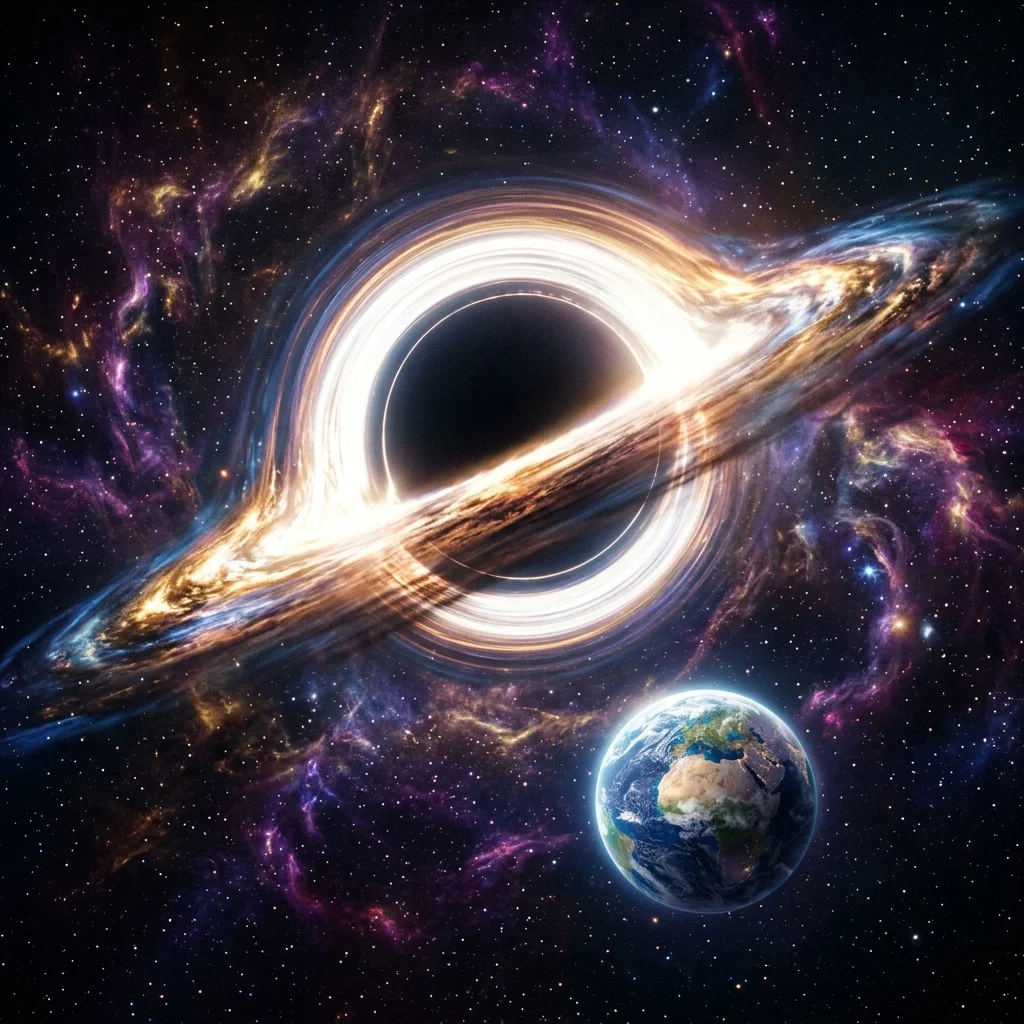
I have always been a massive space nerd, but I’ll admit something right upfront: delving too deeply into the mechanics of our cosmos sometimes genuinely scares me. Most of us go about our daily lives worrying about paying bills or what’s for dinner, completely ignoring the fact that we are spinning on a wet rock in an unfathomably massive, infinitely complex void.
When I started diving into the world of existential theories, I wasn’t prepared for the absolute reality-shattering dread that comes with understanding what physicists and philosophers are actually discovering.
I was genuinely shocked to learn that the mathematical equations governing our universe don’t just allow for bizarre scenarios—they practically guarantee them. Whether it’s the sudden, undetectable deletion of reality or the unsettling mathematical probability that we are entirely alone in a galaxy of a hundred billion stars, these concepts hit different.gov NASA’s science division.
But if you’re ready for a 3 AM rabbit hole, let’s look at the absolute most mind-bending cosmic concepts ever proposed. Brace yourself; reality is much stranger than fiction. Oh, and if this stuff fascinates you, you might also want to read about the mind-blowing paradoxes that will break your brain.
What exactly are existential theories?
Existential theories are philosophical and scientific frameworks that attempt to explain the ultimate nature of reality, human consciousness, and our place in the cosmos. These concepts explore terrifying possibilities, from the universe suddenly collapsing to the idea that we might be completely alone in an infinitely vast galaxy.
Comparing The Most Mind-Bending Cosmic Concepts
Before we dive into the specific ideas that keep me awake at night, I wanted to map out a quick overview of what we are dealing with. Some of these concepts threaten our physical existence, while others just deeply threaten our sense of meaning. Here is how they stack up against one another.
| Concept | Core Idea | Dread Factor |
|---|---|---|
| The Great Filter | An evolutionary wall destroys advanced civilizations. | High (Are we next?) |
| Vacuum Decay | Reality deletes itself at the speed of light. | Extreme (Unstoppable) |
| Rogue Planets | Unseen, wandering worlds that could smash into us. | Moderate (Statistically rare) |
| Information Paradox | Black holes permanently delete quantum data. | Mind-Breaking (Breaks physics) |
1. The Fermi Paradox: The Deafening Silence of Space
Look up at the night sky. The Milky Way alone contains an estimated 100 to 400 billion stars, and there are trillions of galaxies in the observable universe. Statistically speaking, the cosmos should be absolutely teeming with intelligent life, alien megastructures, and sprawling interstellar empires. Yet, when we point our most advanced radio telescopes to the heavens, we hear absolutely nothing. This terrifying contradiction is famously known as the Fermi Paradox.
What fascinated me most about this concept is that the absence of aliens is actually far scarier than the presence of them. If the universe is billions of years old, and it only took humanity a few million years to go from hitting rocks together to splitting the atom, someone else should have conquered the galaxy by now. The fact that the sky is utterly silent implies something deeply unsettling about the nature of life itself.
Are we the first? Are we the last? Or is there something out there keeping everyone quiet?
2. The Great Filter: The Unseen Wall
If the Fermi Paradox is the question, the Great Filter is the horrifying answer. Proposed by Robin Hanson in 1996, this hypothesis suggests that there is some sort of incredibly difficult evolutionary or technological hurdle that almost no civilization manages to pass. It acts as a universal barrier, wiping out species before they can become space-faring empires. The most chilling question is: is this filter behind us, or is it ahead of us?
This one surprised even me. If the filter is behind us—say, the leap from single-celled to multi-cellular life—then humanity is a rare miracle. But if the filter is ahead of us, it means every civilization that reaches our level of technology inevitably destroys itself.
Whether through nuclear war, climate collapse, or runaway artificial intelligence, the universe might be a graveyard of species that flew too close to the sun. Discovering ruins on Mars wouldn’t be a triumph; it would be a death sentence for our future.
3. False Vacuum Decay: The Ultimate Reset Button
Of all the concepts I researched, this is the one that genuinely gives me the creeps. In quantum physics, a “vacuum” isn’t just empty space; it has a baseline energy level.
Right now, physicists believe our universe might be sitting in a “false vacuum”—a state that feels stable but actually isn’t the absolute lowest energy state possible. If a random quantum fluctuation were to trigger a drop to the “true vacuum” anywhere in the cosmos, it would create a bubble of pure destruction.
This bubble would expand outward at the exact speed of light, completely rewriting the laws of physics, chemistry, and biology as it goes. Because it moves at light-speed, we wouldn’t see it coming. The sun, the Earth, and everyone on it would simply cease to exist instantly. We wouldn’t even have the time for our brains to process the pain or the end of reality. It’s the cosmic equivalent of someone tripping over the universe’s power cord.
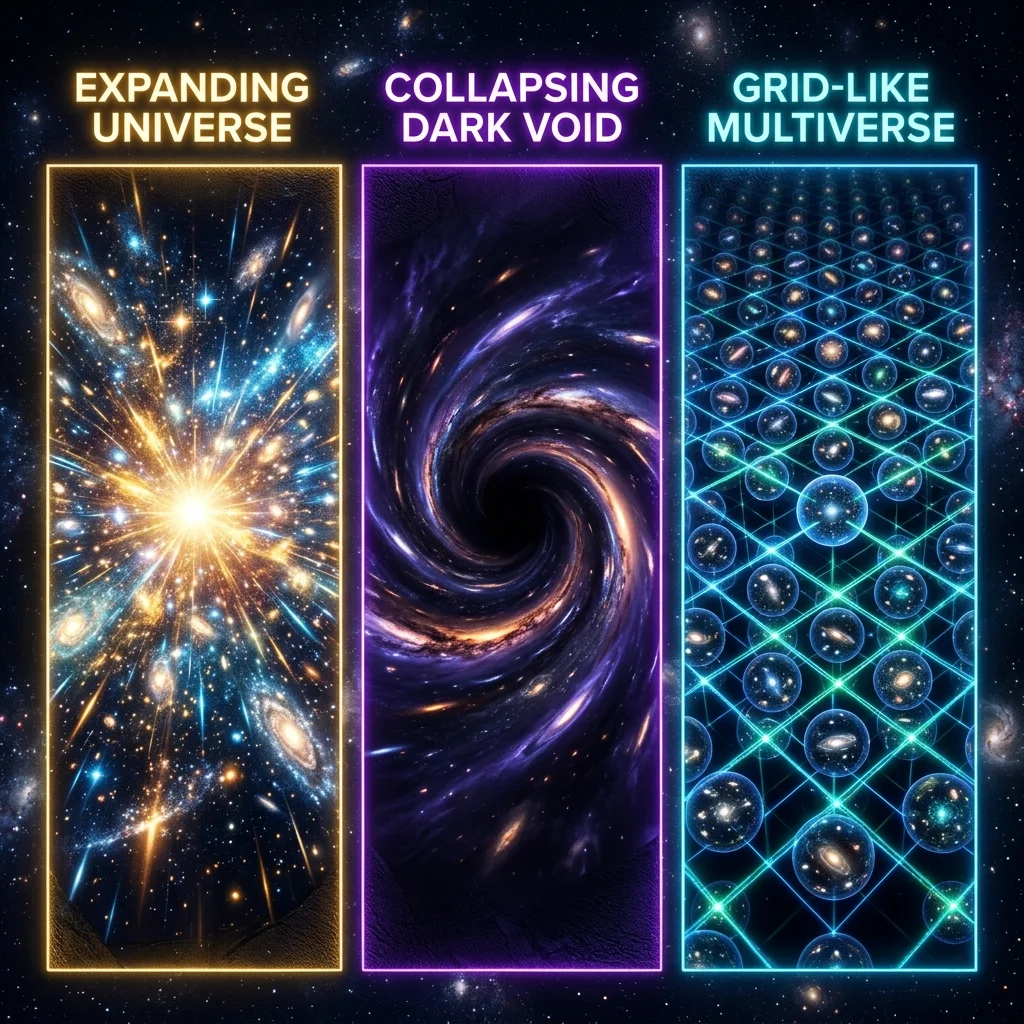
4. String Theory & The Infinite Multiverse
String theory is physicists’ best attempt to marry gravity with quantum mechanics. Instead of point-like particles, it suggests the universe is made of unimaginably tiny vibrating strings. Different vibrations produce different particles. The catch? The math of String Theory absolutely refuses to work in our familiar three dimensions of space and one of time. To make the equations function, scientists have to assume the existence of 11 different dimensions.
What makes this unsettling is what it implies: the Multiverse. If our universe is just one combination of physical laws, there could be an infinite number of other universes bubbling right next to ours, separated by microscopic dimensions we can’t perceive. In an infinite multiverse, anything that can happen does happen.
There is a universe where you are the president, and a universe where the Earth never formed. It makes our specific reality feel completely arbitrary and stripped of its unique significance.
5. Optimistic Nihilism: Embracing the Void
This is less of a physical threat and more of a deeply profound philosophical pivot. If you look at the sheer scale of the cosmos—billions of years behind us and trillions ahead of us—humanity is completely insignificant. Our planet is a speck of dust, and our entire recorded history is less than a blink of an eye in cosmic time. Eventually, the sun will explode, the stars will die, and all memory of our existence will be permanently erased.
While that sounds incredibly depressing, optimistic nihilism flips the script. Because the universe has no inherent meaning, and because our mistakes won’t matter in a billion years, we are completely free to assign our own meaning to life. I found this to be weirdly comforting. You get to dictate your own purpose. The coffee you drink, the people you love, and the experiences you have are meaningful purely because you are experiencing them right now in the present.
6. Rogue Planets: The Invisible Bullets
We are used to the comforting, predictable clockwork of our solar system. The planets orbit the sun in neat little ellipses, keeping us safe and warm. But the early days of star formation are incredibly violent, and gravitational billiards often result in whole planets being violently ejected from their solar systems. These are “rogue planets,” massive spheres of rock and gas drifting endlessly through the freezing void of deep space without a star to call home.
The scary part is that they emit absolutely no light, making them almost impossible to detect until they are right on top of us. A massive rogue planet perfectly aligning with our solar system could pass through, completely disrupting Earth’s orbit. It wouldn’t even have to hit us; just the gravitational pull of a Jupiter-sized ghost world could drag the Earth out of the habitable zone, freezing our oceans and ending all life in a matter of months.
7. The Egg Hypothesis: We Are All One
Popularized by a short story by Andy Weir, this concept touches on something known as Open Individualism. It posits that there is actually only one single consciousness in the entire universe, experiencing time linearly from different perspectives. When you die, you are simply reincarnated back into time as someone else. Every person who has ever lived, or will ever live, is actually just you living another lifetime.
I find this idea uniquely haunting but incredibly beautiful. It means that every time you were cruel to someone, you were actually being cruel to yourself. Every act of kindness was done to another version of you. Under this theory, the entire universe is essentially an “egg,” a training ground designed to mature a single cosmic consciousness through billions of unique human experiences until it is ready to hatch into a higher dimension.
8. Wormholes and Spacetime Folding
We’ve all seen wormholes in sci-fi movies, acting as convenient cosmic subways to hop from one galaxy to another. But the actual physics behind them are deeply disturbing. According to Einstein’s theory of general relativity, space and time are intertwined into a single fabric that can be bent, stretched, and folded. A wormhole—theoretically called an Einstein-Rosen bridge—is a tear in reality that connects two distant points in space-time.
But the mechanics of maintaining a wormhole would require exotic matter with negative mass to prop the throat of the tunnel open. Even more unnerving is that if you manipulate the ends of a wormhole, you don’t just travel through space; you travel through time. Traversable wormholes mathematically allow for time travel to the past, completely breaking the concept of cause and effect and opening the door to paradoxes that logic cannot resolve.
9. The Black Hole Information Paradox
In the physical world, there is a golden rule in quantum mechanics: information can never be permanently destroyed. You can burn a book to ashes, but with a sufficiently advanced computer, you could theoretically track the trajectory of every atom and photon of smoke and reconstruct the book’s contents. The data still exists. But black holes absolutely shatter this foundational rule of the universe.
Stephen Hawking discovered that black holes aren’t completely black—they slowly leak radiation and eventually evaporate into nothing. But the radiation they leak contains absolutely zero information about what originally fell into the black hole. If a black hole evaporates entirely, the quantum information of everything it consumed is permanently deleted from reality. This paradox means that either our understanding of quantum physics is completely wrong, or the universe has a trash bin that permanently deletes the building blocks of reality.
10. Heat Death: The Ultimate End of Everything
We’ve covered sudden destruction and philosophical dread, but the most universally accepted scientific fate of our cosmos is perhaps the bleakest. The universe is expanding, and the expansion is accelerating. Eventually, the galaxies will be pulled so far apart that they will lose sight of one another. The night sky will go completely dark. As stars burn through their fuel, they will flicker out one by one, leaving behind a freezing wasteland of dead planets and black holes.
Eventually, even the black holes will evaporate. The universe will reach a state of maximum entropy known as the “Heat Death.” There will be no usable energy left anywhere. Just a dilute soup of photons drifting endlessly in absolute zero temperatures. Time itself will become meaningless, because nothing will ever happen again, forever. It is the ultimate quiet conclusion to the incredible cosmic firework show we are currently lucky enough to be witnessing.
Final Thoughts
If you’re feeling a little small after reading this, trust me, you are not alone. Exploring these heavy concepts is both terrifying and oddly liberating. When you realize how fragile and incredibly rare our specific moment in cosmic history really is, the everyday anxieties of life seem to melt away. The universe is a vast, violent, and utterly bizarre place, yet here we are, conscious enough to observe it and ask questions.
Which of these existential theories kept you up at night? If you need something a little closer to home after all that space anxiety, check out these terrifying space facts that will keep you awake. Happy existential dread!
Frequently Asked Questions
Is vacuum decay actually going to happen?
While the math suggests false vacuum decay is a possibility, scientists emphasize that even if it did happen, it likely wouldn’t occur for tens of billions of years. It’s a fascinating mathematical quirk of the Higgs boson rather than an imminent threat.
What is the most likely solution to the Fermi Paradox?
There is no consensus, but many scientists believe the “Rare Earth Hypothesis” is the most likely answer. It suggests that while microbial life might be common in the universe, the complex chain of events required to create advanced, intelligent life is incredibly rare.
Can we actually observe other universes in the multiverse?
No. By definition, other universes in a multiverse model exist outside our observable reality, either separated by vast, uncrossable distances or existing in higher spatial dimensions that our 3D physics cannot interact with.