
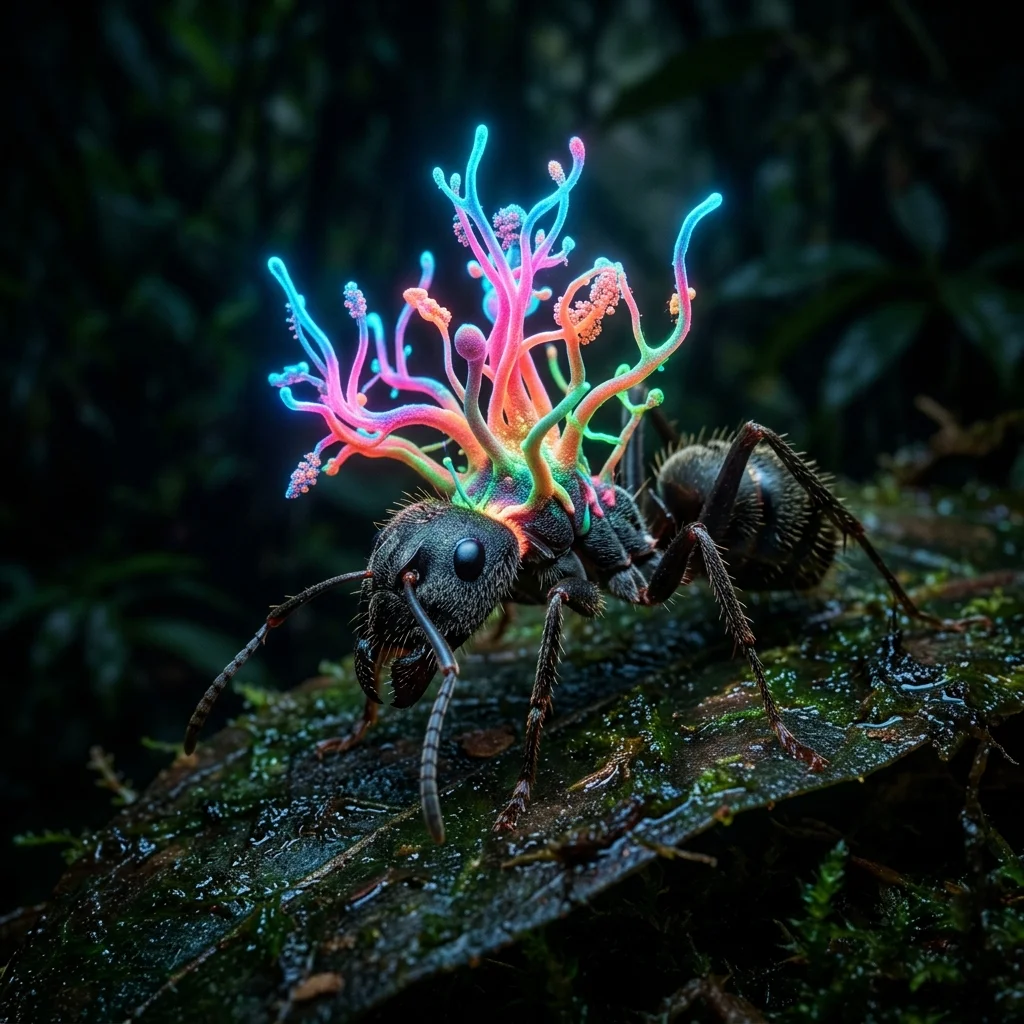
When I first started diving into the bizarre corners of evolutionary biology, I thought I had a pretty good handle on how predators and prey interact. A lion chases a gazelle, a bird eats a worm—it all makes sense. But then I discovered a hidden, microscopic world that completely shattered my understanding of nature. I’m talking about real-life body snatchers.
When you hear the phrase mind-controlling parasites, you probably think of a late-night science fiction movie or a survival horror video game. I certainly did. I was genuinely shocked to learn that these puppeteers aren’t just real; they are flourishing right beneath our feet.
What fascinated me most about these organisms isn’t just their ability to survive, but their sheer, terrifying genius. We often look at mind-blowing rare mutations in humans as the peak of biological complexity, but these microscopic invaders have evolved to literally hack the nervous systems of entirely different species.
They bypass immune systems, rewrite instincts, and force their hosts to act against their own survival BBC, the more I realized that truth really is stranger—and infinitely more terrifying—than fiction.
Are mind-controlling parasites real?
Yes, mind-controlling parasites are entirely real and documented by science. These specialized organisms—including fungi, wasps, worms, and protozoa—have evolved complex biological mechanisms to alter the behavior, neurochemistry, and instincts of their host animals, essentially turning them into living zombies to ensure the parasite’s own reproduction and survival.
How These Bizarre Organisms Compare
Before we dive into the specific nightmares these creatures unleash, I wanted to map out exactly how they operate. It’s absolutely wild to see the different strategies these organisms use to achieve the same goal: total behavioral domination.
| Parasite Name | Target Host | The “Zombie” Effect |
|---|---|---|
| Ophiocordyceps (Fungus) | Carpenter Ants | Forces ant to climb high and bite down before erupting. |
| Toxoplasma gondii (Protozoa) | Mice / Rats | Removes fear of cat predators to ensure it gets eaten. |
| Spinochordodes (Hairworm) | Crickets | Drives the insect to jump into water and drown. |
| Ampulex compressa (Wasp) | Cockroaches | Performs precise brain surgery to remove free will. |
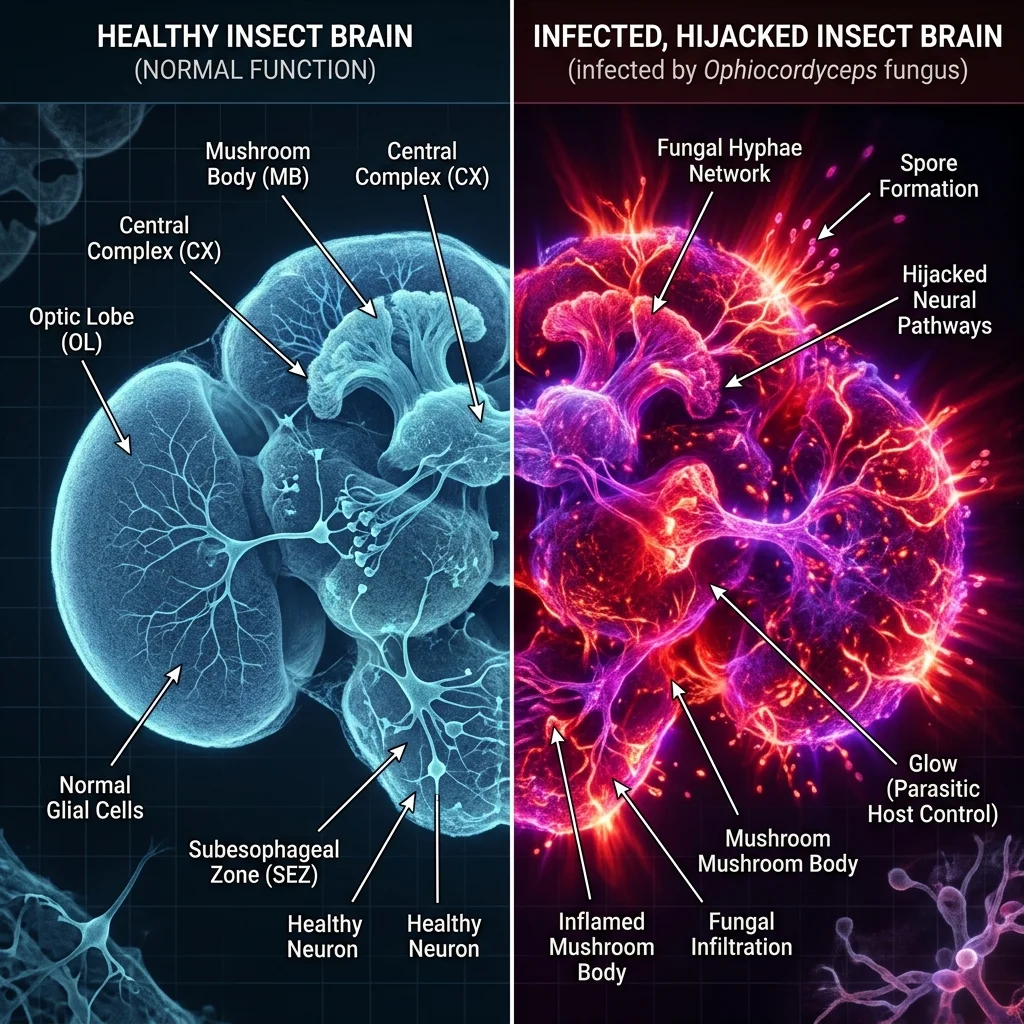
1. The Cordyceps Fungus (The Ant Hijacker)
This is the one that inspired the massively popular video game and TV show, The Last of Us. And let me tell you, the real-world version of Ophiocordyceps unilateralis is just as terrifying as the Hollywood depiction. When a carpenter ant comes into contact with the spores of this fungus, its days of free will are over. The fungus begins growing inside the ant, consuming its non-vital organs while leaving the insect perfectly alive.
But here is the part that genuinely gave me chills: once the fungus is ready to reproduce, it releases chemicals that hijack the ant’s nervous system.
” The ant then dies, and a massive stalk bursts out of its head to rain spores down onto the forest floor, infecting the rest of the colony.
2. Toxoplasma gondii (The Cat-Lover Parasite)
If you have a pet cat, there is a very real chance you have encountered this microscopic protozoan. Toxoplasma gondii has a highly specific life goal: it can only sexually reproduce inside the intestines of a feline. But to get there, it usually has to hitch a ride inside a rodent. The problem for the parasite? Mice and rats are naturally terrified of cats and will run away at the first whiff of cat urine.
The solution this organism came up with is absolutely mind-blowing. Once a mouse ingests the parasite, it travels to the rodent’s brain and rewires its fear responses. Suddenly, the mouse is no longer afraid of cats. In fact, the parasite tweaks the rodent’s dopamine levels so that the smell of cat urine actually becomes sexually attractive to the mouse. The rodent happily walks right up to the cat, gets eaten, and the parasite successfully completes its life cycle.
3. Leucochloridium paradoxum (The Disco Snail Invader)
I remember seeing a video of an infected amber snail for the first time and thinking it looked like a terrible CGI effect. The snail’s eyestalks were massively swollen, violently pulsing with vibrant green, yellow, and red bands. It looked less like an animal and more like a neon sign flashing in the forest. This horrifying display is the work of a parasitic flatworm called Leucochloridium paradoxum.
The flatworm’s ultimate goal is to end up in the digestive tract of a bird. To accomplish this, it invades the snail’s eyestalks and mimics the appearance of a juicy, pulsating caterpillar—a bird’s favorite snack. But the manipulation goes far deeper than a visual trick.
Snails are naturally nocturnal and hide in the dark to avoid predators. The parasite alters the snail’s brain chemistry, forcing the usually cautious creature out into the bright, open sunlight where birds can easily spot it.
4. The Emerald Jewel Wasp (The Neurosurgeon)
If there was a villain in the insect kingdom, the Emerald Jewel Wasp (Ampulex compressa) would be the undisputed kingpin. This gorgeous, iridescent wasp uses American cockroaches as living nurseries for its young. But cockroaches are large, fast, and aggressive. A small wasp can’t simply drag one away. Instead, it turns the cockroach into a perfectly compliant zombie through highly precise neurosurgery.
First, the wasp delivers a quick sting to the roach’s midsection to temporarily paralyze its front legs. Then comes the masterstroke: the wasp carefully inserts its stinger directly into the roach’s brain. It injects a custom venom cocktail specifically into the neural nodes that control the escape reflex.
The roach isn’t paralyzed—it can still walk perfectly fine. It has simply lost the *will* to move. The wasp then grabs the roach by its antennae and walks it like a dog on a leash straight into its burrow.
5. Spinochordodes tellinii (The Suicidal Hairworm)
This entry is the stuff of absolute nightmares. Hairworms start their lives as microscopic larvae in stagnant water, usually getting swallowed by mosquito larvae. When those mosquitoes grow up, they fly onto land and eventually get eaten by crickets or grasshoppers.
Once inside the cricket, the hairworm begins to grow—and I don’t mean it grows a little bit. It can grow up to four times longer than the host insect itself, coiling up inside its body cavity like tightly packed spaghetti.
When the massive worm is ready to mate, it faces a major hurdle: it must return to water, but crickets naturally avoid water because they can’t swim. To bridge this gap, the hairworm floods the cricket’s brain with neurotransmitters that completely reverse its instincts. The cricket becomes overwhelmingly attracted to the reflection of light off water bodies.
It leaps into the nearest pool, pond, or puddle, committing immediate suicide. As the host drowns, the massive worm violently bursts out of the cricket’s exoskeleton to swim free.
6. Sacculina carcini (The Gender-Bending Barnacle)
We usually think of barnacles as harmless, crusty little shells stuck to the bottom of boats or whales. But Sacculina carcini is a parasitic barnacle that makes a living by completely overtaking the body, mind, and even the gender of green crabs. When a female Sacculina finds a crab, she injects herself into its bloodstream as a microscopic slug. From there, she grows tendrils throughout the crab’s entire body, including wrapping directly around its brain.
Once she is in control, she forces the crab to stop molting and stop reproducing. The crab essentially becomes a biological robot existing only to feed the parasite.
But here is the truly shocking part: if the host is a male crab, the parasite chemically alters his hormones, completely feminizing him. His abdomen widens, he begins performing female mating dances, and when the parasite releases its eggs, the male crab aggressively protects and nurtures them exactly as a mother crab would care for her own offspring.
7. Glyptapanteles (The Voodoo Wasp)
This parasitic wasp takes the concept of the “Stockholm Syndrome” to terrifying new extremes. The female Glyptapanteles wasp targets the Thyrinteina leucocerae caterpillar, injecting up to 80 eggs directly into its body. For weeks, the caterpillar lives a normal life, eating leaves and growing fat, completely unaware that dozens of wasp larvae are slowly devouring its bodily fluids from the inside out.
Eventually, the larvae chew their way out of the caterpillar’s skin and spin tiny cocoons on a nearby leaf. You would expect the critically wounded caterpillar to die or crawl away, right? Not a chance.
Two or three larvae stay behind inside the caterpillar, sacrificing themselves to hijack the host’s brain. The half-dead caterpillar completely stops eating and instead stands guard over the cocoons. If a predator like a stink bug approaches, the zombie caterpillar thrashes violently to scare them away, fiercely defending the very creatures that just ate it alive.
8. Euhaplorchis californiensis (The Dancing Brain Worm)
Deep inside the muddy estuaries of Southern California lives a microscopic trematode worm that orchestrates one of the most intricate biological plays in existence. Euhaplorchis californiensis needs to pass through a snail, a fish, and finally a bird to complete its life cycle. The transition from fish to bird is where the mind control comes into play.
Once the worm larvae infect a California killifish, they travel straight to its brain, forming a shimmering carpet over the fish’s neural tissue. Under normal circumstances, killifish swim deep in the water to hide from predatory birds. But the brain worms alter the fish’s serotonin and dopamine levels.
This forces the infected fish to swim right up to the water’s surface and perform erratic, flashing “dances”—darting sideways and exposing their shiny silver bellies to the sky. This makes them ten to thirty times more likely to be spotted and eaten by wading birds.
9. Hymenoepimecis argyraphaga (The Web-Hijacker)
In the rainforests of Costa Rica, a specialized parasitic wasp turns an orb-weaving spider into an unwilling, highly skilled architect. Most spiders weave intricate, circular webs designed to catch flying insects. But when a female Hymenoepimecis argyraphaga paralyzes a spider and glues an egg to its abdomen, the spider’s architectural skills are forcefully reprogrammed.
As the wasp larva grows, it feeds on the spider’s hemolymph (blood). On the night before the larva is ready to pupate, it injects a mysterious, mind-altering chemical into the spider. Suddenly, the spider abandons its normal web-building instincts.
Instead, it works tirelessly all night to spin a heavily reinforced, completely custom “suspension web” consisting of just a few incredibly strong cables. This structure is useless for catching food, but it is the absolute perfect anchor for a wasp cocoon. Once the web is finished, the larva kills the spider, drinks it dry, and hangs its cocoon from the very masterpiece the spider was forced to build.
10. Ribeiroia ondatrae (The Frog Mutator)
While the previous entries focus heavily on chemical mind control, Ribeiroia ondatrae achieves behavioral dominance through pure, horrific physical mutation. This flatworm parasite needs to end up in the belly of a heron or other wetland bird. To get there, it targets developing tadpoles in ponds. But rather than altering brain chemistry, it physically rewrites the frog’s body plan.
The microscopic parasite burrows directly into the tadpole’s limb buds. As the frog develops, the parasite severely disrupts its cell growth, causing the amphibian to grow multiple, useless extra legs, or sometimes forcing limbs to grow backward. Why?
Because a frog with six mangled legs cannot jump properly. It becomes clumsy, slow, and completely incapable of escaping predators. By physically mutating the host to destroy its mobility, the parasite guarantees that the frog will become an easy meal for a hungry bird.
Conclusion
Learning about mind-controlling parasites has completely changed the way I look at the natural world. It proves that survival isn’t just about sharp teeth or brute strength; sometimes, it’s about biochemical warfare and microscopic sabotage.
These ten examples showcase an evolutionary arms race that is as brilliant as it is profoundly disturbing. If you found these creatures fascinating, you should definitely check out our guide to incredible bizarre natural phenomena, where we explore even more mind-bending scientific wonders that will leave you questioning reality!
Frequently Asked Questions
Can mind-controlling parasites infect humans?
While most of these highly specialized parasites target specific insects or animals, humans can be infected by Toxoplasma gondii. However, our complex brains usually prevent full “zombification.” Studies suggest it may cause subtle behavioral shifts, but you don’t need to worry about being mind-controlled like a grasshopper!
How do these parasites actually control the brain?
It varies by species, but most rely on complex biochemistry. They secrete custom proteins and neurotransmitters (like dopamine or serotonin) that mimic the host’s natural chemicals, effectively allowing them to override the host’s central nervous system and rewrite their survival instincts.
Are there any parasites that replace organs?
Yes! While not strictly a “mind-controller,” the Cymothoa exigua (tongue-eating louse) enters a fish through its gills, severs the blood vessels to the fish’s tongue, and physically attaches itself to become a living, functioning replacement tongue for the host.
For more on this topic, visit National Geographic and Smithsonian Magazine.