
I was genuinely shocked to learn that despite having laser-guided ground-penetrating radar and artificial intelligence capable of mapping entire lost cities, some of the most unexplained archaeological mysteries on Earth continue to completely stump the world’s brightest minds.
We tend to think of the modern era as an age where everything has been mapped, categorized, and neatly explained in textbooks. Yet, according to features published by , there are still objects, monuments, and texts buried beneath the dirt that completely defy our conventional understanding of human history.
These discoveries laugh in the face of our established timelines.
What fascinated me most while researching these historical anomalies is how many of them shouldn’t exist based on what we know about ancient technology.
It is one thing to find an old broken pot, but it is an entirely different reality when you unearth an ancient analog computer or a massive subterranean city capable of housing tens of thousands of people. These incredible finds remind us that our ancestors were far more capable—and mysterious—than we give them credit for.
If you find yourself captivated by the unknown, you’ll also want to check out our deep dive into the mysterious ancient artifacts that continue to baffle scientists worldwide.
What Are the Greatest Unexplained Archaeological Mysteries in the World?
The greatest unexplained archaeological mysteries include the undeciphered Voynich Manuscript, the impossibly precise stonework of Pumapunku, the purpose of the Roman Dodecahedrons, and the advanced ancient mechanics of the Antikythera Mechanism. Despite decades of modern scientific analysis, these historical anomalies completely lack verified explanations regarding their creators, purposes, or methods of construction.
📋 Table of Contents
Overview of These Unexplained Archaeological Mysteries
Before we dive into the specific details of these incredible finds, it helps to understand the sheer scale and global spread of these enigmas. From the remote mountains of South America to the deep underground caves of Turkey, these unexplained archaeological mysteries prove that human history is full of missing chapters.
The table below outlines the core facts about each mystery, giving you a quick glimpse at the impossible timelines, strange materials, and bizarre locations that make these ten entries so genuinely mind-boggling.
| # | Name | Key Fact | Location/Category |
|---|---|---|---|
| 1 | Voynich Manuscript | Completely undecipherable text | Italy (Originated) |
| 2 | Göbekli Tepe | Predates agriculture by millennia | Turkey |
| 3 | Antikythera Mechanism | Ancient Greek analog computer | Greece |
| 4 | Plain of Jars | Thousands of massive stone jars | Laos |
| 5 | Pumapunku | Laser-precise interlocking stone | Bolivia |
| 6 | Copper Scroll | Treasure map etched in metal | West Bank |
| 7 | Rongorongo Script | Undeciphered isolated language | Easter Island |
| 8 | Derinkuyu City | Subterranean city for 20,000 | Turkey |
| 9 | Tarim Mummies | European features in ancient China | China |
| 10 | Roman Dodecahedrons | Bronze objects with no written record | Europe |
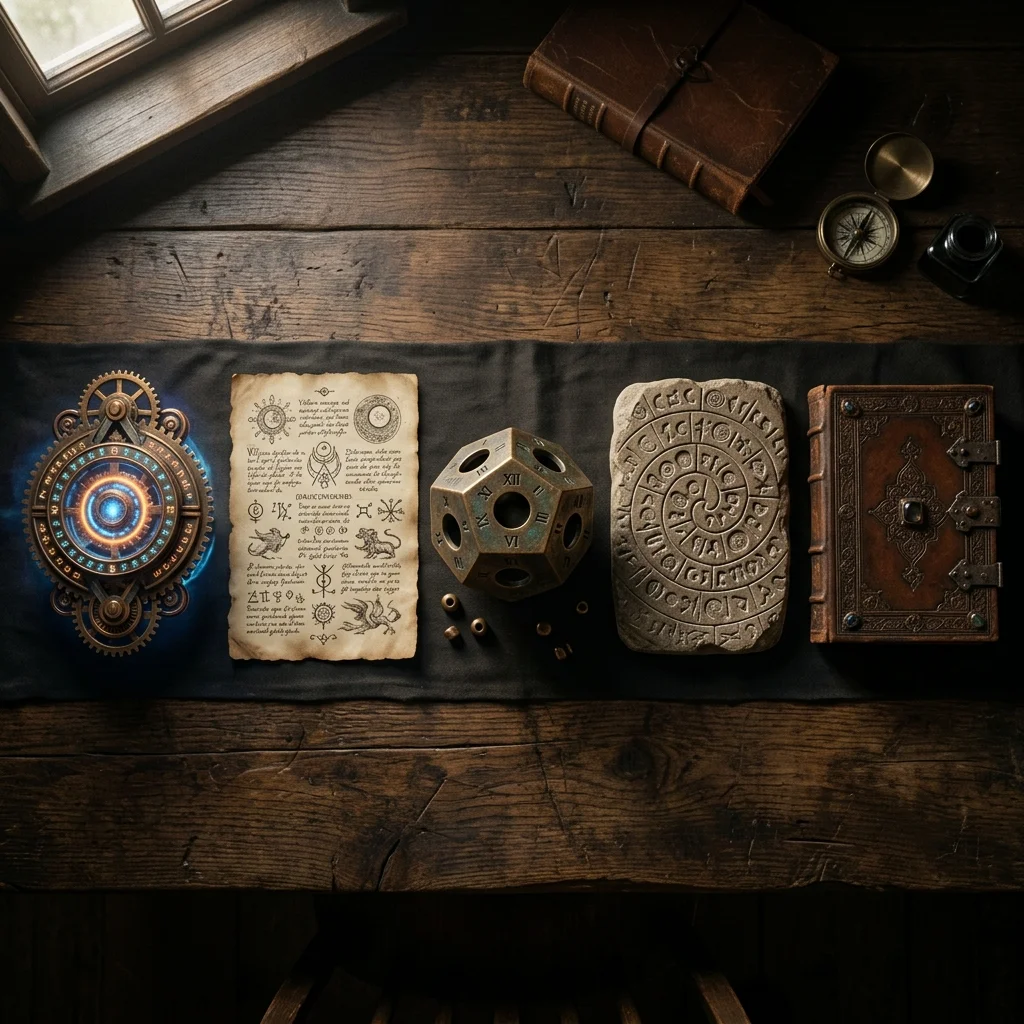
1. The Voynich Manuscript — An unexplained archaeological mystery in written form
What fascinated me most about the Voynich Manuscript is that it actively taunts modern science. Discovered in 1912 by a Polish book dealer named Wilfrid Voynich, this 240-page illustrated book is written in a language or code that no one on Earth can read.
You would think that with today’s supercomputers and AI-driven cryptography, we could crack a 15th-century text in an afternoon. I was genuinely shocked to learn that every single attempt by professional codebreakers, including the brilliant minds who cracked the Enigma code during World War II, has resulted in absolute failure. The text completely defies decipherment.
The mystery deepens when you look at the intricate, bizarre illustrations that accompany the text. The manuscript is filled with detailed drawings of plants that do not exist on this planet, naked women bathing in strange green liquids connected by tubes, and elaborate astrological charts that don’t match any known constellations. The counter-intuitive part?
Linguistic analysis proves that the text isn’t just random gibberish. It adheres to Zipf’s Law, a statistical rule that governs the structure of all genuine human languages. Whoever wrote this didn’t just smash a pen onto parchment; they used a highly structured, fully functional language that has been entirely lost to the sands of time.
2. Göbekli Tepe — The temple that rewrites human history
I remember the exact moment I first read about Göbekli Tepe, and it completely shattered everything I thought I knew about human evolution. Located in modern-day Turkey, this sprawling archaeological site is composed of massive, intricately carved stone pillars arranged in massive circles.
Here is the part that will twist your brain: these structures were built over 11,000 years ago. To put that staggering timeline into perspective, Göbekli Tepe is older than the invention of agriculture, older than the wheel, and predates Stonehenge by a whopping 6,000 years.
It was constructed by hunter-gatherers who supposedly didn’t possess the social organization required to build massive megalithic monuments.
The traditional historical narrative insists that humans had to invent farming first, settle down into villages, and then slowly develop the spare time required to build temples and complex religions.
Göbekli Tepe suggests the exact opposite might be true: the desire to build a massive religious monument may have forced these ancient people to invent agriculture just to feed the massive workforce. But the most baffling detail of all is its end. After using the site for centuries, the builders didn’t just abandon it.
They intentionally buried the entire sprawling complex under thousands of tons of dirt and refuse, hiding it from the world for over ten millennia.
3. The Antikythera Mechanism — A computer from ancient Greece
When it comes to unexplained archaeological mysteries, few objects are as scientifically jarring as the Antikythera Mechanism. Discovered by sponge divers in 1901 off the coast of a small Greek island, this corroded lump of bronze turned out to be an impossibly complex analog computer.
I was absolutely amazed to discover that this device, built around 100 BCE, contains a sophisticated system of over 30 interlocking bronze gears. It was designed to predict astronomical positions, eclipses, and even track the four-year cycle of the ancient Olympic games with terrifying precision.
The existence of this device is an absolute historical paradox. According to the experts who have scanned the device using 3D X-ray microfocus tomography, the mechanism utilizes a complex differential gear. This is a type of mechanical engineering that supposedly wasn’t invented until the 16th century, well over a thousand years later.
It’s the equivalent of finding a fully functional jet engine buried inside a medieval castle. We have zero evidence of intermediate devices leading up to its creation, and the knowledge required to build it mysteriously vanished for over a millennium.
4. The Plain of Jars — Laos’s heavy stone enigma
In the lush, war-torn highlands of Laos sits an incredibly haunting and massive puzzle known as the Plain of Jars. Spread across thousands of square miles are more than 2,000 giant stone jars, carved from solid rock.
What shocked me the most about this unexplained archaeological mystery is the sheer, brutal physical effort required to create it. Some of these megalithic stone jars weigh up to 14 tons and stand almost 10 feet tall.
Yet, the stone they are carved from doesn’t match the bedrock of the plain; they were dragged from quarries located miles away over rough, mountainous terrain.
The true purpose of these massive stone vessels remains heavily debated. Local legends insist they were created by a race of giants to brew massive quantities of rice wine to celebrate a great military victory.
Modern archaeologists lean toward a much darker theory: they were likely part of complex ancient burial practices, serving as massive urns where bodies were left to decompose before their bones were cleaned and finally buried. Unfortunately, investigating this site is incredibly dangerous today.
During the Vietnam War, the area was heavily bombed, and millions of unexploded cluster munitions still litter the landscape, severely limiting archaeological research.
5. Pumapunku — The impossible masonry of Bolivia
If you ever want to see stones that look like they were cut yesterday with a laser beam, look no further than Pumapunku in Bolivia. Located nearly 13,000 feet above sea level in the Andes, this ancient ruined temple complex is famous for its mind-bending stonework.
I was absolutely floored to learn that the ancient Tiwanaku people, who lacked written language and the wheel, managed to carve massive blocks of andesite with microscopic precision. These H-shaped blocks interlock like massive pieces of a Lego set, with corners so perfectly square that not even a razor blade can fit between the joints.
The counter-intuitive reality of Pumapunku is the material itself. Andesite is an incredibly hard volcanic rock. In the modern era, cutting andesite with this level of smooth, sharp precision requires specialized diamond-tipped masonry tools and heavy-duty electric saws.
The idea that indigenous people achieved this using only primitive stone tools and copper chisels stretches the limits of plausibility. How did they achieve such perfect geometry? And how did they move stone slabs weighing up to 131 tons across the high-altitude, treeless landscape? It remains a spectacular mystery that refuses to be solved.
6. The Copper Scroll — A billion-dollar entry among unexplained archaeological mysteries
Among the famous Dead Sea Scrolls discovered in the caves of Qumran, one document stood out in a completely bizarre way. While the other scrolls were written on delicate parchment or papyrus containing religious texts, the Copper Scroll was deeply engraved onto thin sheets of pure copper.
What fascinated me most about this specific artifact isn’t just its unique material, but its contents. It is not a religious text or a prayer—it is quite literally a real-life treasure map. The text lists 64 specific locations scattered across the ancient Middle East where massive caches of gold and silver are hidden.
The quantities described in this metal document are absolutely staggering. If the ancient measurements are accurately translated, the scroll details the location of roughly 4,600 talents of precious metals. In today’s market, that hoard would be worth well over a billion dollars. The mystery lies in the deeply cryptic instructions.
Directions like “In the salt pit that is under the steps: forty-one talents” or “In the cave of the old washer’s chamber” are incredibly localized. Despite numerous massive expeditions led by seasoned archaeologists and treasure hunters over the last seventy years, not a single coin from this legendary hoard has ever been found.
7. The Rongorongo Script — The lost voices of Easter Island
Easter Island is globally famous for its massive monolithic statues, the Moai, but it harbors another, perhaps more profound secret. During the 19th century, missionaries discovered a series of wooden tablets inscribed with strange glyphs known as Rongorongo.
I was genuinely shocked to realize that this script represents one of the very few times in human history that a written language was independently invented from scratch. The symbols feature strange depictions of animals, plants, and geometric shapes, intricately carved into the wood using shark teeth or obsidian flakes.
The truly counter-intuitive aspect of Rongorongo is how it was meant to be read. It uses a system called reverse boustrophedon.
You read the first line from left to right, then you must physically turn the wooden tablet 180 degrees upside down to read the second line, continuing this spinning motion all the way down the board.
Tragically, in the 1860s, Peruvian slave raiders decimated the island’s population, kidnapping or killing the few elders who actually knew how to read the script. Today, only two dozen of these tablets exist globally, and the beautiful language carved into them remains entirely untranslated, locking away the island’s true history forever.
8. Derinkuyu Underground City — A massive subterranean refuge
When investigating unexplained archaeological mysteries, the sheer scale of Derinkuyu is hard to comprehend. Discovered by pure accident in 1963 when a Turkish man knocked down a wall in his basement, this site revealed a staggering subterranean metropolis.
Carved directly into the soft volcanic tuff rock of Cappadocia, Derinkuyu plunges an unbelievable 18 stories deep beneath the Earth’s surface. What absolutely blew my mind was learning that this underground bunker was designed to hold up to 20,000 people, along with their livestock and food supplies, for months at a time.
The engineering required to build this is nothing short of miraculous for the ancient world. The city features over 15,000 ventilation shafts strategically placed to bring fresh oxygen down to the deepest levels, preventing carbon dioxide poisoning. It contains elaborate wine presses, stables, religious chapels, and schools.
To protect against invaders, massive, circular stone doors weighing up to 1,000 pounds could be rolled across the corridors from the inside. While we know various groups used it to hide from invasions over centuries, archaeologists still cannot agree on who initially carved out this massive underground world, or exactly when the colossal excavation began.
9. The Tarim Mummies — A genetic and geographical paradox
Deep within the inhospitable Taklamakan Desert of Xinjiang, China, lies an archaeological discovery that completely contradicts our understanding of ancient migration. Starting in the early 20th century, explorers began uncovering hundreds of incredibly well-preserved mummies.
But here is the bizarre twist that threw archaeologists for a loop: these mummies, dating back up to 4,000 years, possessed distinctly Caucasian features. They had blonde or red hair, light skin, high cheekbones, and were buried wearing brightly colored, woven tartan fabrics that look like they belong in the Scottish Highlands.
The dry, salty environment of the desert naturally mummified these people, preserving their clothing, tattoos, and even the food they were buried with in pristine condition.
DNA testing has confirmed they have genetic ties to Western Eurasian populations, creating a massive mystery about how and why they settled in one of the most brutal deserts in East Asia thousands of years ago.
To make things even weirder, they were buried in upside-down wooden boats covered in cowhide, in a region completely devoid of rivers or oceans. They represent an isolated pocket of humanity whose unique culture and origins have entirely vanished.
10. The Roman Dodecahedrons — The object history forgot
We know an incredible amount about the ancient Romans. They were meticulous record-keepers who documented their wars, recipes, engineering techniques, and politics in painstaking detail. Yet, there is one bizarre artifact they left behind that completely defies explanation. Across Northern Europe, archaeologists have unearthed over 100 strange, hollow bronze objects known as Roman Dodecahedrons.
These objects feature twelve flat pentagonal faces, each with a differently sized hole in the center, and small knobs on every corner. They look like strange puzzle pieces or advanced mathematical models.
What makes this so infuriatingly fascinating is that in the millions of words of surviving Roman literature, there is absolutely zero mention of these objects. Not a single painting, mosaic, or text explains what they are. Theories range wildly from the practical to the absurd.
Some believe they were surveying instruments for laying out Roman roads, while others suggest they were used to measure the optimal time for sowing winter grain based on the angle of sunlight. A popular modern theory even suggests they were simply intricate tools used for knitting wool gloves.
Without a single word of historical context, they remain a tantalizing blind spot in one of history’s most well-documented empires.
Final Thoughts on These Unexplained Archaeological Mysteries
Delving into these unexplained archaeological mysteries has been a profoundly humbling experience. For all our advanced technology, satellite mapping, and genetic sequencing, we are repeatedly reminded that the past holds secrets we may never fully uncover.
What fascinated me the most was the sheer variety of these puzzles—from the impossibly hard andesite stones carved with laser-like precision at Pumapunku to the billion-dollar treasure map of the Copper Scroll that continues to elude modern hunters.
It makes you wonder: what artifacts from our modern era will completely baffle future historians thousands of years from now? If you loved diving into these puzzles, you should definitely read our piece on the 10 Mysterious Ancient Structures That Defy Explanation to keep the curiosity going.
Which of these historical anomalies shocked you the most? Do you think we will ever crack the Voynich Manuscript or find the lost gold of Qumran? Drop a comment below—I’d love to hear your theories!

Written by the List of Ten Team
We research and verify every fact in our lists using peer-reviewed sources, official records, and expert interviews. Our goal: content that genuinely surprises and educates curious readers worldwide.
🕒 Last updated: 2026-05-11 — Facts verified and list reviewed for accuracy.
Frequently Asked Questions
Why are there so many unexplained archaeological mysteries today?
Even with modern technology, we are separated from these ancient cultures by thousands of years. Natural degradation, warfare, intentional destruction of records, and lost languages mean that we often lack the vital context needed to understand these unexplained archaeological mysteries. We are essentially trying to solve a jigsaw puzzle with half the pieces permanently missing.
Will AI ever be able to decipher the Voynich Manuscript?
Artificial Intelligence has been heavily utilized in recent years to analyze the Voynich Manuscript. While AI algorithms have successfully confirmed that the text follows the natural statistical rules of a real language, it still cannot translate it.
Without a “Rosetta Stone” or bilingual text to provide a baseline, AI lacks the contextual data required to unlock the meaning behind the symbols.
How did ancient people build things like Pumapunku without modern tools?
This remains a point of heavy debate among structural engineers and historians.
While some believe ancient people used tremendous amounts of manpower, sand abrasion, and primitive copper chisels over decades, the sheer precision of the cuts suggests the possibility of lost ancient techniques, such as primitive rotary drills or chemical stone-softening methods that we have yet to rediscover.
Is it legal to dig for the treasure mentioned in the Copper Scroll?
No, amateur treasure hunting is strictly illegal in the regions mentioned by the Copper Scroll. The areas described are heavily regulated archaeological zones overseen by the Israel Antiquities Authority and Palestinian authorities. Any excavation requires extensive official permits, and anything discovered automatically belongs to the state, not the individual who unearths it.
For more on this topic, visit National Geographic and Smithsonian Magazine.