
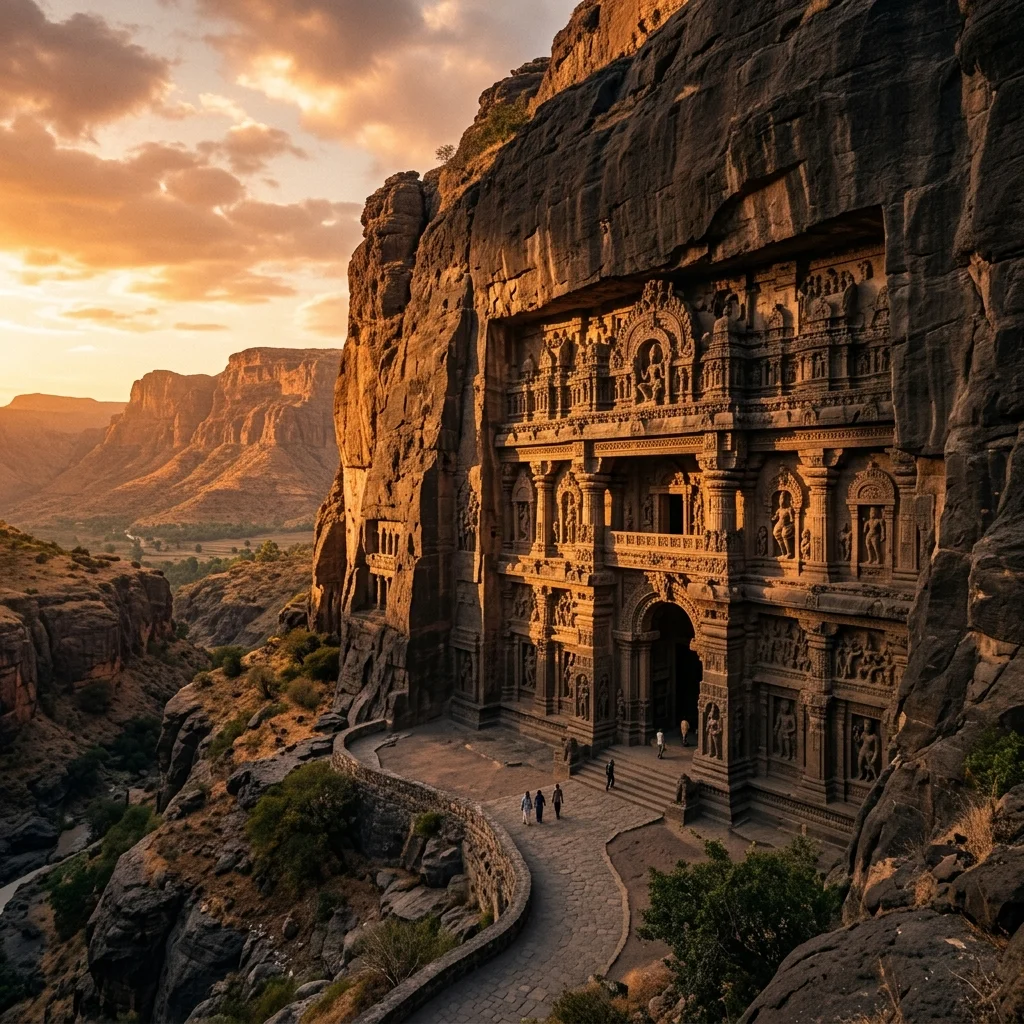
I was genuinely shocked to learn that modern construction companies with massive hydraulic cranes and laser-guided cutting tools would struggle to rebuild the Great Pyramid today. We tend to suffer from “chronological snobbery,” assuming that because we live in the digital age, our ancestors were just hammering crude rocks together in the dirt.
But when you start looking closely at ancient engineering marvels across the globe, that illusion shatters instantly. From self-healing concrete that actually gets stronger after two millennia to monolithic temples carved perfectly out of single mountains, the past is filled with technological achievements that completely defy our conventional understanding of human history.
Researchers at institutions like the frequently publish findings that force us to rewrite the textbooks on what ancient builders were truly capable of achieving without electricity, heavy machinery, or computers.
What fascinated me most during my research is not just that these structures exist, but that in many cases, modern structural engineers have openly admitted they do not fully understand the methods used to create them.
We are talking about precision so exact that you can’t slide a single sheet of paper between megalithic stones weighing hundreds of tons. Whether it was through lost acoustic technologies, ingenious chemical mixtures, or simply an incomprehensible level of generational patience, these builders left behind a legacy that laughs in the face of modern architecture.
If you’ve ever found yourself captivated by mysterious ancient artifacts, this deep dive into the world’s most baffling structural achievements is going to completely change how you view human history. Let’s dig into the past and explore the impossible.
What Are the Most Baffling Ancient Engineering Marvels?
The most baffling ancient engineering marvels include Peru’s Sacsayhuamán walls, the self-healing Roman concrete of the Pantheon, India’s top-down carved Kailasa Temple, and the incredibly precise interlocking stones of Pumapunku in Bolivia. These structures feature advanced construction techniques that modern engineers still struggle to fully replicate or explain.
📋 Table of Contents
- Exploring the World’s Greatest Ancient Engineering Marvels
- 1. Pumapunku — The Impossible Interlocking Stones
- 2. Derinkuyu — The 18-Story Underground Metropolis
- 3. Roman Concrete — The Recipe That Heals Itself
- 4. Sacsayhuamán — The Jigsaw Walls Without Mortar
- 5. The Barabar Caves — The Mirrors Carved from Granite
- 6. Nan Madol — The Sinking Megalithic City on a Reef
- 7. Göbekli Tepe — The Monument That Predates Agriculture
- 8. Chand Baori — The Ancient Climate-Controlled Stepwell
- 9. The Nazca Puquios — The Subterranean Wind Pumps
- 10. Kailasa Temple — The Monument Carved Top-Down
- Frequently Asked Questions
Exploring the World’s Greatest Ancient Engineering Marvels
Before we break down each specific site, it helps to see the sheer geographic and chronological scale of what we are dealing with. These extraordinary sites span almost every major continent, bridging thousands of years of human development.
What truly unites them is a shared mastery of their local environments and materials, resulting in structures that have outlasted empires, natural disasters, and the relentless march of time itself.
| # | Name | Key Fact | Location |
|---|---|---|---|
| 1 | Pumapunku | Millimeter-perfect cuts in solid andesite rock. | Bolivia |
| 2 | Derinkuyu | An underground city built to hold 20,000 people. | Turkey |
| 3 | Roman Concrete | Self-healing chemistry that outlasts modern blends. | Italy |
| 4 | Sacsayhuamán | 150-ton puzzle-piece stones laid without mortar. | Peru |
| 5 | Barabar Caves | Granite walls polished to a mirror-like reflection. | India |
| 6 | Nan Madol | Massive basalt log city built atop a coral reef. | Micronesia |
| 7 | Göbekli Tepe | Megalithic pillars erected before the invention of the wheel. | Turkey |
| 8 | Chand Baori | 13-story inverted pyramid designed for passive cooling. | India |
| 9 | Nazca Puquios | Spiral funnels using wind to push underground water. | Peru |
| 10 | Kailasa Temple | Entire temple excavated top-down from a cliff face. | India |
1. Pumapunku — The Impossible Interlocking Stones
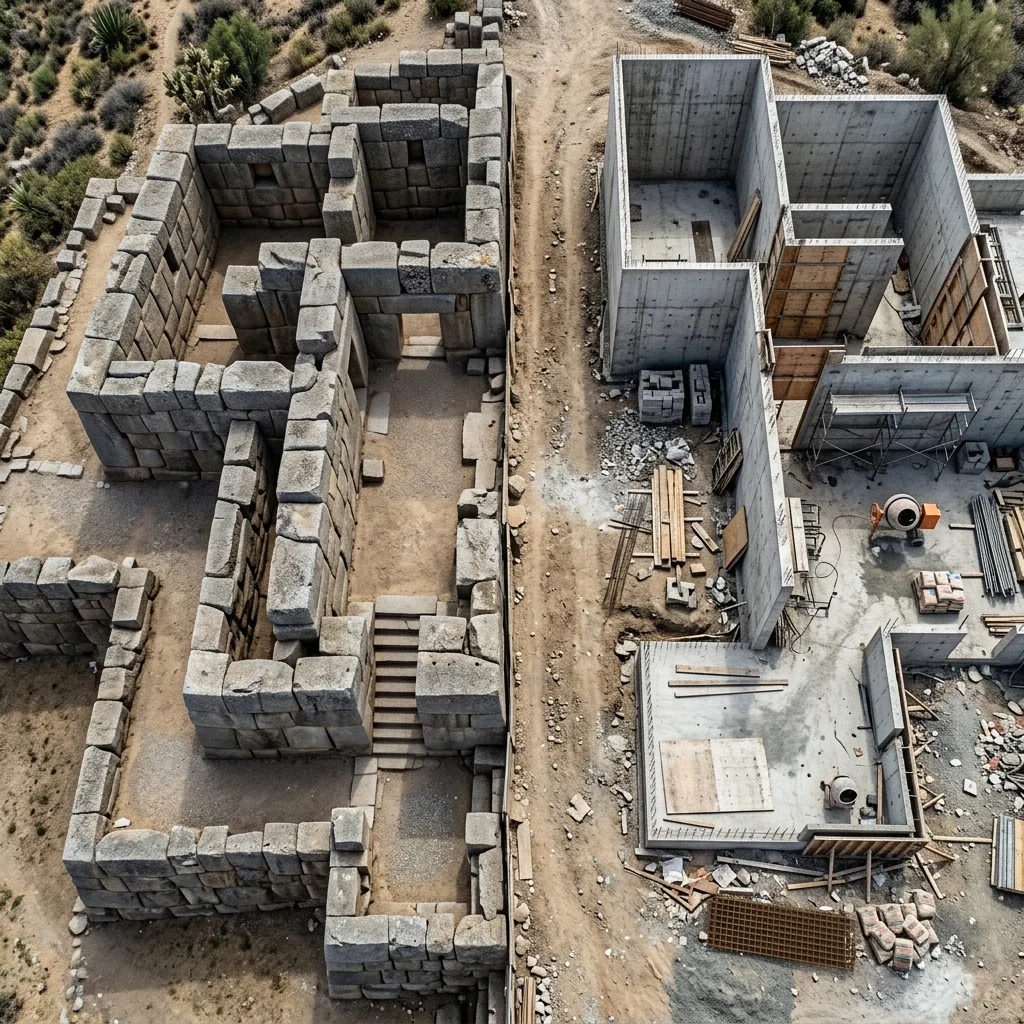
What fascinated me most about Pumapunku in Bolivia isn’t just its staggering age, but the absolute, millimeter-perfect precision of its stone blocks. Located high in the Andes near Lake Titicaca, this ancient site features massive “H” shaped stone blocks that lock together like giant pieces of Lego.
The genuinely surprising fact here is the material itself: these blocks are carved from andesite and diorite, some of the hardest volcanic rocks on the planet. On the Mohs hardness scale, they sit just below diamond and corundum.
How a pre-Incan civilization managed to slice through these stones with perfectly straight, smooth edges without the use of high-powered diamond-tipped saws remains a fiercely debated mystery among archaeologists and engineers alike.
Modern masons looking at the deeply recessed right angles and perfectly drilled, uniform holes at Pumapunku are routinely baffled. To recreate these exact shapes today, we would need advanced CNC milling machines. Yet, standard historical timelines insist the builders only had access to primitive copper chisels and stone hammers.
Copper is vastly softer than andesite, meaning a copper chisel would blunt and shatter almost immediately upon striking the rock. Furthermore, some of these highly finished blocks weigh well over 100 tons, and the quarry they were extracted from is situated approximately 60 miles away.
The logistics of cutting, transporting, and perfectly assembling these stones without wheels or draft animals pushes the boundaries of logic.
2. Derinkuyu — The 18-Story Underground Metropolis
When diving into the most astonishing ancient engineering marvels, I was genuinely shocked by the sheer scale of Derinkuyu in the Cappadocia region of Turkey. Discovered relatively recently in 1963 when a local man knocked down a wall in his basement, Derinkuyu is an entire city excavated directly downward into the volcanic tuff rock.
Reaching depths of nearly 280 feet across 18 subterranean levels, this underground metropolis was designed to safely house, feed, and protect up to 20,000 people—along with their livestock—for months at a time.
The excavation required the removal of millions of cubic feet of solid rock, meticulously planned to ensure the ceilings didn’t collapse under the crushing weight of the earth above.
The counter-intuitive brilliance of Derinkuyu lies in its life-support systems. If you bury 20,000 people underground today, oxygen depletion and carbon dioxide poisoning would become fatal within hours. Yet the ancient engineers carved out an incredibly sophisticated network of over 15,000 vertical ventilation shafts that successfully circulated fresh air down to the deepest sub-levels.
To protect the inhabitants from invading armies, each level could be sealed off from the inside using massive, circular stone doors weighing 1,000 pounds each. These doors were ingeniously carved to only be rollable from the inside.
Creating such an intricate, multi-tiered structural web in total darkness without modern surveying equipment is a staggering feat of architectural planning.
3. Roman Concrete — The Recipe That Heals Itself
It honestly makes you wonder about modern industry when you realize our contemporary concrete structures are expected to degrade and crumble within 50 to 100 years, while Roman harbors built two millennia ago are still structurally sound despite being battered by ocean waves.
The Romans didn’t just stumble upon a good recipe; they developed a hyper-advanced chemical mixture that modern science only recently cracked. I was amazed to find out that Roman concrete is actually self-healing. When cracks form in modern Portland concrete, water seeps in, rusts the steel rebar, and destroys the structure.
But when saltwater seeps into Roman concrete, it triggers a chemical reaction that actively seals the crack.
A fascinating study published by revealed that the secret lies in “hot mixing” quicklime with volcanic ash (pozzolana). This high-heat process creates distinct lime clasts throughout the material. When a crack eventually forms and water enters, it dissolves these lime clasts, which then recrystallize and effectively glue the crack back together.
The Romans built aqueducts, massive bathhouses, and the iconic Pantheon using this exact method. The fact that an ancient civilization figured out molecular-level self-repairing materials through trial and error—without microscopes or a formal understanding of chemistry—is nothing short of extraordinary.
4. Sacsayhuamán — The Jigsaw Walls Without Mortar
Of all the ancient engineering marvels scattered across South America, the imposing zigzagging walls of Sacsayhuamán in Cusco, Peru, consistently leave modern architects speechless.
Built by the Incas (or possibly a culture predating them), this fortress-like complex is made of colossal limestone boulders that have been carved to fit together perfectly without a single drop of mortar. What blew my mind is the precision of this “jigsaw puzzle” masonry.
The stones are cut with such multi-angled complexity that they lock into one another in three dimensions. The fit is so astonishingly tight that you literally cannot slide a piece of paper or a razor blade between the joints today.
Why go through the painstaking effort of carving irregular, multi-angled polygons instead of simple, uniform square blocks? The answer reveals a staggering understanding of seismic engineering. Peru sits on a highly active tectonic fault line, and square blocks bound by mortar will shatter and collapse during an earthquake.
The interlocking, mortarless stones of Sacsayhuamán, however, are designed to dynamically shift, “dance,” and resettle back into their exact original positions when the earth violently shakes. Over centuries, massive earthquakes have flattened the Spanish colonial buildings in Cusco, while the ancient walls of Sacsayhuamán haven’t moved an inch.
5. The Barabar Caves — The Mirrors Carved from Granite
When you hear the word “cave,” you probably picture a damp, rough, and jagged natural cavern. The Barabar Caves in the Jehanabad district of India will completely shatter that expectation.
Carved directly out of a massive, solid granite outcropping during the 3rd century BCE under the Mauryan Empire, these man-made chambers possess an interior finish that is genuinely unbelievable.
I was astounded to learn that the inner walls, ceilings, and floors of these caves were polished to such an extreme degree that they literally reflect light like a high-definition mirror.
This technique, known today as the “Mauryan polish,” has no equal in the ancient world, and achieving it on pure granite—an incredibly dense and unforgiving igneous rock—is a logistical nightmare.
Beyond the visual spectacle of the mirror polish, the true genius of the Barabar Caves lies in their acoustic properties. The chambers were meticulously sculpted with specific geometric proportions, featuring perfectly arched, vault-like roofs.
This exact geometry creates an acoustic resonance chamber where a single spoken word or chanted note will echo and reverberate continuously for several seconds without any loss in clarity. The sound waves bounce off the flawlessly polished granite, creating a mesmerizing, otherworldly auditory experience that clearly served a deep meditative purpose.
How the builders achieved this acoustic and visual perfection using tools from 2,300 years ago is still a profound mystery.
6. Nan Madol — The Sinking Megalithic City on a Reef
Often referred to as the “Venice of the Pacific,” Nan Madol is an architectural anomaly that shouldn’t exist. Located off the eastern shore of the island of Pohnpei in Micronesia, this ancient ruined city was constructed entirely on top of a living coral reef in the middle of a lagoon.
What blew my mind is the building material: the city is composed of 92 artificial islets made entirely from massive, naturally hexagonal basalt columns stacked log-cabin style. Some of these incredibly dense basalt “logs” weigh up to 50 tons each.
The builders somehow managed to move, lift, and perfectly align these colossal stones in deep water without the use of pulleys, cranes, or even metal tools.
The scale of the labor required to build Nan Madol is mathematically staggering. Archaeologists estimate that the total weight of the basalt used to construct the city is approximately 250 million tons.
Given the incredibly small population of the island at the estimated time of construction, every single resident would have had to move tons of basalt every day of their lives just to finish it in a few centuries.
Furthermore, the foundations run deep beneath the water line, and no one can fully explain how they managed to place these colossal pillars directly onto the slippery, uneven coral reef below the ocean’s surface without the entire structure sinking or collapsing.
7. Göbekli Tepe — The Monument That Predates Agriculture
What makes Göbekli Tepe in southeastern Turkey one of the most paradigm-shifting ancient engineering marvels is not just how it was built, but when it was built. Dating back to roughly 9600 BCE, this sprawling complex of massive, intricately carved stone pillars is a staggering 11,000 years old.
To put that into perspective, Göbekli Tepe is older to the builders of Stonehenge than Stonehenge is to us today. I was completely astonished to realize that conventional history insists humans at this time were mere nomadic hunter-gatherers. They hadn’t invented writing, metal tools, pottery, the wheel, or even agriculture.
Yet, somehow, they organized a massive labor force to quarry, transport, and erect T-shaped limestone pillars weighing up to 20 tons.
The engineering required to stand these massive pillars upright in perfect, geometric circular enclosures is incredibly sophisticated for a society that supposedly only hunted for daily survival. The pillars are adorned with high-relief carvings of lions, scorpions, vultures, and boars, showing an artistic mastery that contradicts the “primitive” label given to Ice Age humans.
The sheer existence of Göbekli Tepe flips the script on human evolution. It suggests that the desire to build monumental, complex architectural structures is actually what forced humanity to settle down and invent agriculture to feed the massive workforce, rather than the other way around.
8. Chand Baori — The Ancient Climate-Controlled Stepwell
In the arid state of Rajasthan, India, water is more valuable than gold, and the ancient solution to water scarcity resulted in an architectural masterpiece that looks like an optical illusion. Built between the 8th and 9th centuries, Chand Baori is a breathtaking stepwell that descends 13 stories into the earth. C. Escher-like geometric design.
The well features 3,500 perfectly symmetrical, incredibly narrow stone steps arranged in a dizzying inverted pyramid structure. This allowed thousands of people to easily descend to the water level at any time of year, regardless of whether the water table was exceptionally high during monsoon season or perilously low during droughts.
However, the real engineering genius of Chand Baori isn’t just water storage; it’s ancient climate control. The builders understood complex thermodynamics long before the advent of modern HVAC systems.
Because the structure is dug deep into the earth and features a massive pool of water at the base, it acts as a colossal passive cooling funnel. The air temperature at the bottom of the 100-foot-deep stepwell is consistently 5 to 6 degrees Celsius cooler than at the surface.
The royal family even built an adjoining pavilion with intricately carved stone windows specifically to capture this chilled updraft during the scorching summer months, effectively creating the world’s most beautiful natural air conditioner.
9. The Nazca Puquios — The Subterranean Wind Pumps
When we discuss ancient engineering marvels, the massive geoglyphs known as the Nazca Lines in Peru get all the media attention. But honestly, the true masterpiece of the Nazca civilization is entirely underground. The Nazca inhabited one of the driest, most unforgiving deserts on the planet, where surface water is virtually non-existent.
To survive, they engineered the “Puquios”—an incredibly elaborate network of subterranean aqueducts that tap into deep, naturally occurring underground aquifers. From the surface, these access points look like beautiful, spiraling stone funnels leading deep into the earth, but their aesthetic beauty hides a highly technical function.
The spiraling corkscrew shape of the stone walls wasn’t just for decoration; it was an active aerodynamic engine. The Nazca engineers perfectly calculated the prevailing desert winds and designed the spiral funnels to catch and force the wind down into the underground canals.
This concentrated wind pressure actively pushed the water through the subterranean network and out onto their agricultural fields, effectively creating a wind-powered hydraulic pump system centuries before electricity or mechanical motors. It is a stunning example of working in perfect harmony with natural forces to solve an impossible geographical problem.
10. Kailasa Temple — The Monument Carved Top-Down
If there is one structure on Earth that truly challenges our understanding of human patience and precision, it is the Kailasa Temple in Ellora, India. Most buildings in human history are built by stacking materials from the ground up. Kailasa Temple, however, was excavated entirely from the top down.
Starting at the very peak of a solid basalt mountain, ancient artisans slowly chipped away the rock, digging downwards to reveal a multi-story temple complex complete with towering pillars, life-sized stone elephants, and impossibly intricate wall reliefs. The temple wasn’t built; it was “freed” from the mountain in a single, uninterrupted piece.
The sheer mathematics of this top-down excavation method are terrifying to modern construction experts. When you build from the ground up, a mistake can be fixed by replacing a block. When you carve downwards into solid bedrock, there is a zero percent margin for error.
If a sculptor accidentally chipped off a piece of a pillar or a statue’s face, the entire structural aesthetic would be ruined forever, and no new stone could be added.
The fact that the entire sprawling complex features perfect architectural symmetry means the builders had to hold a flawless, three-dimensional CAD model of the temple in their minds before striking the very first blow against the rock.
Final Thoughts on Ancient Engineering Marvels
Looking at these ancient engineering marvels completely humbles me. We live in an era where we rely on supercomputers to calculate load-bearing limits and laser levels to ensure a wall is straight, yet our distant ancestors achieved architectural immortality using little more than stone, mathematics, and sheer generational willpower.
The Kailasa Temple’s top-down excavation honestly leaves me speechless—the absolute lack of room for human error is something no modern contractor would ever dare attempt. It forces us to ask: what other incredible technologies and methodologies have been completely lost to the sands of time?
If you enjoyed this dive into the past, you should definitely check out our list of incredible megastructures humans could actually build in the future. Which one of these ancient sites shocked you the most? Drop a comment below!

Written by the List of Ten Team
We research and verify every fact in our lists using peer-reviewed sources, official records, and expert interviews. Our goal: content that genuinely surprises and educates curious readers worldwide.
🕒 Last updated: 2026-05-13 — Facts verified and list reviewed for accuracy.
Frequently Asked Questions
Why can’t modern science replicate these ancient engineering marvels?
It’s not that modern science lacks the technology, but rather that we have lost the specific, highly localized techniques the ancients used. Replicating something like the exact chemical “hot mix” of Roman concrete or the precise acoustic carving of the Barabar Caves requires reverse-engineering lost knowledge, which often proves incredibly difficult even with modern tools.
Did ancient builders use advanced technology or just primitive tools?
Archaeologists believe ancient builders used tools that were appropriate for their era, such as copper chisels, stone hammers, and sand abrasives. However, their methods of application, understanding of physics, geometry, and mechanical leverage were exceptionally advanced, allowing them to achieve results that seem impossible for their time period.
How did ancient civilizations move stones weighing over 100 tons?
While theories vary by location, researchers believe ancient engineers utilized an ingenious combination of sledges, wooden rollers, wet sand to reduce friction, massive counterweights, and thousands of highly coordinated laborers. At sites like Nan Madol, they may have even used the buoyancy of water and rafts to transport heavy basalt logs.
What is the oldest known megalithic structure in the world?
Currently, Göbekli Tepe in southeastern Turkey holds the record. Dating back over 11,000 years (around 9600 BCE), it completely predates the invention of agriculture, pottery, and the wheel, making it one of the most significant architectural discoveries in human history.
For more on this topic, visit National Geographic and Smithsonian Magazine.