
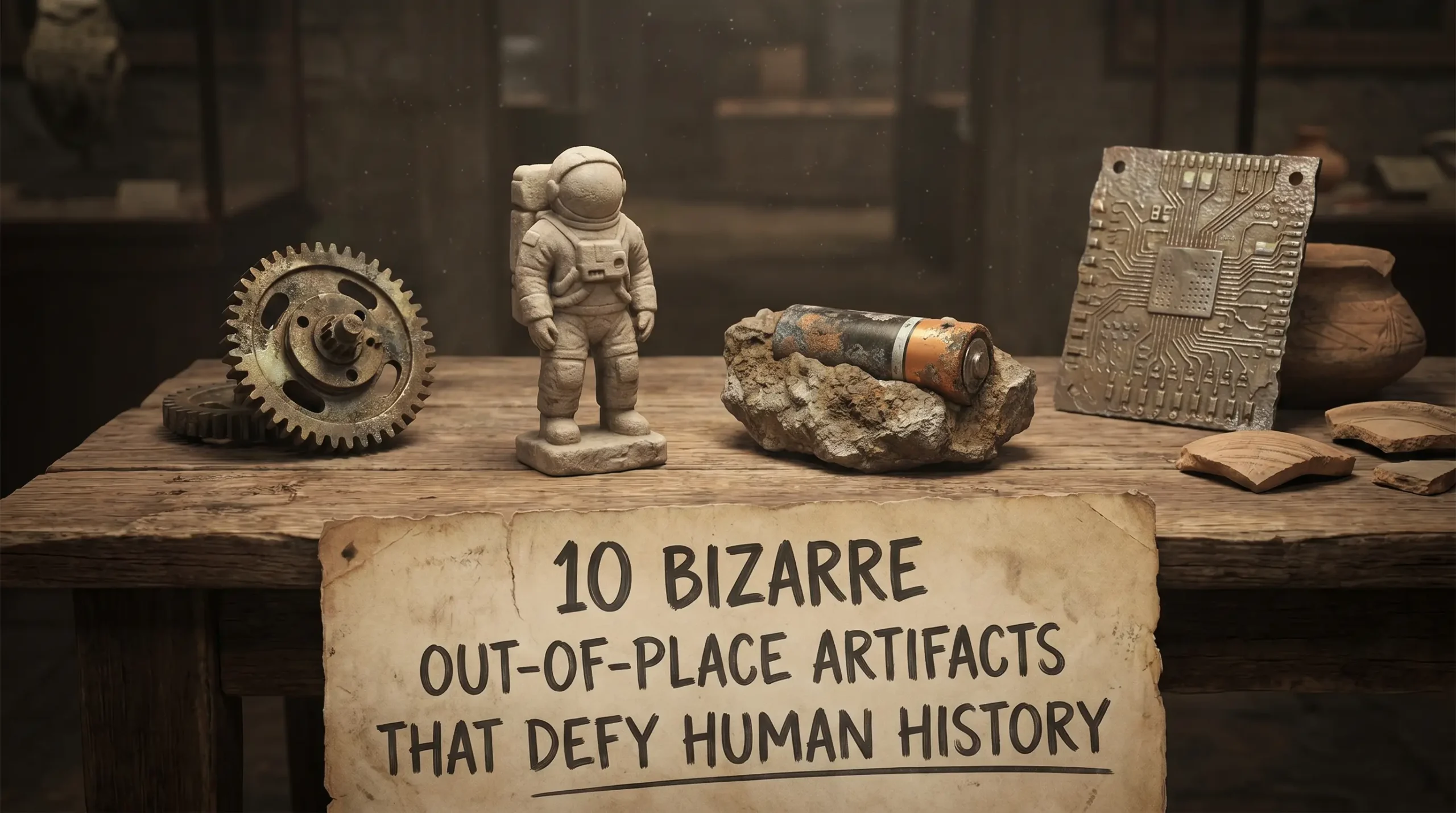
Look, I was genuinely shocked to learn just how many strange items are hiding in museum basements across the globe. When you start digging into the world of out-of-place artifacts, the accepted timeline of human history suddenly looks incredibly fragile.
You can easily spend hours falling down rabbit holes reading about these anomalies on historical archives like the Smithsonian.
I have always been fascinated by things that simply should not exist in the time periods they were found. Some of these strange objects are categorized as out-of-place artifacts because they display technology that was supposedly invented centuries later.
If you enjoyed reading about unexplained archaeological mysteries, you are going to absolutely love this deep dive.
What Exactly Are Out-Of-Place Artifacts?
Out-of-place artifacts are archaeological discoveries that appear technologically or culturally too advanced for the era in which they were found. These bizarre items, ranging from ancient analog computers to fossilized modern tools, heavily challenge our traditional understanding of historical timelines and human technological evolution.
📋 Table of Contents
A Quick Look At History’s Weirdest Anomalies
Before we jump into the full list, I want to give you a quick cheat sheet of what we are looking at today. Studying these out-of-place artifacts forces us to ask some really uncomfortable questions about our ancestors. Here is a quick breakdown of the bizarre items we are exploring.
| # | Name | Key Fact |
|---|---|---|
| 1 | Antikythera Mechanism | An ancient Greek analog computer. |
| 2 | Baghdad Battery | A 2,000-year-old potential galvanic cell. |
| 3 | London Hammer | A modern tool encased in ancient rock. |
| 4 | Piri Reis Map | A 1513 map showing an ice-free Antarctica. |
| 5 | Maine Penny | An 11th-century Norse coin found in the US. |
| 6 | Roman Dodecahedrons | Geometric bronze objects with no known use. |
| 7 | Quimbaya Airplanes | Golden ancient figures shaped like modern jets. |
| 8 | Nimrud Lens | A 3,000-year-old carved optical crystal. |
| 9 | Coso Artifact | A 1920s spark plug found inside a geode. |
| 10 | Dropa Stones | Alleged stone discs with microscopic writing. |

1. The Antikythera Mechanism
Discovered in a Roman-era shipwreck near Greece in 1901, this heavily encrusted bronze device completely shocked the archaeological world. X-ray scans revealed it contained a complex system of over 30 interlocking gear wheels. It was essentially an ancient analog computer designed to predict astronomical positions and eclipses.
I honestly consider this the undisputed king of all out-of-place artifacts because of its sheer mechanical brilliance. Technology of this complexity did not appear in the historical record again until European clockmaking began in the 14th century. It proves that ancient Greek engineering was leaps and bounds ahead of what we previously assumed.
My personal take is that this device could not possibly have been a one-off prototype. The craftsmanship is too precise, suggesting there was a thriving industry of mechanical engineering that was somehow lost to time. It makes me wonder how many similar devices were melted down for scrap bronze during the fall of ancient empires.
2. The Baghdad Battery
In 1936, workers near Baghdad unearthed a small, unassuming clay jar containing a copper cylinder and an iron rod. When scientists examined the setup, they realized it perfectly resembled a modern-day galvanic cell. If filled with an acidic liquid like grape juice or vinegar, this 2,000-year-old jar could theoretically produce a mild electrical charge.
Many skeptics argue it was simply a vessel used to store sacred papyrus scrolls safely. However, this is one of those out-of-place artifacts that sparks endless debate among scientists. Mythbusters even built replicas of these jars and successfully produced enough voltage to electroplate coins.
I find it absolutely fascinating to imagine ancient Parthians using rudimentary batteries to gold-plate their silver jewelry. Even if they had no concept of electrical theory, they might have stumbled upon the chemical reaction by pure accident. It highlights just how much ancient humans could accomplish through simple trial and error.
3. The London Hammer
In 1936, a local couple walking along Red Creek in Texas found a piece of loose rock with a piece of wood protruding from it. When the rock was cracked open, it revealed a perfectly preserved iron hammerhead. The catch? The limestone encasing the hammer was estimated to be over 400 million years old.
This is a textbook example of out-of-place artifacts that leave geologists scratching their heads. For decades, alternative historians claimed it was proof of an advanced civilization living before the dinosaurs. The iron composition of the hammerhead is incredibly pure, adding another layer of weirdness to the find.
Look, the rational explanation is that soluble minerals quickly formed a concretion around a 19th-century miner’s tool. But seeing a recognizable, human-made object fused seamlessly inside ancient bedrock is visually staggering. It genuinely messes with your perception of how long geologic processes actually take.
4. The Piri Reis Map
Drawn in 1513 by an Ottoman admiral, the Piri Reis map is famous for depicting parts of the globe with startling accuracy. The map shows the western coast of Africa, the eastern coast of South America, and an enigmatic southern landmass. Many researchers firmly believe this southern landmass is Antarctica.
This map joins the ranks of famous out-of-place artifacts because Antarctica was not officially discovered until 1820. To make matters weirder, the map appears to show the continent’s coastline without its massive ice cap. Admiral Reis claimed he compiled his work from much older, ancient source maps.
I am totally captivated by the idea that a lost, ancient seafaring culture mapped the globe long before European explorers. The mathematical projections needed to draw these coastlines accurately simply did not exist in the 16th century. It makes you wonder what other geographical secrets were burned in the Library of Alexandria.
5. The Maine Penny
Found at a Native American archaeological site in Maine in 1957, this small silver coin completely changed the historical narrative. Experts authenticated it as an 11th-century Norse penny minted under the reign of King Olaf Kyrre. Finding a genuine Viking coin in the northeastern United States was utterly unprecedented.
What I love about out-of-place artifacts like this is how they force us to rewrite textbooks. We know Vikings settled in Newfoundland, but finding their currency hundreds of miles further south is incredible. It implies that Norse explorers traveled much deeper into the American continent than we originally thought.
My personal theory is that this coin was not dropped by a Viking, but rather traded down the coast by Native American networks. The sheer distance this tiny piece of silver traveled highlights a complex indigenous trade system we rarely give enough credit to. It perfectly illustrates how connected the ancient world truly was.
6. The Roman Dodecahedrons
Over a hundred of these bizarre, hollow bronze objects have been discovered scattered across Northern Europe. They feature twelve flat pentagonal faces, circular holes of varying sizes, and small knobs on each corner. Despite finding so many of them, historians have absolutely zero written records explaining what they are.
These geometric oddities are my favorite out-of-place artifacts simply because they defy all logical explanation. Theories range wildly from astronomical measuring devices to water pipe calibrators. Some historians even suggest they were religious artifacts used by Celtic druids.
Honestly, my favorite theory is that they were specialized tools used for knitting winter gloves for Roman soldiers. When you see modern knitters use 3D-printed replicas to seamlessly craft woolen fingers, the whole mystery suddenly makes sense. Sometimes, the most complex archaeological mysteries have remarkably mundane solutions.
7. The Quimbaya Airplanes
Created by the Quimbaya civilization in Colombia around 1000 CE, these small golden figures are incredibly polarizing. Mainstream archaeologists insist they are simply stylized depictions of local birds, fish, or insects. However, aerospace engineers have pointed out some highly suspicious aerodynamic features.
These golden trinkets have become wildly famous out-of-place artifacts due to their vertical tail fins and delta wings. In 1994, German aviation enthusiasts built large-scale, radio-controlled models based exactly on the artifacts’ proportions. Shockingly, the models were highly aerodynamic and achieved stable, powered flight without any major modifications.
I find it hard to look at these objects and see a natural bird or insect. The rigid wings and perfectly upright tail fins look exactly like a modern fighter jet. While I do not believe ancient Colombians were flying planes, I wonder if they saw something in the sky that inspired this specific shape.
8. The Nimrud Lens
Discovered in modern-day Iraq in 1850, this 3,000-year-old piece of rock crystal is shaped remarkably like an optical lens. It was found in the ancient Assyrian palace of Nimrud and dates back to roughly 750 BCE.
The crystal has been ground and polished to a slight convex shape, giving it a focal length of about 4.5 inches.
I love discussing this piece because many out-of-place artifacts challenge our assumptions about ancient scientific knowledge. Traditional history tells us that optical lenses were not invented until the 13th century in Europe. Yet, here is a perfectly functional magnifying glass sitting in an ancient Mesopotamian palace.
My personal take is that Assyrian artisans desperately needed this lens to carve the incredibly detailed microscopic seals found in the region. Without a magnifying tool, the intricate artwork on their clay tablets would be nearly impossible to achieve by the naked eye.
It proves that human ingenuity always finds a way to solve complex problems.
9. The Coso Artifact
In 1961, three rock hounds looking for geodes in California cracked open a seemingly ancient nodule. Inside the rock, they found a porcelain cylinder containing a tiny magnetic metal shaft and a copper ring. Early reports claimed the nodule surrounding the object was over 500,000 years old.
This quickly became one of the most famous out-of-place artifacts among paranormal researchers and UFO enthusiasts. They genuinely believed it was an advanced spark plug left behind by ancient aliens or a highly advanced prehistoric human race. The mystery captured national attention for decades before experts finally got a good look at it.
I find this story amazing because it eventually turned out to be a 1920s Champion spark plug encased in fast-forming iron oxide. It teaches us a brilliant lesson about how quickly nature can swallow up our modern trash and make it look ancient.
It really makes you rethink how long it takes for rocks to form.
10. The Dropa Stones
According to legend, a Chinese archaeological expedition in 1938 discovered a series of caves in the remote Baian-Kara-Ula mountains. Inside, they supposedly found hundreds of stone discs with double spiral grooves, heavily resembling modern vinyl records. The grooves allegedly contained microscopic hieroglyphs detailing a crashed alien spacecraft.
Any comprehensive list of out-of-place artifacts usually includes these stones, even though their authenticity is highly debated. Skeptics argue that the original researcher never existed and that the stones are purely a product of modern folklore. Yet, the story persists strongly within alternative history communities across the globe.
I am fascinated by the Dropa Stones not as a real archaeological find, but as an incredible piece of cultural myth-making. It shows how deeply humans crave the idea of ancient, mysterious contact. Whether real or fake, the legend of these stone records is undeniably captivating to read about.
Final Thoughts
Hunting down stories of out-of-place artifacts always leaves me feeling incredibly inspired about human history. The past is clearly much more complex and technologically diverse than our standard history textbooks want to admit. If you want to keep exploring hidden wonders, I highly recommend checking out our guide on incredible underground cities next.
Keep questioning the established narrative, because there are always more anomalies waiting to be dug up.

Written by the List of Ten Team
We verify every fact using peer-reviewed sources.
Frequently Asked Questions
What are out-of-place artifacts?
They are historical objects discovered in unusual contexts that seem to defy the chronological timeline of human technological development. These items often feature advanced engineering or materials that should not have existed during the era they were created.
Are all of these mysterious artifacts proven to be real?
No, while items like the Antikythera Mechanism are completely verified by scientists, others are considered hoaxes or misinterpretations. Many fake out-of-place artifacts are simply modern items rapidly encased in natural geologic formations.
How do scientists explain these historical anomalies?
Mainstream archaeologists often attribute these objects to lost trade routes, natural geological phenomena, or ancient techniques that were simply forgotten over time. In many cases, ancient humans were much more resourceful and clever than we give them credit for.